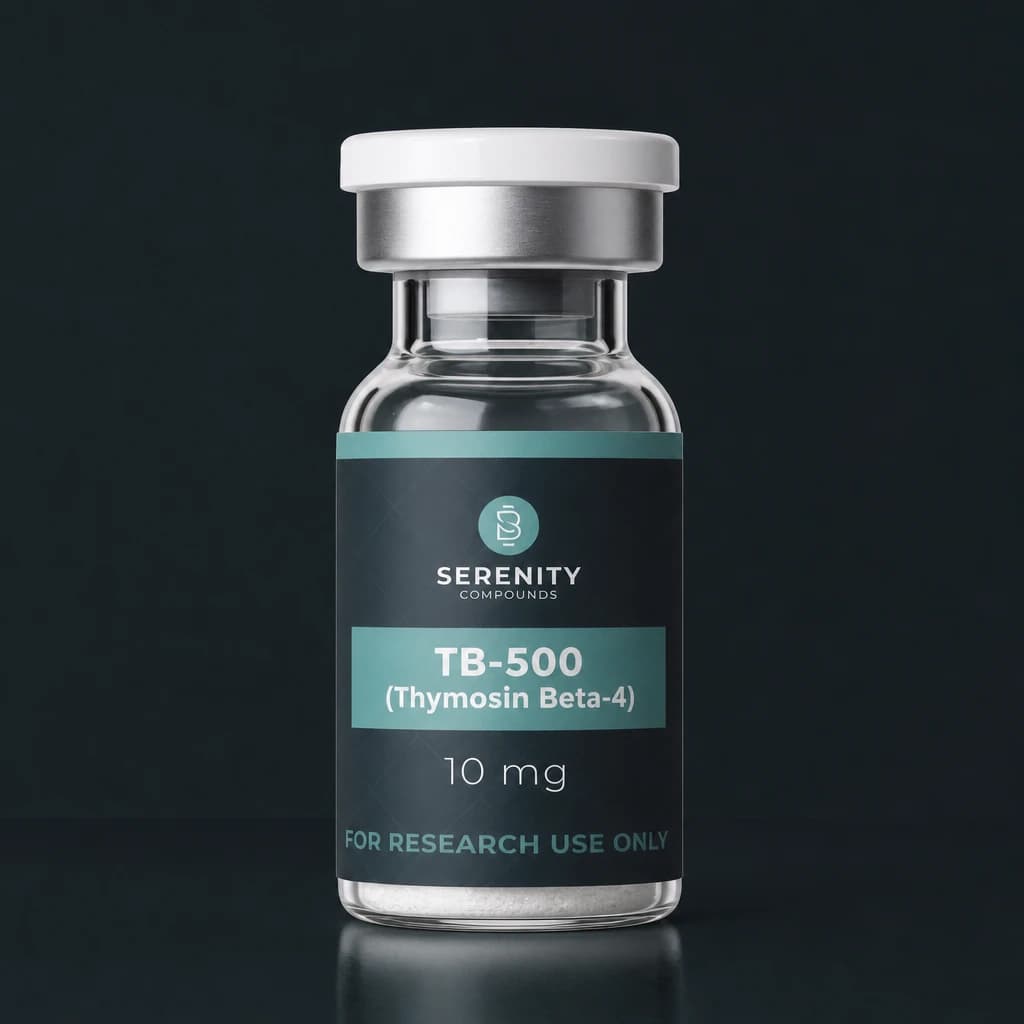
TB 500 peptide is a catalog term associated with thymosin beta-4, but usage isn't consistent enough to establish the exact sequence. Some descriptions concern the full length peptide, while others refer to a shorter fragment. Those materials shouldn't be treated as interchangeable without documentation. Published actin and wound model studies concern specified compounds, not every vial carrying a similar nickname. This article explains the identity problem and how it affects interpretation of laboratory evidence.
TB-500 peptide identity: why the sequence distinction matters
Thymosin beta-4 is a 43 amino acid peptide associated with actin regulation. A fragment contains only part of that sequence and has a different molecular mass. Removing residues can also alter interactions or stability. The fact that a short region occurs within a larger peptide doesn't demonstrate that the isolated region reproduces every property of the full molecule under the same conditions.
Names are useful for finding literature, but a method needs a chemical definition. Sequence length and terminal modifications can distinguish references that sound similar. A paper's abbreviation should be checked against its materials description rather than matched to a store title by appearance alone. If the source doesn't define the material adequately, that limitation should remain visible in the evidence record.
Serenity's thymosin related reference listing should be connected to the available specification and lot report. Researchers need to resolve any difference between those documents and the sequence in the intended experiment. This article doesn't assert a sequence on the basis of the nickname alone, and it doesn't substitute for the current analytical documentation of a supplied batch.
What is the connection with actin?
Actin exists in monomeric and filamentous forms that participate in cell structure and movement. Proteins and peptides that interact with this system can affect the availability or assembly of actin under defined conditions. The published polymerization research concerns such molecular behavior. It should be read as a biochemical experiment, not as direct evidence that a person will recover more quickly from an injury.
Binding and polymerization are related but distinct measurements. A binding experiment asks about an interaction, while a polymerization assay observes assembly behavior under its specific conditions. Buffer composition and component concentrations can influence the result. A finding from one method doesn't automatically establish every downstream effect in a living cell, where many additional regulators interact with the same system.
Concentration ratios matter because an interaction can depend on the relative amounts of the participating molecules. Reporting only the test peptide concentration leaves out part of that context. A useful biochemical record identifies the actin preparation and the comparison conditions as well. Otherwise, two experiments may appear contradictory simply because they examined different parts of the concentration space.
TB 500 benefits: how far does a wound model take the evidence?
Published thymosin beta-4 wound research provides a tissue model context distinct from isolated actin measurements. Such work can connect a molecular hypothesis to an observed experimental endpoint. It doesn't erase the differences between a controlled animal model and a human injury, and it doesn't verify the identity or performance of unrelated catalog material.
Wound closure is a composite observation. Changes in cell movement, proliferation and tissue contraction may all contribute depending on the model. A smaller visible gap doesn't identify which process changed. Histology or other measurements may help address those questions, but each has its own limits. The report needs to specify which observations support its interpretation rather than relying on a broad label such as regeneration.
Mechanical performance is another separate endpoint. Tissue can look more organized without having demonstrated a particular load bearing capacity. Conversely, a measured change in mechanical behavior may not explain the molecular mechanism. Our healing model evidence review compares these endpoint categories and explains why they shouldn't be compressed into a general treatment claim.
A fictional identity mismatch in a literature review
Suppose a laboratory purchases a short reference fragment and cites a full length peptide paper as its main precedent. The intended assay may still be scientifically interesting, but the citation no longer describes identical material. The correct record would state that the experiment tests whether the fragment shares a response observed with the larger molecule. Calling it a direct replication would conceal the central difference.
Now imagine that the resulting assay shows no response. That observation wouldn't necessarily contradict the full length study because the material changed. It might reflect a sequence requirement or another difference in experimental conditions. This hypothetical example shows why identity should be checked before interpreting agreement or disagreement between experiments. It isn't a report of a test performed by Serenity.
Conversely, a similar response in the fragment condition would support only the tested endpoint under those conditions. It wouldn't establish matching pharmacokinetics or an identical safety profile. Similarity at one biological level is not universal equivalence. The conclusion needs to retain the endpoint and model that made the comparison possible.
What controls help distinguish migration from growth?
Cell migration studies often depend on images collected across time. The analysis should define the region and measurement method before interpreting a change. Differences in initial cell density can affect the apparent rate of closure. If the starting conditions aren't comparable, a later image may reflect the original imbalance as much as the experimental exposure.
Proliferation can add cells to an area even when their movement hasn't increased. Viability loss can reduce apparent movement for a different reason. Suitable accompanying measurements help distinguish those explanations. A single image based endpoint may be useful for screening, but stronger mechanistic claims need additional evidence about what produced the change.
Blinding image analysis can reduce the influence of expectations on boundary selection. Consistent acquisition settings and a prespecified analysis method improve comparability too. Repeated images of one culture are not independent biological replicates, so the statistical unit needs to be clear. More pictures can document a time course without increasing the number of independently tested samples.
How do blends change the interpretation?
Mixtures containing this material and another peptide create an attribution problem. If only the mixture is tested, the result cannot identify the contribution of each constituent. Separate conditions with matched constituent exposure can help address that question. Total blend mass is insufficient because it doesn't reveal the individual concentrations represented in the experiment.
KLOW naming introduces a further ingredient alongside those commonly associated with GLOW. Our four constituent blend guide explains why the actual formulations must be compared before assigning a difference to that addition. The sequence ambiguity discussed here remains relevant inside a blend and should not disappear when several ingredients share one label.
Synergy requires a defined expectation for the combined response. A mixture producing the highest numerical value doesn't establish that the constituents interact beyond an additive expectation. Nor does a positive result for each ingredient in separate papers establish the behavior of their combination. Different models and endpoints can't simply be added together as though they were one experiment.
Questions about thymosin related research
What is TB 500?
Resolve the sequence rather than relying on the nickname. A source may discuss full length thymosin beta-4 or a fragment, and those are not automatically interchangeable. The intended reference must match the material in the relevant paper before its findings can be transferred into a research rationale. A shared abbreviation cannot complete that identity check.
What does TB 500 do?
Evidence depends on the actual sequence and model. Actin related findings or tissue observations for the full length peptide do not establish the behavior of every material sold under a shortened label. Name the measured endpoint and preserve the structural distinction. That supports a useful literature review without converting a catalog nickname into a clinical benefit claim.
Which analytical details should remain in the record?
Mass information can help evaluate whether a sample is consistent with the intended sequence, but interpretation depends on the method and reported species. A chromatographic purity value addresses a different question. Researchers should distinguish identity evidence from relative purity and from any quantitative content determination. A document that supports one claim may leave the others unresolved.
Handling history can affect comparison if the material changes before measurement. The relevant question is whether the reference remains suitable under the laboratory's actual conditions, not whether a generic peptide storage statement sounds reassuring. Any validated stability information should be connected to its matrix and observation period. No preparation method or human administration instruction is supplied here.
Finish by preserving the exact identity beside every cited result. The actin literature and tissue models provide useful scientific questions, but their conclusions depend on what was actually tested. Resolving full length and fragment terminology is therefore a prerequisite for meaningful research interpretation, not a minor naming preference.