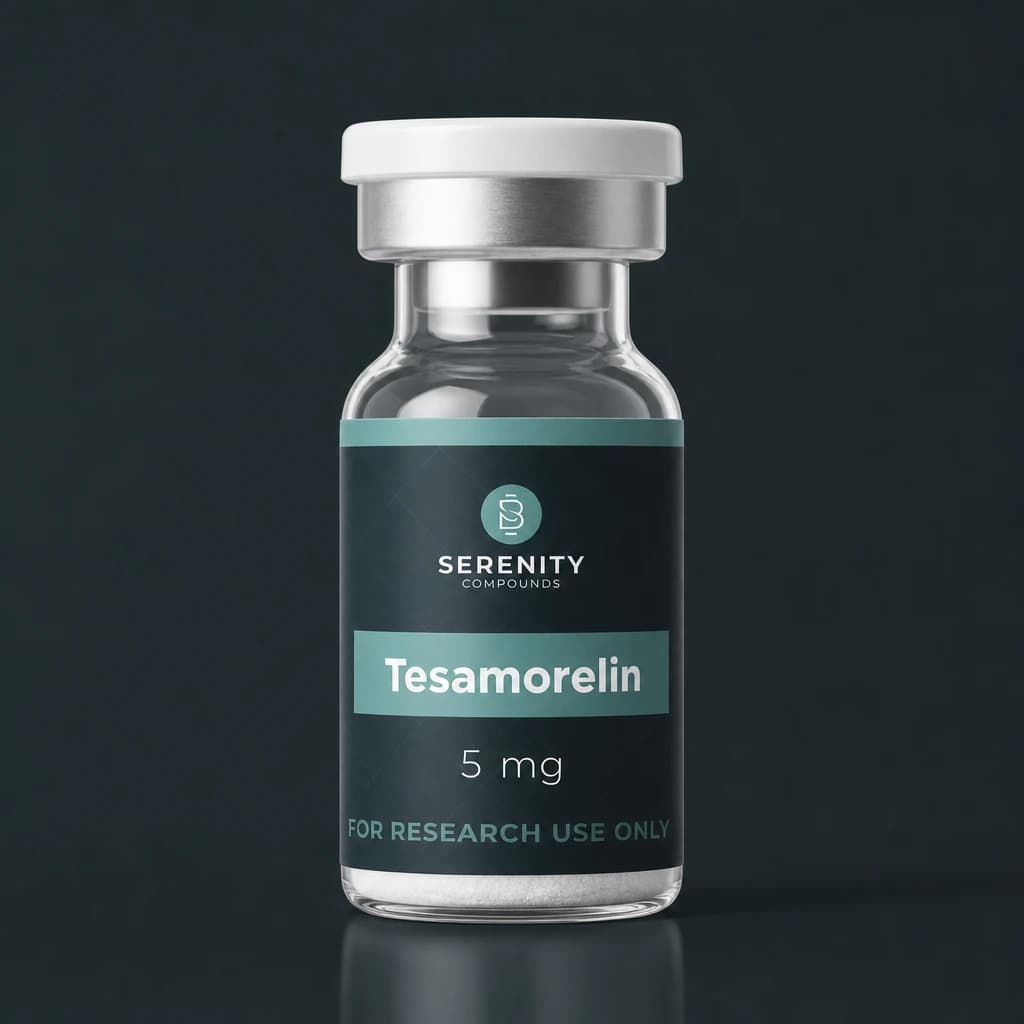
Tesamorelin peptide is a synthetic growth hormone releasing hormone analog. Its literature includes clinical research on visceral fat in a defined population with HIV associated abdominal fat changes. That evidence does not establish a general bodybuilding treatment or make a research reference equivalent to a pharmaceutical product. The mechanism and the studied endpoint need to remain separate from broader promotional claims.
How does the GHRH pathway frame the research?
The analog is associated with the growth hormone releasing hormone receptor pathway. A downstream endocrine response can be measured, but it does not by itself establish every functional outcome attributed to that pathway. The assay or trial needs to measure the actual claimed result.
Serenity's tesamorelin reference is a research material with its own lot documentation. A pharmaceutical label or clinical publication characterizes a different product context. The shared ingredient name does not establish equivalence of formulation or intended use.
What did the abdominal fat trial investigate?
Published clinical research evaluated a defined population and measured abdominal fat related outcomes. Those participants and methods define the conclusion. Extending the result to healthy athletes or a different condition would require additional evidence.
Visceral adipose tissue is a particular compartment. A change there is not the same as total body weight change or muscle gain. The body composition discussion explains why different tissue and functional endpoints should not be merged under one broad claim.
What does the liver fat study add?
A separate randomized investigation examined visceral and liver fat in a defined clinical setting. It contributes evidence about those measurements rather than proving every metabolic benefit sometimes attributed to the molecule. The population and observation period still matter.
Are different GHRH analogs interchangeable?
Related pathway activity does not make structures identical. Sequence and modifications can affect how a material behaves in an experimental system. A comparison needs the exact analog and a matched question rather than a shared category label.
Ghrelin receptor secretagogues introduce a different pathway again. A similar downstream hormone marker does not mean an exposure to one can be substituted for an equal mass of another. Molecular identity and the chosen readout belong together in the study record.
Why do pharmaceutical formulation distinctions matter?
Pharmaceutical documentation in the EGRIFTA WR label differentiates its formulation from another branded version. A research vial is not either pharmaceutical product. Borrowing a label's instructions would erase differences the label itself treats as important.
Our dosage chart analysis explains why a clinical amount cannot become a laboratory concentration by simple unit conversion. It also separates nominal vial content from actual measured content without providing a personal regimen.
How should before and after or side effect claims be read?
Claims based on tesamorelin before and after images cannot identify which tissue compartment changed or what else occurred during the interval. A useful claim needs a measured endpoint and an appropriate comparison. Photographic appearance cannot substitute for those data.
Interpreting tesamorelin side effects requires the actual product and study context. Missing observations should not be turned into a claim of safety, and a desired outcome does not erase an adverse event. Pharmaceutical decisions belong with qualified care using the applicable product information.
Tesamorelin mechanism: receptor signaling and endocrine output
Receptor pathway descriptions explain why an analog is investigated, but the downstream response still needs measurement. A hormone concentration at one time point cannot describe its entire temporal pattern. Sampling design determines whether a study captures a peak, an average or another feature. That distinction matters when a mechanistic observation is compared with a tissue outcome collected over a much longer interval.
IGF-I is one endocrine marker discussed in the clinical literature. It is not a direct measurement of muscle strength or a universal score for improved body composition. A study can observe a marker change while leaving a functional question unanswered. Keep the measured hormone result separate from the tissue or performance claim that a reader may be tempted to infer.
What the abdominal fat study measured directly
Enrollment in the cited trial comprised 412 participants with HIV and abdominal fat accumulation. Investigators assessed visceral adipose tissue by computed tomography over 26 weeks. Its primary endpoint was percentage change in that imaging measurement. This is concrete evidence about a defined compartment and population. It should not be described as a study demonstrating general weight loss or muscle gain in healthy athletes.
Secondary observations can add context without replacing that primary question. Lipid measurements and endocrine markers describe other aspects of the study. An evidence review should identify which result was planned as primary and how the others were analyzed. Selecting the most favorable secondary value for a broad promotional claim can obscure the purpose and limits of the original experiment.
Liver fat, visceral fat and the observation period
In the separate six month randomized study cited above, investigators examined visceral and liver fat in a smaller population receiving antiretroviral treatment. These were specified endpoints rather than visual appearance measures. The paper also collected glucose related observations. That combination illustrates why a desired tissue result should be interpreted alongside other monitored outcomes instead of standing alone as a general metabolic benefit claim.
Different time points can tell different parts of the story. An early change in a measurement may differ from the later observation. A summary quoting only the endpoint at the end of follow up can lose that pattern. The appropriate interpretation follows the study's analysis and preserves the times relevant to the claim, particularly when discussing safety or metabolic response.
Tesamorelin before and after and the muscle question
Images do not establish which tissue compartment changed. Posture and lighting can influence visible shape, while a lean tissue estimate has its own measurement limits. If a claim concerns stronger muscles, a suitable functional test is needed. Neither a photograph nor a visceral fat measurement can supply that result simply because the person appears leaner.
Training and nutritional conditions also matter to a muscle outcome. A design that does not address those alternatives cannot confidently assign a strength change to the compound. Mechanistic plausibility does not resolve the issue. The correct conclusion may be that the cited study did not test the proposed performance claim, even though it contributes useful evidence on another endpoint.
Tesamorelin dosage and research material preparation
Clinical amounts and laboratory concentrations describe different exposures. The method must justify the conditions used in an assay rather than borrow a value from a medicine's schedule. The calculation then needs the appropriate material specification and quantity basis. Nominal vial content, measured peptide content and peak area purity are separate pieces of information that should not be collapsed into one number.
Prepared solution stability requires evidence for the actual matrix and endpoint. A dry reference's documentation does not automatically support every later solution. If the experiment compares analogs, each needs its own traceable preparation record. An apparent biological difference may otherwise include an unrecognized difference in recovery or handling that the compound names alone cannot reveal.
Tesamorelin side effects and product specific interpretation
Safety information belongs to the defined product and its medical context. A research certificate does not confer that same evidence on an independently supplied vial. Adverse event frequency and discontinuation also answer different questions within a trial. A balanced summary keeps those outcomes distinct and avoids presenting a desired tissue change as an assurance that other concerns do not matter.
What is tesamorelin used for?
Here the literature concerns a GHRH analog and defined clinical research on HIV associated abdominal fat changes. Pharmaceutical use follows the applicable product information and qualified care. Serenity's reference is supplied for research and is not that medicine. A laboratory use should be described by its actual analytical or biological question rather than by a clinical indication borrowed from another product.
Does tesamorelin work?
Trials cited above provide evidence for the outcomes they measured in their enrolled populations. They do not answer every claim about body composition or athletic performance. To evaluate a new assertion, identify its endpoint and compare it with the source's actual measurement. A favorable result in one tissue compartment cannot establish an unmeasured benefit elsewhere or predict a response to a research vial.
What can a research summary responsibly conclude?
Describe the analog and the clinical population behind the evidence. Name the tissue endpoint rather than replacing it with general fat loss or muscle growth language. A laboratory reference can support a justified research method without being presented as a treatment or performance product.