Tesamorelin dosage charts need the exact formulation and context behind their values. Pharmaceutical labeling applies to the named product, not every vial containing a similarly named peptide. Laboratory concentration tables answer another question again. This article explains those distinctions without reproducing a human schedule or offering a bodybuilding regimen.
Why does formulation identity matter?
The EGRIFTA WR label distinguishes its formulation from EGRIFTA SV. The existence of that distinction is enough to show why an ingredient name alone cannot define preparation or administration instructions. Readers should use the current label for the actual prescribed pharmaceutical product with qualified guidance.
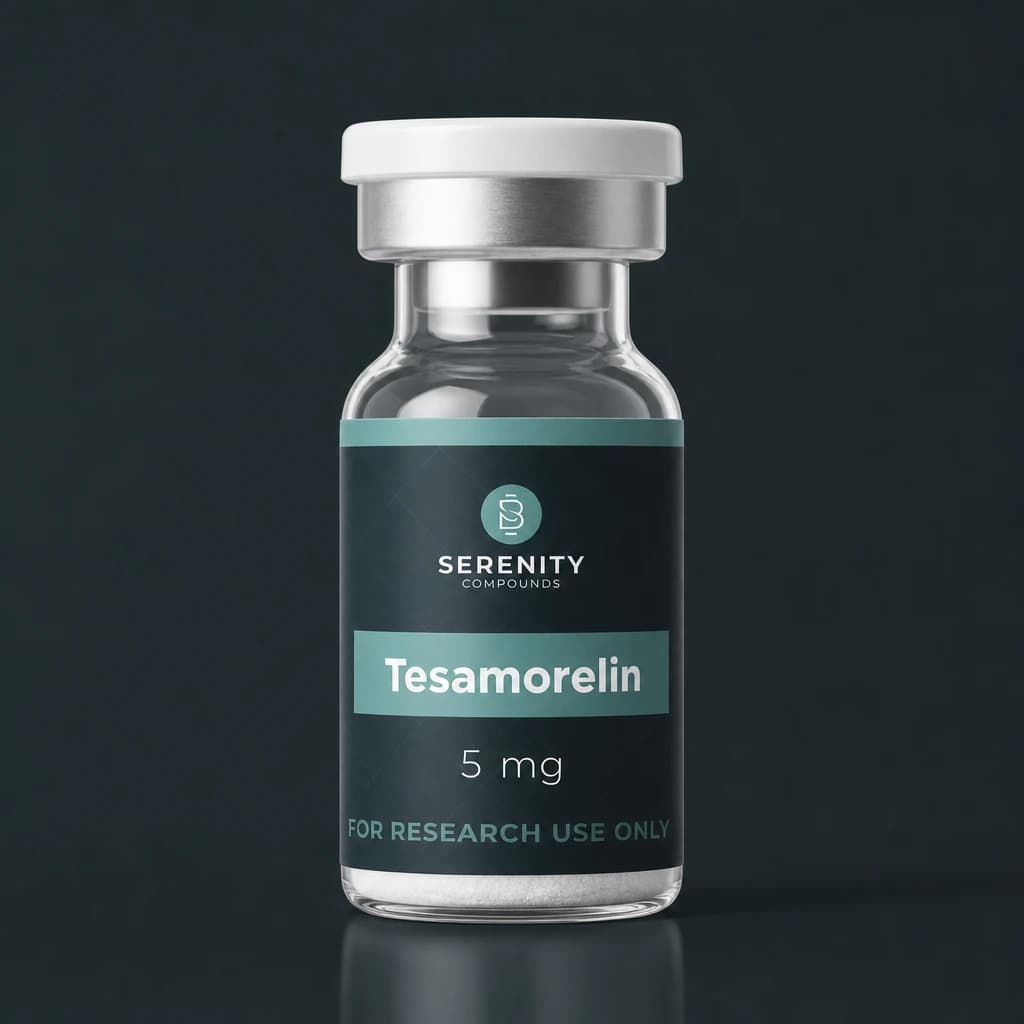
Serenity's tesamorelin peptide reference is neither of those pharmaceutical formulations. Its research specification cannot inherit a clinical label by matching the ingredient name. An analytical certificate is not a regulatory equivalence determination.
What clinical population does the literature describe?
A randomized study investigated abdominal fat in a defined population with HIV associated changes. Its endpoint and participants matter. That evidence should not be rewritten as validation of a general muscle building schedule.
Our compound evidence guide explains the GHRH analog context and the distinction between visceral fat and broader body composition claims. A chart cannot expand the population studied merely by changing its heading.
Does a labeled daily amount establish an assay exposure?
No. A clinical amount and a cell culture concentration describe different experimental situations. The route and biological system affect exposure in ways that unit conversion alone cannot resolve. A laboratory protocol must justify its own conditions rather than copy a pharmaceutical schedule into a plate worksheet.
Which quantities should a laboratory chart preserve?
Nominal material content and prepared stock concentration belong in separate fields. The final concentration in the assay needs another entry. This structure lets a reviewer identify the actual quantity used in each calculation instead of guessing from a single amount column.
For a hypothetical generic reference, transferring one part of a stock into a final mixture of ten equal parts produces one tenth of the stock concentration. That is arithmetic only. The calculator guide explains the same relationship with explicit mass and volume units.
Why is measured content different from nominal content?
Labels can provide a stated amount without proving it was quantitatively measured for that lot. Chromatographic peak area purity is another property and cannot automatically correct the label into an actual peptide mass. The analytical method should support whichever quantity the worksheet treats as measured.
Recovery during preparation can create another difference between nominal and actual exposure. A correct calculation cannot detect material lost before it enters the assay. If the experiment depends on that distinction, an appropriate measurement is needed.
What do bodybuilding charts leave unresolved?
Searches for tesamorelin dosage per day may combine clinical label values with claims about strength or appearance. Those claims need their own relevant evidence. Neither a hormone response nor a visceral fat result establishes an increase in muscle performance.
Safety also depends on the actual product and clinical context. A research summary should not strip warnings from a pharmaceutical label while borrowing its apparent authority for another material. This page does not recommend personal administration or combining research compounds.
Tesamorelin dosage per day: a label is not a generic chart
Product labels identify the formulation to which their instructions apply. A chart that removes the product name while keeping an amount has discarded part of the instruction's basis. That omission is especially important where the official documentation distinguishes formulations. The correct response is to preserve the source and refer clinical questions to the applicable product information, not to construct a universal schedule for every similarly named vial.
Preparation and storage directions are also formulation specific. Borrowing only one number from a pharmaceutical label can create a mixture of instructions from incompatible sources. A research reference has a different documentation context and does not inherit the medicine's label. This article therefore examines why source identity matters without reproducing administration steps or suggesting that a laboratory purchase is a clinical substitute.
Tesamorelin peptide charts and the measured clinical endpoint
Computed tomography was used to assess visceral adipose tissue in the cited 26 week clinical study. The primary question concerned change in that compartment in participants with HIV and abdominal fat accumulation. An endocrine marker or a body image assessment was a different outcome. A chart should not replace the primary tissue measurement with an untested claim about athletic strength or general muscle development.
Study population is part of the evidence rather than a footnote to discard. The same amount in a table does not imply the same risk or effect in a different population. Clinical transfer requires evidence and qualified assessment beyond dimensional arithmetic. A laboratory article can explain the original context while keeping that transfer unresolved rather than presenting a bodybuilding heading as justification.
Tesamorelin before and after: what a chart cannot predict
Photographs cannot quantify the visceral fat endpoint measured by imaging. They also cannot establish the preparation used or account for other changes during the interval. Even a genuine visual difference is therefore a different kind of observation. A table pairing an amount with a photograph does not transform the image into a controlled prediction of an individual's response.
Average study outcomes should not be attached to a research vial's nominal content. The trial estimate concerns participants assigned under a protocol, while a vial label describes a material quantity. Dividing one by the other has no scientific meaning as a prediction of appearance. The relevant question is which preparation and outcome the source actually investigated.
Laboratory concentration records and quantitative content
Molar comparisons require the applicable molecular mass and a clear basis for the starting amount. If a specification includes a particular chemical form, the worksheet should document how it relates to that basis. A generic value from an unrelated source can introduce an error despite correct division. The calculation should be reconstructable from the supplied material record without unstated assumptions.
Serial dilutions need an explicit parent concentration at every stage. Once an intermediate stock has been created, the next calculation must use that concentration rather than the original vial preparation. A simple lineage record can connect the source lot, stock and final assay mixture. That connection helps distinguish an arithmetic error from a change in material recovery or analytical performance.
Reconstitution and storage evidence for a research reference
Compatibility depends on the actual material and assay matrix. A pharmaceutical formulation's instructions do not establish that a separately supplied reference behaves identically in a laboratory solution. The method needs support for its own preparation. Visual clarity can be recorded, but it cannot prove intact sequence, measured content or stability over the intended observation interval.
Handling history matters when comparing results across preparations. Stocks made on different dates or stored under different conditions should remain distinguishable in the worksheet. If a response changes, those records can help investigate whether the experimental exposure differed. A single compound name in the assay output would hide the preparation information needed to explore that possibility.
Tesamorelin side effects and the scope of clinical evidence
Clinical safety information belongs with the actual pharmaceutical product and studied population. A desired tissue outcome does not eliminate adverse observations or establish a general profile for a research vial. A chart that borrows a label's apparent authority while omitting its context is incomplete. Clinical decisions require the current applicable information and qualified care rather than a research concentration table.
Does tesamorelin help build muscle?
Visceral fat research discussed here does not establish a general muscle building regimen. A claim about hypertrophy or strength needs a relevant measurement and a suitable population. Changes in endocrine markers cannot fill that gap on their own. This guide separates the source's actual endpoint from broader claims that sometimes appear beside its numbers.
How much tesamorelin should I take?
This research article cannot select a personal amount. Pharmaceutical decisions depend on the prescribed product and qualified guidance, while laboratory calculations depend on a justified method. A research vial is not interchangeable with the products named in clinical labeling. The useful task here is verifying what a chart's values mean, not converting them into administration advice.
What should a defensible chart say?
Identify the source and formulation behind each value, then keep clinical labeling separate from laboratory arithmetic. Preserve the final assay concentration and the source of the starting amount. That makes the worksheet interpretable without implying that a research reference has a validated human regimen.