A peptide reconstitution calculator checks the relationship between a stated amount and a defined volume. It can also help verify later dilution arithmetic. It cannot establish whether a solution is compatible with a compound or select an appropriate human dose. The examples here use hypothetical analytical values to explain units, not to prescribe preparation or administration.
What does the basic concentration formula mean?
Concentration equals amount divided by final volume. When amount is expressed as mass, the result is mass per volume. The units remain part of the answer. A number such as 5 without milligrams per milliliter or another explicit unit cannot describe the resulting solution.
Serenity's peptide calculator provides the working tool. Its output should be checked against the inputs and the laboratory method. The calculation doesn't determine which diluent or exposure is scientifically appropriate.
A hypothetical mass and volume example
Suppose a generic analytical reference contains 6 milligrams and the preparation has a final volume of 3 milliliters. Dividing 6 by 3 gives 2 milligrams per milliliter. Because 1 milligram equals 1,000 micrograms, the same concentration is 2,000 micrograms per milliliter.
Notice that the physical concentration has not changed during the unit conversion. Only its numerical expression has changed. Treating 2 milligrams as 2 micrograms would introduce a thousandfold error while leaving the arithmetic superficially tidy.
Why is final volume different from added volume?
Some methods specify the volume of solvent added, while others specify a final solution volume. A worksheet should preserve the quantity defined by its method. Silently substituting one for the other can create an error that a calculator cannot recognize because both inputs look like valid numbers.
How does a stock become a final assay concentration?
Imagine that the hypothetical stock above is used only as an analytical dilution example. Transferring 0.05 milliliter into a mixture with a final volume of 1 milliliter transfers 0.1 milligram. The final concentration is therefore 0.1 milligram per milliliter, or 100 micrograms per milliliter.
Reporting the original 2 milligrams per milliliter as the assay concentration would overstate that exposure twentyfold. The stock and final values belong in separate fields. The equation C1V1 = C2V2 expresses the same relationship when the quantities and units are consistent.
What changes in a serial dilution?
Each intermediate solution becomes the starting concentration for the next step. Reusing the original stock concentration at every stage loses the history of the dilution. A reproducible worksheet keeps the parent concentration and final volume for each step rather than storing only the last answer.
Independent arithmetic can help catch a transcription error. One check is to calculate transferred mass and divide by final volume. Another is to use the dilution factor. Agreement between two methods is useful, although it still cannot prove that the physical preparation matched the worksheet.
Can a peptide dosage calculator establish a biological dose?
No. Experimental exposure selection depends on a justified protocol and an appropriate model. Human administration requires clinical evidence and qualified oversight that a laboratory arithmetic tool cannot provide. A precise result is not evidence that the input amount was appropriate.
Syringe markings, where a tool displays them, describe a volume scale for a specified device. They are not a universal biological unit of peptide activity. Confusing those meanings can make a chart appear more authoritative than its underlying calculation warrants.
Does diluent choice follow from the answer?
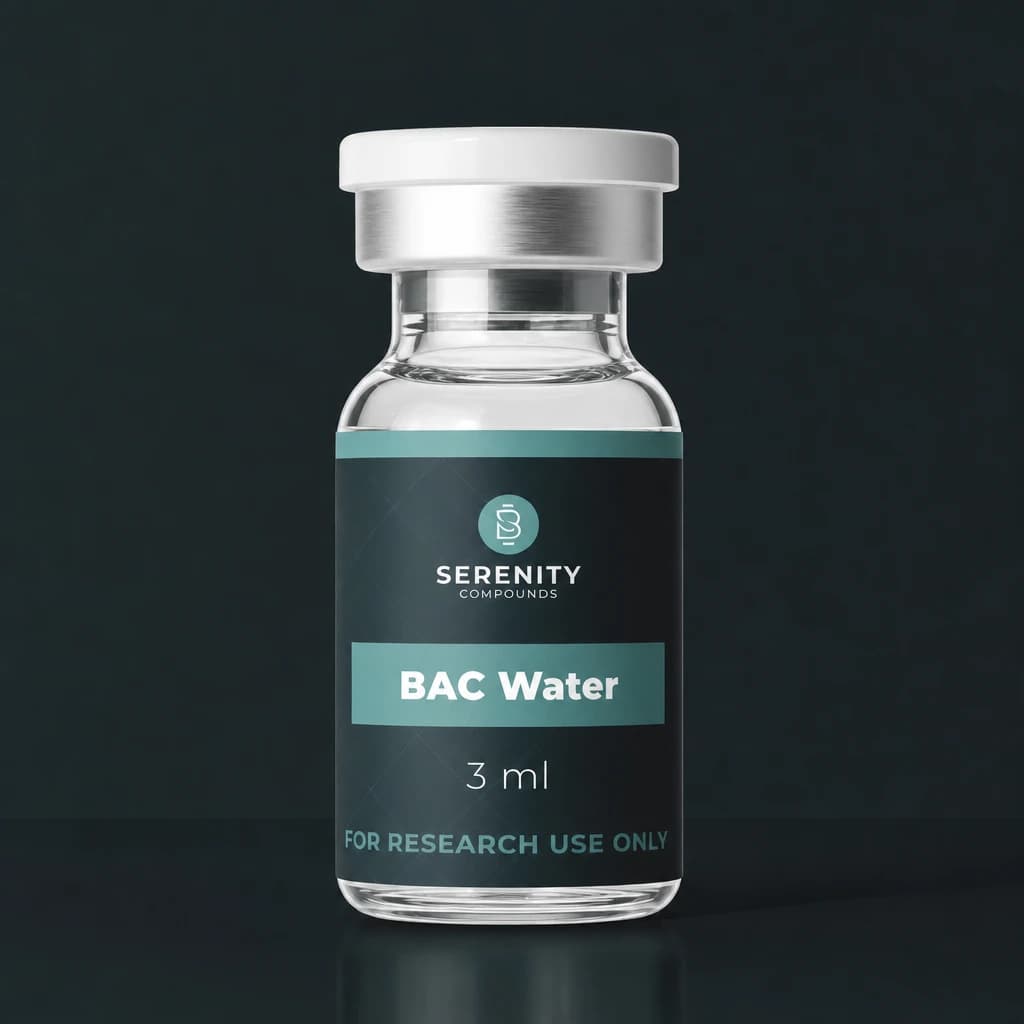
Compatibility needs separate evidence. The bacteriostatic water research reference and an unpreserved solution are not interchangeable simply because either could produce the same mathematical concentration. Our diluent comparison discusses formulation differences.
Solubility and stability also cannot be inferred from a correct division. The laboratory reconstitution guide explains the evidence needed before a preparation is treated as suitable for a method.
Peptide dilution calculator: checking a series independently
Dilution factors multiply across sequential stages. A stock diluted fivefold and then fourfold has undergone an overall twentyfold dilution. Adding the factors would give nine, which describes neither step nor the complete series. Recording the factor at each stage gives a second way to check the final concentration against a calculation based on transferred mass and final volume.
Intermediate labels should carry enough information to identify their parent solutions. A tube marked dilution 2 becomes ambiguous if several different stocks are in use. The worksheet can assign a unique preparation identifier and store the full relationship elsewhere. That connection matters when an assay run contains solutions made on different dates or from different source lots.
Peptide concentration calculator inputs: nominal versus measured
Labeled vial content is an input with a particular evidential basis. It may be nominal rather than an independently measured quantity. A content assay can provide a different basis when the method requires it. The calculator cannot decide which number is justified. Preserve the source of the input so that a later reader understands whether the result is a nominal prediction or a calculation based on analytical measurement.
Purity should not be used as an automatic mass correction. A chromatographic peak area percentage may exclude water or other contributions to gross mass and may not respond equally to every species. Multiplying the vial label by that percentage can therefore imply a content measurement that was never performed. Use a suitable quantitative basis when actual peptide amount is required.
When does molar concentration require another input?
Molarity expresses amount of substance per volume rather than mass per volume. Converting a mass concentration requires the applicable molecular mass. That value must match the specified sequence and the chemical basis used for the starting quantity. A salt or another documented form can introduce a distinction that a generic compound name does not resolve.
Blends cannot use one arbitrary molecular mass for their total. Each constituent needs its own amount and applicable molecular mass to calculate its molar concentration. Equal component masses do not contain equal numbers of molecules when their molecular masses differ. A tool returning one number for an unspecified mixture may be doing arithmetic, but that number does not describe a valid component exposure.
Peptide syringe calculator terminology and laboratory units
Device scales report volume according to the particular device's calibration. They are not standardized biological activity units for every peptide. A research worksheet should keep volume separate from mass and concentration even if a display shows them together. Without a known concentration and a correctly interpreted volume, a marked scale cannot identify an amount of the named material.
International units of biological activity are a different concept from a device's volume markings. A conversion between activity and mass requires an appropriate material specific relationship, not a universal peptide formula. This guide does not provide device settings or administration amounts. The distinction is included because ambiguous use of the word units is a common reason a chart cannot be interpreted reliably.
Precision and physical preparation limits
Equipment has a validated operating range. A calculated transfer that falls outside that range needs a method review rather than blind acceptance of the displayed result. More decimal places do not make a tiny transfer accurate. An alternative intermediate dilution may be appropriate within a validated procedure, but the tool cannot establish that procedure's compatibility or scientific purpose on its own.
Uncertainty also carries forward through repeated steps. A concentration series can be internally consistent while sharing an error in its original stock. Independent preparation or an appropriate analytical check addresses a different question from repeating the same formula. The worksheet should make clear which checks verified arithmetic and which, if any, evaluated the actual prepared material.
How to reconstitute peptides with a calculator?
Enter only quantities whose meaning and units are established by the laboratory method. The result can check a concentration or dilution relationship, but it cannot select a compatible matrix or assign a storage interval. If the starting material or final volume is uncertain, resolve that uncertainty before treating the answer as a reliable preparation record. The calculation does not authorize personal administration.
How to calculate peptide dosage?
For research reporting, first identify whether the source means a concentration, a total amount or an amount normalized to an experimental subject. Those quantities require different information and should not be merged into one answer. This guide supports dimensional checks for justified laboratory conditions. It cannot choose a human dose or transform preclinical numbers into a clinical schedule.
What should be saved with the result?
Preserve the source of the starting amount and the units used at every stage. Record whether concentration is nominal or analytically measured and connect the worksheet to the prepared sample. That makes the calculation useful to another researcher without assigning it the clinical meaning it cannot support.