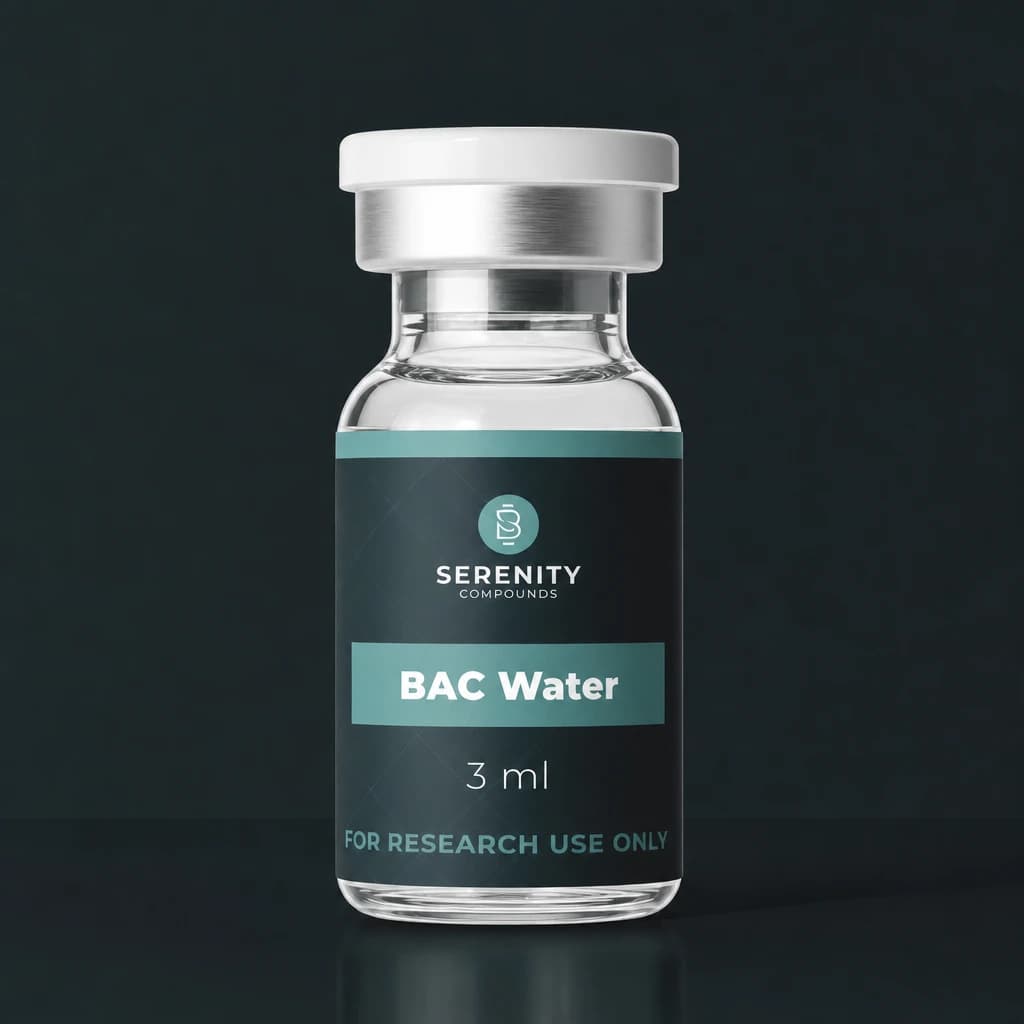
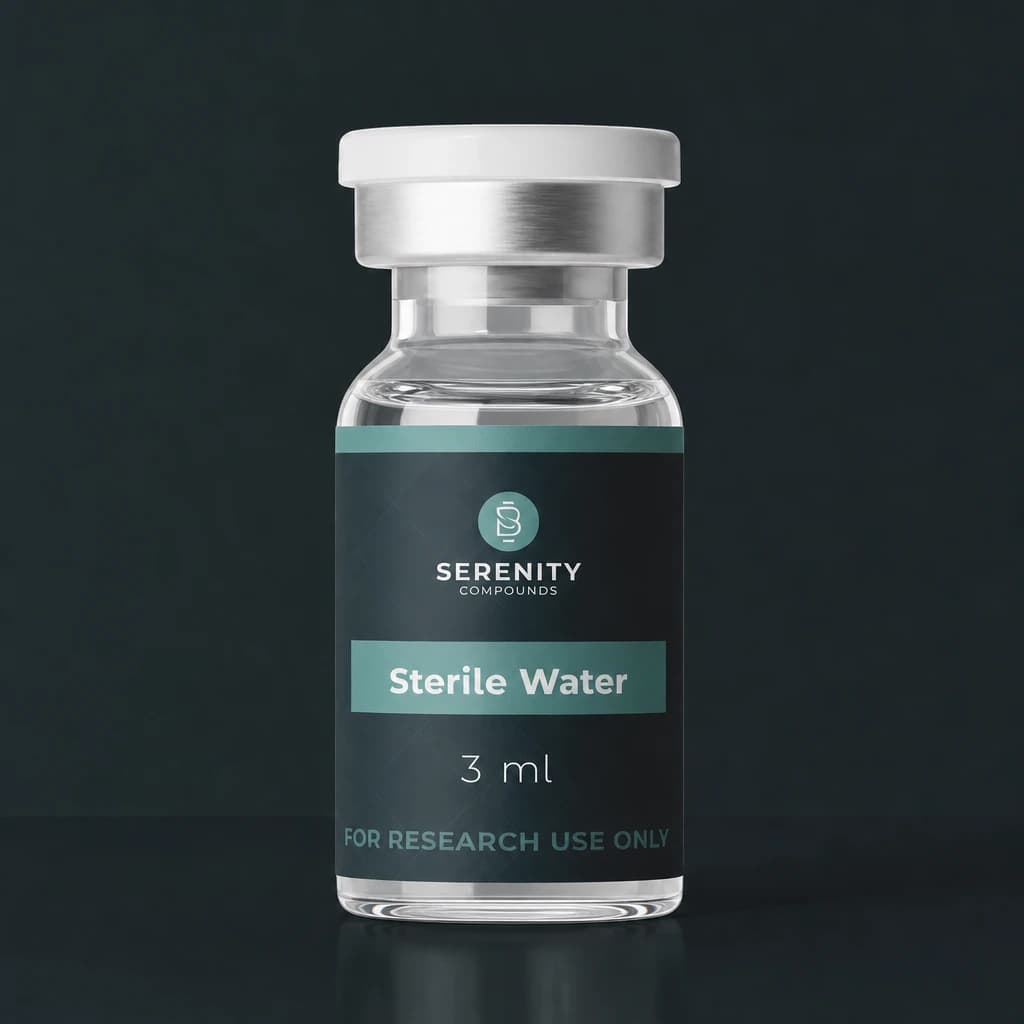
Bacteriostatic water vs sterile water is mainly a comparison of preservative content and product specifications, not a choice between universally better and worse diluents. The former commonly contains benzyl alcohol in pharmaceutical formulations, while the latter can be labeled without an antimicrobial additive. Those label examples don't certify an unrelated research supplier's formulation. A laboratory must verify its actual product and assess compatibility with the intended method. Neither name provides a human preparation or injection instruction.
Bacteriostatic water: what the preservative term means
Inhibition of bacterial growth under appropriate conditions is what bacteriostatic describes. It doesn't mean that a preservative can reliably sterilize a contaminated preparation or eliminate every kind of microorganism. Treating the word as a substitute for contamination control misunderstands its scope. The relevant formulation and validated handling information should come from the specific product documentation, with laboratory procedures established by qualified personnel.
An example pharmaceutical label describes a formulation containing 0.9% benzyl alcohol. That is useful evidence about the labeled medicine, not proof that every vial sold under a similar name has the same composition. Researchers should retain the distinction between a reference label used for explanation and the actual specification of their purchased material.
Preservatives become part of the experimental matrix when a solution enters an assay. Their presence can matter even when the study's main interest is a peptide. A suitable comparison should account for the background introduced by the diluent rather than attributing every difference to the target compound. Whether an additive affects a particular method needs validation in that setting, not a universal assumption.
What does sterile water for injection mean on a label?
Sterile water for injection is a pharmaceutical designation with a defined product context. The example label used here describes a product without an antimicrobial additive. Its instructions and limitations belong to that specific regulated product. The name should not be used to imply that a research material is interchangeable with it or suitable for direct administration.
Sterility addresses microorganisms under the applicable test and manufacturing framework. It isn't identical to absence of endotoxin or to chemical purity. Different quality attributes require different evidence. A solution can meet one specification while another relevant property remains unestablished. Procurement documentation should therefore state the claims actually supported rather than relying on a reassuring adjective to cover every laboratory concern.
Opening and subsequent handling introduce a different context from the unopened product. An initial specification doesn't automatically describe every later condition. This guide doesn't assign a universal discard interval because the applicable label and validated procedure must govern. Copying a familiar time limit from another product can create an unsupported claim about a material with different packaging or intended use.
Which matters more for a peptide assay: the name or the matrix?
Compatibility depends on the peptide and the method. A diluent that keeps one reference visibly dissolved may be unsuitable for another compound or interfere with a detector. The relevant factors can include pH and the presence of additives. A clear solution is an observation, not a complete test of molecular integrity or biological activity.
Buffering is another distinction. Water without a buffer doesn't necessarily maintain the pH required by an experiment after material is added. A laboratory should not assume that an unbuffered solution reproduces the conditions of a published assay using a defined buffer. The method's matrix is part of its scientific specification, even when the paper's headline focuses only on the peptide.
Container interactions can affect recovery too. Material may adsorb to surfaces or change during storage, depending on the compound and conditions. Those possibilities make nominal concentration different from confirmed available concentration. Our diluent compatibility discussion explains how a laboratory can frame that question without treating a generic water choice as a validated preparation protocol.
A hypothetical matrix mismatch
Suppose a fictional assay compares a peptide condition prepared with a preservative containing diluent against a control prepared with additive free water. If the readout changes, the experiment contains at least two differences: the peptide and the preservative background. The result may still be worth investigating, but the design cannot automatically assign the entire response to the peptide alone.
Matching the background can help address that ambiguity when scientifically appropriate. A separate matrix assessment may also be needed if the additive changes viability or the detection reaction. The exact design belongs to the validated laboratory method. This example is a reasoning exercise, not an instruction to prepare a particular product or a report that either Serenity diluent affected a tested assay.
Blank measurements should be interpreted carefully. A blank can reveal background signal in a detection system, but it may not capture every effect on living cells. Conversely, a cell viability check may not identify direct interference with an analytical reaction. Different controls answer different questions, and a single clean result should not be treated as universal proof of compatibility.
Why does concentration arithmetic not settle compatibility?
Mass divided by volume describes a nominal mass concentration. That calculation says nothing about whether the compound dissolves completely or remains intact. It also doesn't establish whether the diluent supports the biological system used by the assay. Correct arithmetic is necessary for a defined concentration record but insufficient to validate the chemistry of a preparation.
Unit conversions can still prevent avoidable errors. Milligrams and micrograms differ by a factor of one thousand, while volume units need consistent handling. The calculator explanation addresses that bookkeeping. It cannot select the appropriate diluent or determine an experimental exposure, and it must not be used to infer a safe human administration amount.
Molar concentration adds the requirement for an applicable molecular mass and chemical form. If a preparation contains several constituents, each needs separate accounting. A total blend amount doesn't provide every component concentration. The diluent decision and the concentration record therefore interact, but neither can substitute for the other.
Bacteriostatic water for injection: procurement and label context
Serenity's bacteriostatic water listing and sterile water listing are the relevant catalog records for its available research supplies. Compare the stated formulation and accompanying documents instead of assuming that the generic names settle every specification. Any missing information needed for the intended method should be resolved before the material is treated as suitable.
Packaging and lot traceability matter because the report must apply to the purchased material. A document for another manufacturer or batch is not an interchangeable certificate. Researchers should distinguish supplier descriptions from independently measured results and preserve the method behind any analytical claim. A copied pharmaceutical label can explain terminology but cannot certify an unrelated vial.
Intended use should remain explicit in the comparison. A laboratory reference and a regulated pharmaceutical product occupy different contexts even if their names resemble each other. The presence of sterile or bacteriostatic in a listing does not authorize human administration of a research material. Clinical preparation questions should be directed to qualified healthcare professionals using the applicable approved product information.
Questions that often cause confusion
What is bacteriostatic water?
Preserved water contains a component intended to inhibit microbial growth under its specified conditions. That description does not validate every mixture prepared with it or prove compatibility with a biological assay. The actual product label and formulation remain necessary. The preservative's presence is not a substitute for appropriate sterility evidence or the laboratory's method requirements.
How long does bacteriostatic water last?
Duration depends on the actual product and the state being discussed, such as unopened material versus an accessed container. Its label does not automatically define the lifetime of a peptide solution made with it. Keep the diluent's documentation separate from stability evidence for the final mixture rather than assigning both one generic expiry.
Does preservative make contaminated material safe?
No. A preservative's role is not a blanket guarantee that contamination has been removed. Material with a suspected contamination problem needs to be handled under the laboratory's appropriate procedures, not rescued through an assumption about its diluent. The generic term cannot replace evidence about the actual sample.
Can one water type be recommended for every peptide?
Neither category is universally suitable. The correct research choice depends on the specific material and validated method, including the final matrix presented to the assay. Finish the comparison with those requirements and the actual product documents. A familiar bottle name is not enough to establish compatibility or a safe human use pathway.