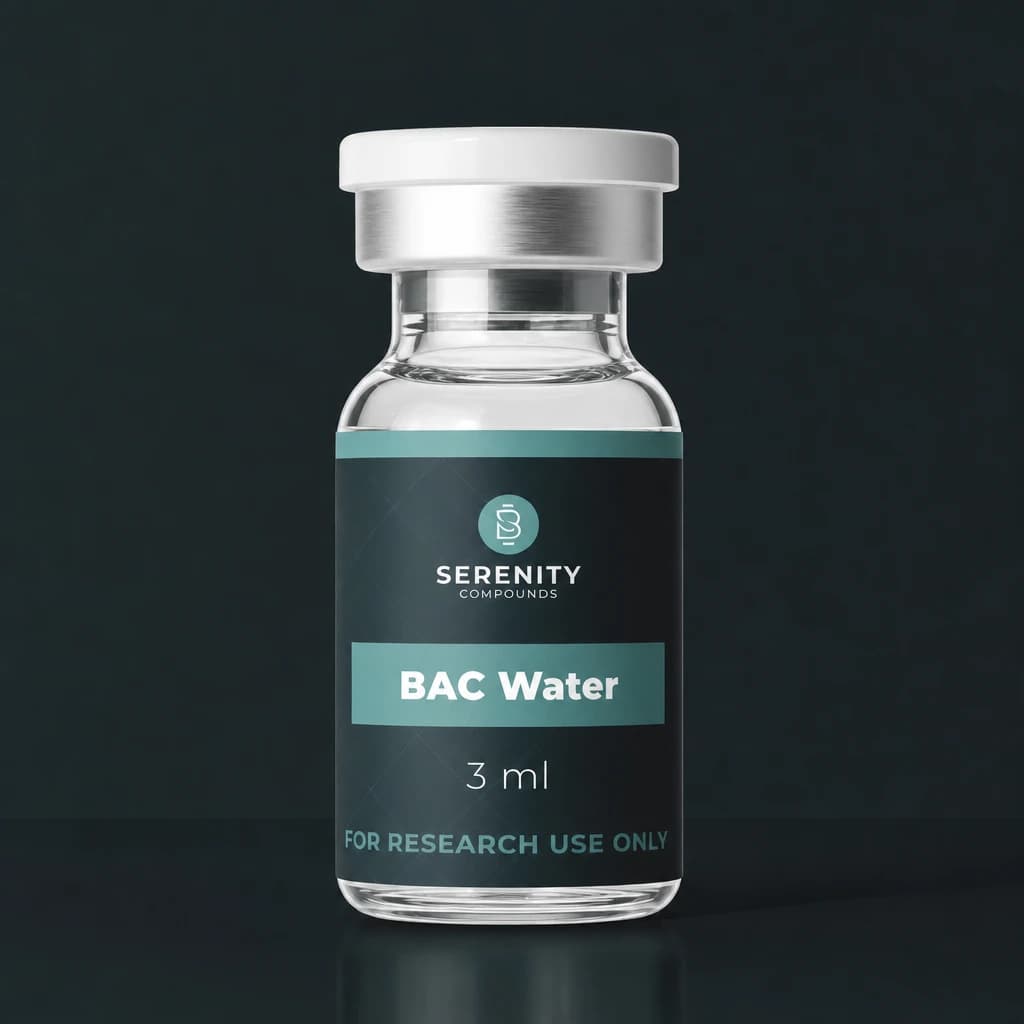
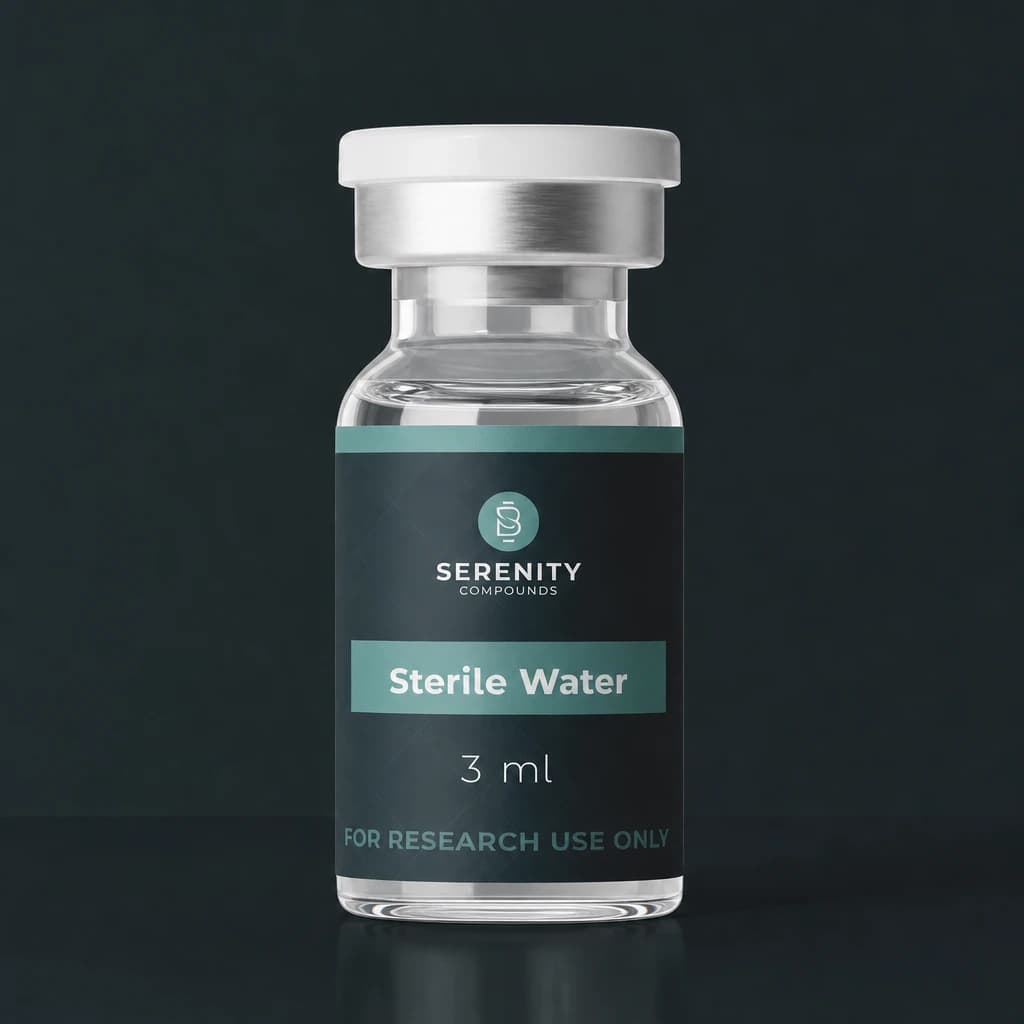
Bacteriostatic water for peptides is a laboratory compatibility question, not a universal preparation rule. The preservative and the water matrix may affect an assay differently from a published method's buffer. A peptide can appear dissolved while its recovery or integrity remains uncertain. The useful research approach is to define the material and measurement first, then assess the proposed matrix under an appropriate validated procedure. This article provides a reasoning framework, not instructions for human preparation or injection.
Start with the scientific question
Analytical identification and cell based activity testing may require different conditions. A matrix that works for one measurement may interfere with another. Before selecting a diluent, a laboratory needs to identify the endpoint and the method's requirements. The fact that a supplier stocks a familiar water product doesn't establish that it belongs in every experimental workflow involving a peptide.
Published methods should be read beyond the compound name. Buffer composition and other solution conditions can influence the experiment. Replacing a defined matrix with a different diluent changes the method, even if the nominal peptide concentration stays the same. That change may be reasonable to investigate, but it requires validation rather than an assumption that all clear liquids are functionally equivalent.
Serenity's bacteriostatic water catalog record provides product context for procurement. The actual specification and available lot documents should support any claims about the supplied formulation. An example pharmaceutical label describes 0.9% benzyl alcohol in that labeled product, but it does not independently certify Serenity's research supply.
Three different questions: dissolved, intact and active
Solubility concerns how much material is present in solution under the specified conditions. Visual clarity can be useful to record, but it isn't a quantitative recovery measurement. Small particles or losses to surfaces may escape a simple visual check. A laboratory should use an appropriate method if its conclusion depends on knowing how much reference material is actually available.
Integrity concerns whether the molecule remains the intended chemical species. A solution may contain degradation products while still appearing clear. The relevant analytical method needs to distinguish the target from changes important to the study. A storage statement for unopened material cannot automatically establish the behavior of a solution held in a different matrix for a different interval.
Activity is a biological or functional property measured by a suitable assay. Confirming an expected mass can support identity without proving that every aspect of activity is preserved. Conversely, observing a biological signal doesn't fully characterize the sample's composition. Keeping these questions separate helps a laboratory identify which assumption failed when an experiment produces an unexpected result.
Bacteriostatic water and preservative effects in peptide assays
Matrix effects can arise at the detector or within the biological system. An additive might alter background signal in a chemical assay, while a cell experiment introduces additional questions about viability and physiology. A control designed for one type of interference may not address the other. The effect needs to be evaluated in the actual method rather than declared present or absent for all assays.
Vehicle matching is relevant when comparing exposed and control conditions. If only one condition receives a preservative containing background, that difference can complicate attribution. A well described experiment states what each condition contains and why the comparison answers the intended question. This discussion does not prescribe a particular matrix or concentration for an experiment.
Our comparison with sterile water explains the labeling distinction in more detail. The alternative supply listing remains a separate product record with its own specification. Choosing an additive free material doesn't automatically solve every compatibility issue because pH and compound stability may still matter.
A hypothetical concentration worksheet
Suppose a fictional reference record states that a sample contains two milligrams of material in one milliliter of final solution. Its nominal concentration is two milligrams per milliliter, equivalent to two thousand micrograms per milliliter. This is a unit conversion example only. It does not specify how to prepare any Serenity product or establish an experimental or human exposure.
Now suppose an appropriate analytical method indicates that only 80% of the nominal target amount is recovered under those fictional conditions. The measured target concentration would differ from the label based calculation. That discrepancy could reflect incomplete dissolution or another source of loss, depending on the evidence. Correct arithmetic alone cannot identify the cause, and the laboratory shouldn't silently treat nominal and measured values as identical.
Uncertainty should be retained with the recovery estimate. Every analytical method has limits, and a single measurement may not establish a stable correction factor. A laboratory needs evidence that the result is reproducible and relevant to the actual conditions. The concentration calculator guide can support unit checking, but it cannot validate the chemistry behind the inputs.
Why does final matrix composition matter?
Dilution changes the concentrations of background constituents as well as the peptide. If a stock enters another medium, the final assay contains a combination of both matrices. Reporting only the original stock solvent can therefore leave the experimental exposure incompletely described. The useful record identifies what is present at the point of measurement, subject to the method's relevant level of detail.
Blends need constituent specific accounting. A fixed total mass doesn't reveal the amount of every ingredient, and the components may differ in recovery. A single nominal blend concentration can conceal those differences. If the hypothesis concerns one constituent's contribution, the laboratory needs a record that supports that comparison rather than assuming all ingredients behave identically in the chosen matrix.
Adsorption can depend on surfaces and conditions. An apparent loss of target signal doesn't automatically establish chemical degradation if material may have been retained elsewhere in the system. Appropriate analytical work can help distinguish those possibilities. The point isn't to assume that adsorption always occurs, but to avoid interpreting a concentration discrepancy without considering plausible alternatives.
Storage claims need their own evidence
Time in solution introduces a different question from the initial concentration measurement. A preparation may be suitable at one observation point without remaining suitable throughout a longer experiment. The stability evidence should match the relevant matrix and conditions. Generic claims that all peptides remain usable for a fixed number of days are not a substitute for that evidence.
Repeated handling can alter the context further. The laboratory's validated procedure should govern how material is managed and when suitability needs reassessment. This article deliberately doesn't supply a universal refrigeration rule, reuse period or discard deadline. Those instructions would require the exact product and procedure, and research handling guidance must not be repurposed into a human administration method.
Contamination control remains separate from peptide stability. Preservative content doesn't guarantee that a compromised preparation is acceptable, and visual appearance doesn't establish sterility. A suspected quality issue should be addressed through the appropriate laboratory process rather than explained away because the solution still looks clear or the product name contains a reassuring term.
Questions about laboratory diluent selection
How to reconstitute peptides?
Begin with the specified material and a method supporting the matrix. The desired concentration is only one requirement. Dissolution does not establish retained identity or compatibility with the readout. A laboratory worksheet should preserve the final assay concentration and vehicle composition without turning those quantities into preparation instructions for a person.
Where to buy bacteriostatic water?
Procurement should compare the documented formulation with the method's requirements. The useful evidence includes the exact product identity and relevant label information, not merely a familiar generic name. A research supply listing does not establish that the diluent suits every peptide or that a mixture prepared from independently supplied materials is clinically appropriate.
What a useful compatibility record looks like
Record the reference identity and lot, then state the question the method needs to answer. Separate nominal concentration from measured recovery. Preserve the final matrix description and the observation period. Document which tests address integrity and which address activity so that a later reader can see where the evidence is strong and where assumptions remain.
Deviations from a published method should be named explicitly. If a different diluent was used, the report shouldn't imply an exact replication. A transparent account can still provide valuable evidence about the modified conditions. Concealing the change makes it harder to interpret both successful and unsuccessful results or to compare them with the original publication. The supplier evidence assessment applies the same documentation discipline to procurement claims.
Ultimately, the appropriate diluent is the one supported for the defined research task, not the one most frequently recommended in an online comment. Product documentation and validated method evidence need to agree with the intended experiment. Neither a water label nor a concentration calculation turns a laboratory reference into material suitable for human use.