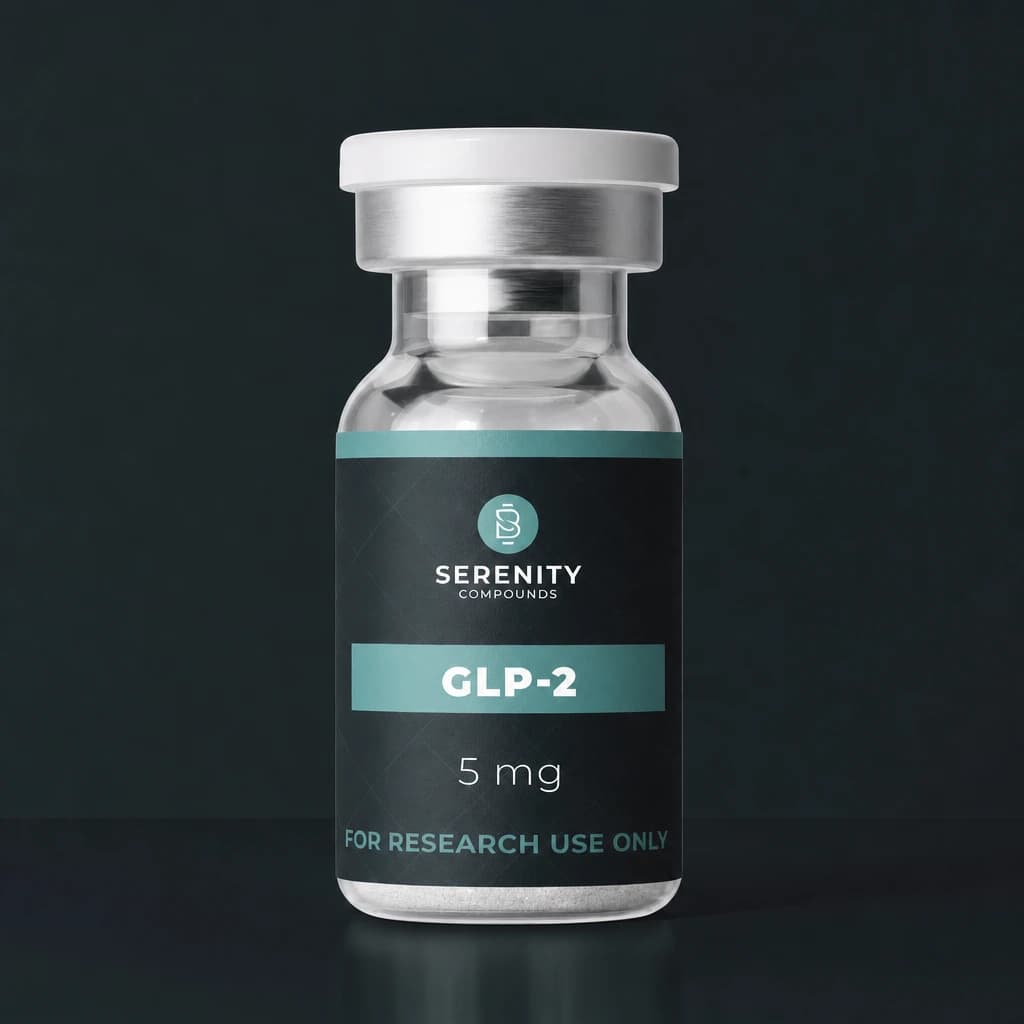
Is tirzepatide a peptide? Yes. It is a modified peptide with activity at GIP and GLP-1 receptors. Serenity's GLP-2 catalog label refers to this molecule and must not be confused with endogenous glucagon like peptide-2, which is a different peptide and signaling system. The number in the catalog shorthand doesn't identify the native GLP-2 hormone. This guide clarifies the identity and receptor evidence without providing human dosing or preparation instructions.
Tirzepatide peptide identity and chemical classification
Amino acid residues joined through peptide bonds provide the basis for the classification. Sequence substitutions and a chemical side chain can modify the properties of the molecule while it remains a peptide. The category describes chemical structure, not whether a product is approved for clinical use. A laboratory reference and a pharmaceutical product can share a molecular identity without being interchangeable formulations.
The discovery and proof of concept publication describes LY3298176, the development designation associated with the molecule. That identifier is useful when following earlier literature. A review should connect the development name to the current identity rather than treating them as unrelated compounds or assuming that every similarly named dual agonist is identical.
Native GIP provides a sequence related context for the analog's design, but the modified molecule isn't simply the endogenous hormone in a vial. Structural changes and receptor behavior need their own evidence. A study of native hormone physiology cannot establish every exposure or signaling feature of the analog, and the reverse inference is equally limited.
Two receptors do not imply two identical responses
Dual agonism means that activity involves two receptor systems under the relevant evidence. It doesn't imply equal potency or identical signaling at each target. The assay readout and receptor environment can affect the measured relationship. A comparison should therefore state which receptor and which response were measured before interpreting a ratio as a universal property.
Published signaling research examines imbalanced and biased activity across relevant pathways. That work illustrates why one broad label cannot describe every pharmacological detail. The finding belongs to its methods and comparators. It should not be reduced to a claim that two receptor effects simply add into a fixed multiplier of clinical benefit.
Receptor binding and downstream signaling are related but distinct observations. A molecule's interaction with a target doesn't fully describe how a cell translates that interaction into a response. Different signaling assays can therefore provide complementary information. Apparent disagreement may reflect different measurements rather than an error, and a useful review preserves that distinction.
Why is the GLP-2 catalog name potentially confusing?
GLP-2 already has an established biological meaning as an endogenous peptide distinct from GLP-1. Using the same short label for a catalog item creates a naming collision. Serenity's tirzepatide listing should therefore be recorded with the full molecule name in research documentation. That prevents a procurement shorthand from being interpreted as a native hormone identity.
Numbering should not be used to infer receptor targets. The GLP-3 catalog label elsewhere on the site maps to retatrutide rather than a native hormone named glucagon like peptide-3. Our triple agonist guide explains that separate identity. These labels are catalog conventions, not a new biological classification system.
Semaglutide has its own single receptor agonist research context and appears under Serenity's GLP-1 mapping. The structure explanation distinguishes that molecule from native hormone. Keeping all three full names visible makes comparisons more accurate without relying on a numerical shorthand that can obscure chemistry and mechanism.
How should an assay compare the two pathways?
Define the question before selecting a response measure. A study comparing receptor pharmacology may need systems appropriate to each target and a justified reference comparator. Receptor expression should be considered because different expression levels can influence apparent response. The raw numerical output from two cell systems isn't automatically comparable simply because both results are expressed as a percentage.
Normalization can change the meaning of that percentage. One assay might normalize to its own maximum reference response, while another uses a different comparator. Equal normalized values don't necessarily represent equal absolute signaling. The method should preserve the reference definition so readers can understand what the percentage actually compares.
Concentration response curves can describe potency and maximum effect separately. A single point may indicate activity but is often insufficient to characterize either feature well. Different time points can reveal different aspects of signaling too. A precise summary should avoid calling a compound stronger without identifying which parameter supports that description.
A hypothetical dual receptor interpretation error
Suppose a fictional experiment reports activity in separate GIP and GLP-1 assay systems. An online summary adds the two percentages and calls the result total metabolic power. That arithmetic has no justified biological meaning because the percentages may have different reference scales and describe separate systems. The experiment provides two observations, not a validated combined clinical score.
Now suppose another study measures body weight in a clinical population. That outcome can address a therapeutic question for its tested product, but it doesn't reveal the exact contribution of each receptor pathway by itself. Mechanistic attribution requires an appropriate design and additional evidence. Clinical efficacy and receptor mechanism are connected questions without being identical measurements.
Comparing headline results from unrelated clinical trials introduces further differences in populations and analysis. The incretin comparison article explains why those differences prevent a simple universal ranking. A numerical table is useful only when its entries represent sufficiently comparable quantities and retain the limitations of the underlying evidence.
Why doesn't an approved medicine validate a research reference?
FDA's information on unapproved GLP-1 related products distinguishes regulated medicines from other products marketed with related names. Approval belongs to a defined pharmaceutical product and framework. A laboratory supplier's material doesn't inherit that status because its active identity appears in a medicine. The regulator information was checked during this September 5, 2026 review.
Formulation and manufacturing context matter when connecting a publication to a product. A powder with a matching molecule name isn't automatically equivalent to the intervention used in a clinical trial. Analytical identity can support one part of the material question while leaving other product attributes unresolved. A purity percentage doesn't establish clinical suitability or reproduce a regulated delivery system.
Human administration questions therefore cannot be answered by dividing a catalog vial amount into an online schedule. Research concentration arithmetic is not prescribing. This article doesn't recommend a route or provide a conversion from trial exposure to use of a laboratory reference. Clinical decisions require qualified guidance using the applicable pharmaceutical information.
Questions about the dual agonist reference
What peptide is tirzepatide?
It is a defined synthetic peptide with activity at GIP and GLP-1 receptors, not a generic label for every dual agonist. The exact structure and supplied material form belong in the research specification. A receptor category or a catalog nickname cannot establish those details or characterize the quantity present in a particular vial.
Where to buy tirzepatide peptide?
Procurement for research should follow the laboratory method's requirements for identity and analytical evidence. Compare the selected lot and its documents rather than assuming that every matching product name describes equivalent material. A research listing is not a substitute for authorized clinical care and should not be interpreted as a route to personal administration.
Tirzepatide peptide for sale: procurement and evidence records
Document the full molecule name alongside any catalog shorthand. Retain the lot and relevant chemical form specification. Compare the analytical report with the identity required by the intended method. If a paper uses the development identifier, make that relationship explicit so the evidence trail remains clear without collapsing distinct analogs into a shared category.
Separate the evidence into structure, receptor response and clinical outcome. Within receptor findings, retain the target and measurement method. Within clinical findings, retain the product and population. This organization makes it easier to see where a claim is directly supported and where an inference would require additional evidence.
Ultimately, the molecule is a peptide with dual receptor activity, but Serenity's GLP-2 shorthand is not the endogenous GLP-2 hormone. That naming distinction is essential for accurate research records. It clarifies what the catalog contains without implying that a reference vial is an approved medicine or a human use product.