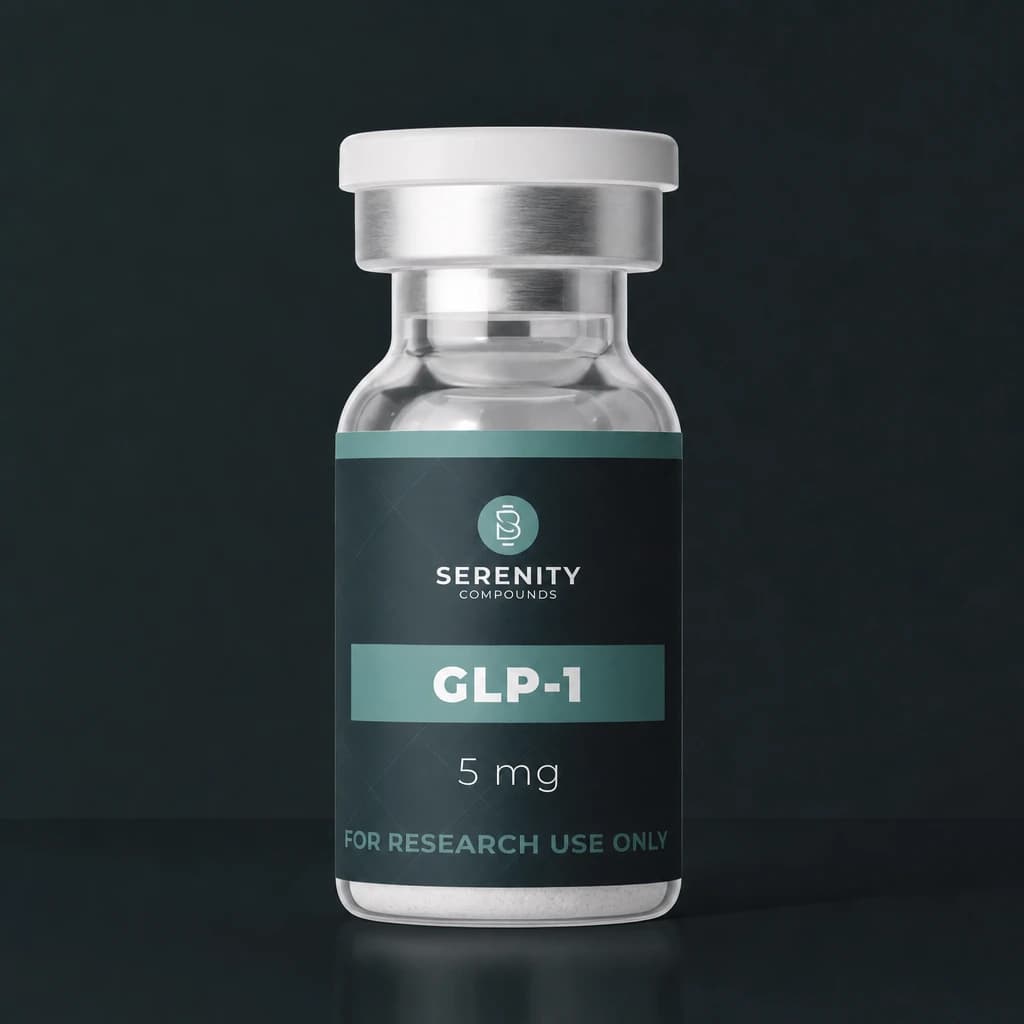
Is semaglutide a peptide? Yes. It is a modified peptide analog of GLP-1, with structural changes that distinguish it from the native hormone. Chemical classification doesn't make a research reference equivalent to an approved pharmaceutical formulation. Serenity uses GLP-1 as a catalog label for this material, but the exact compound identity still needs to be retained in research records. This article explains the structure and naming without providing human dosing or preparation instructions.
Semaglutide peptide identity: what defines the chemical class?
Peptide classification concerns amino acid residues linked through peptide bonds. The molecule remains a peptide when specific residues are changed or a chemical side chain is attached. Those modifications can substantially affect behavior without changing the underlying classification. A catalog category alone isn't the evidence for the classification, because some products grouped near peptides are chemically different small molecules.
The original discovery publication describes the molecular design and modifications. Those details help explain why the analog should not be treated as identical to naturally occurring GLP-1. The publication concerns a defined compound and research program. It does not independently verify the identity or quality of every later supplier's material carrying the same name.
Native hormone and modified analog are therefore separate entries in a rigorous evidence record. A study using the endogenous peptide cannot automatically establish the exposure profile of the modified reference. Conversely, findings about the analog shouldn't be assigned to every GLP-1 related molecule. The shared receptor context makes the papers related, not interchangeable.
Why were structural modifications important?
Enzymatic degradation can limit the persistence of peptide hormones. Sequence modification is one strategy used in drug discovery to change susceptibility to particular processes. The relevant question is which modification was made and what the supporting experiment measured. A general claim that a peptide is modified doesn't establish a specific duration in every formulation or biological system.
Acylation introduces a chemical group that can affect interactions with proteins such as albumin. Protein association can influence the relationship between total and freely available material. A laboratory assay that lacks the same protein environment may therefore produce a response that cannot be directly compared with a physiological exposure. The matrix belongs in the interpretation rather than being treated as an incidental detail.
Molecular design and formulation are different layers. A structural feature belongs to the active identity, while a pharmaceutical formulation contains additional product specific characteristics. Both can influence an experiment or clinical use, but one cannot substitute for the other. Confirming a sequence doesn't establish that a research vial reproduces the delivery characteristics of a regulated product.
What does GLP-1 receptor activity establish?
Receptor activation supports a mechanistic statement within the system used to measure it. The response depends on receptor expression and the selected signaling readout. A cell assay may be appropriate for comparing pharmacology while remaining insufficient to predict a person's clinical outcome. The experiment needs to be described at the level it actually measured rather than promoted as direct evidence of every downstream benefit.
Potency and maximum response are different features. A lower concentration producing a specified response doesn't automatically mean a larger maximum effect. The reference comparator and curve analysis matter. A single concentration point generally can't characterize the whole response relationship, even when the numerical difference between conditions appears large.
Our weight related research overview separates receptor mechanisms from body composition outcomes. A shared association with metabolic research doesn't make all catalog compounds GLP-1 agonists. Accurate classification is particularly important when a reader compares incretin references with amylin analog research or small molecules that act through different systems.
How should Serenity's catalog label be interpreted?
Serenity's semaglutide reference page uses the GLP-1 catalog mapping. That shorthand should be expanded to the exact molecule when recording a study material. GLP-1 is also the name of an endogenous hormone and a common receptor class shorthand, so using it alone can leave the identity ambiguous in a laboratory notebook or procurement comparison.
Numbered catalog names should not be assumed to follow the names of native hormones. The tirzepatide identity guide explains the particularly important GLP-2 distinction elsewhere in this catalog. Retaining the full molecule name prevents a product shorthand from being mistaken for a different endogenous peptide or receptor target.
Lot documentation needs to support the actual reference identity. A product title and a general family description aren't enough to resolve every chemical question. Any relevant salt or chemical form designation should remain explicit. If the specification and analytical report differ, the laboratory should resolve the discrepancy before treating the material as equivalent to the intended reference.
Why isn't a research vial an approved medicine?
Approval applies to a specific pharmaceutical product and its regulated context. A research supplier's material doesn't inherit that status simply because the molecule appears in approved medicines. FDA's information about unapproved GLP-1 products explains why product identity and approval distinctions matter. The regulator source was checked during this September 5, 2026 review.
Formulation differences can include constituents and presentation relevant to product behavior. A clinical study's outcome belongs to the tested intervention, not to an arbitrary reference powder with a matching name. A catalog purity result cannot bridge that difference or establish clinical suitability. This article intentionally does not describe how to recreate a pharmaceutical product from research materials.
Clinical dosing questions therefore cannot be answered by converting the nominal mass on a laboratory vial. Product specific prescribing information and qualified clinical guidance belong to a different context. A concentration calculator performs arithmetic and does not establish an appropriate human amount, administration route or treatment decision.
A hypothetical receptor assay comparison
Suppose a fictional experiment compares native hormone and modified analog at equal nominal molar concentrations. If the matrix contains a protein that interacts differently with the two materials, freely available exposure may differ. A response difference could therefore reflect more than direct receptor affinity. The example illustrates why nominal concentration and receptor pharmacology need to be interpreted together.
Now suppose a second laboratory repeats the comparison in a different medium. Its result may differ without either laboratory making an arithmetic error. The biological and chemical environments changed. A transparent report would state those conditions and avoid presenting an assay specific potency ratio as a universal property independent of the method.
Controls should address the relevant background and detector behavior. An appropriate reference condition helps establish that the assay can respond, while additional measurements may be needed to assess stability or available concentration. These are design considerations for qualified research, not a preparation protocol or a recommendation for human exposure.
Questions about classification and procurement
Are peptides the same as semaglutide?
Classification runs in one direction: this molecule is a peptide, but the peptide class contains many other sequences with different behavior. A shared class does not establish a common receptor profile or clinical effect. Resolve the exact molecule before comparing a publication or report rather than treating the category as an interchangeable ingredient name.
Are semaglutide and tirzepatide peptides?
Both are peptide based molecules, yet their structures and receptor profiles differ. A research comparison needs those identities and the actual measured endpoint. Their classification does not establish equal activity at equal mass or make independently supplied references equivalent to pharmaceutical products. The lot specification remains necessary even when the broad chemical category is clear.
Semaglutide peptide for sale: what an identity review should retain
Record the full compound name and the relevant structural form before extracting a paper's result. Separate receptor observations from pharmacokinetic findings and clinical outcomes. Preserve the formulation and population where they matter. This structure prevents a broad peptide label from hiding the differences that determine whether two pieces of evidence are actually comparable.
Analytical claims should remain tied to their methods. A certificate needs to distinguish identity from purity and other quality attributes. Neither a clean chromatogram nor an expected mass establishes the clinical efficacy of a catalog product. Those measurements support narrower questions about the sample.
Ultimately, the answer to the classification question is straightforward, but the product inference is not. The molecule is a modified peptide analog, while a research reference remains distinct from an approved pharmaceutical formulation. Keeping those two facts together provides an accurate basis for reading the literature without turning a catalog label into a human use recommendation.