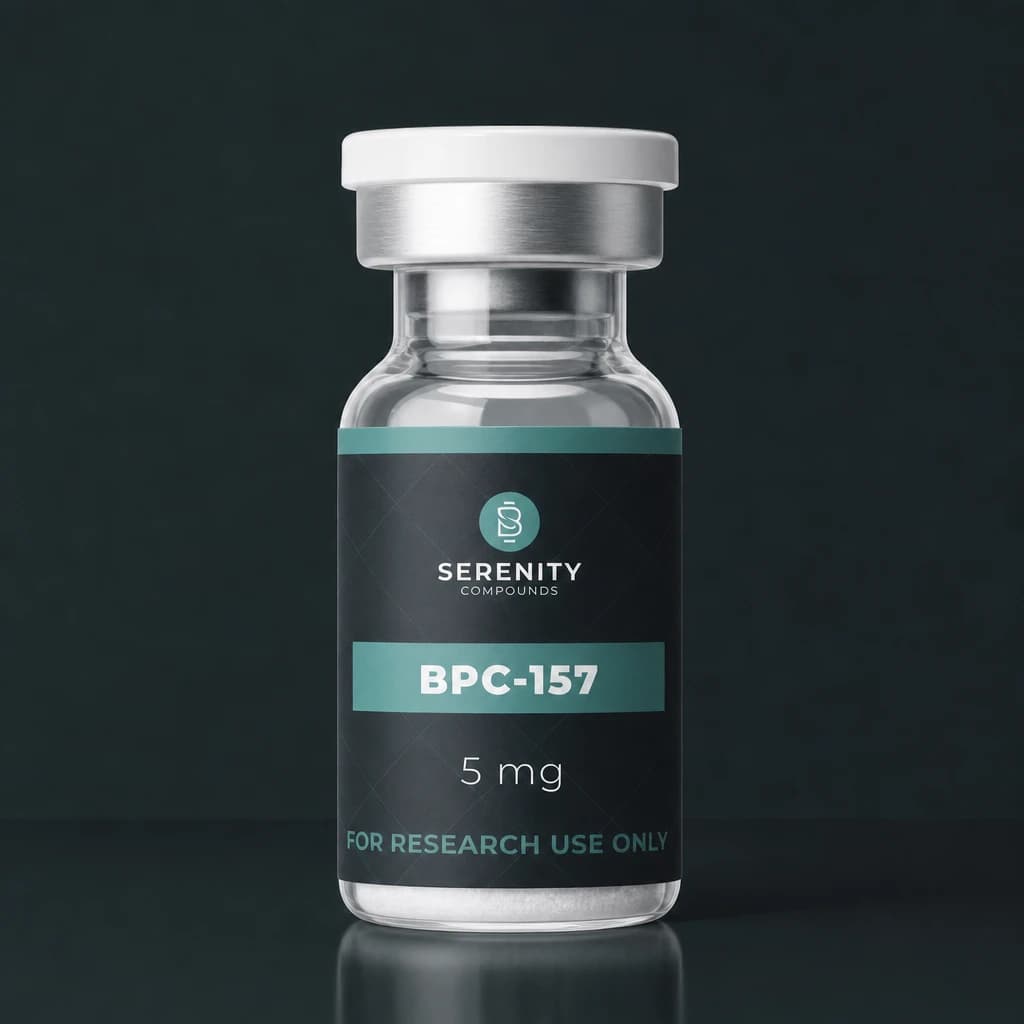
BPC 157 peptide is a synthetic sequence of 15 amino acids studied in preclinical tissue research. The literature includes experiments involving cells and animal models. Those findings do not establish that a research vial treats an injury in humans. Understanding the evidence starts with the material's identity and the endpoint a study actually measured.
What does the peptide name identify?
Sequence order defines a peptide, not simply the presence of its constituent amino acids. An identity method should be suitable for distinguishing the intended sequence from relevant alternatives. Expected mass and chromatographic behavior provide useful information, but each has limits. A report is more informative when it explains what those measurements establish together.
Serenity's BPC-157 listing provides the available research quantities and material context. The chosen lot should remain connected to its analytical documents. A catalog description cannot replace the method specific question of whether the supplied reference is suitable for a particular experiment.
What do tissue model studies investigate?
Published tendon fibroblast research examined changes in growth hormone receptor expression in a controlled cell setting. That is a mechanistic observation. It should not be rewritten as proof of tendon repair in a person or used to imply that the same response will occur in every tissue.
Migration, proliferation and viability are distinct measurements. A culture surface that becomes covered more quickly may reflect more cells, faster movement or several changes together. A useful experiment separates those possibilities. Naming the endpoint precisely helps readers understand what the finding does and does not show.
Why does the control condition matter?
Consider a hypothetical comparison in which one culture receives a reference in a solvent while the other receives untreated medium. A difference might arise from the reference, the solvent or their interaction. A matched vehicle condition addresses one of those uncertainties. It doesn't answer every question, but it makes the specific comparison easier to interpret.
Independent repeats add a different kind of information. They help assess whether the response survives another preparation or experimental run. Repeating the same reading many times from one sample is not the same as repeating the experiment. Both forms of replication may be useful, but their roles should remain clear.
Does high purity prove biological activity?
No. Purity and biological activity are different properties. A chromatographic method may report the fraction of detected peak area assigned to the main species. A functional assay investigates a response under selected conditions. A high value in the first test does not supply the result of the second.
Identity also needs separate interpretation. An apparently clean chromatogram is not a universal certificate of sequence, sterility or suitability for administration. The COA reading guide explains how to distinguish those claims and recognize a measurement that the report never made.
How should benefits and safety claims be judged?
Benefit language becomes meaningful only when attached to a defined outcome. A marker in a cell model cannot establish reduced pain or faster recovery in a clinical population. The number of participants or experimental units and the comparison design influence how much confidence a result can support.
Safety uncertainty is not evidence of safety. FDA's information on peptide substances with potential safety risks discusses concerns relevant to this compound, including characterization and immunogenicity. Our BPC-157 safety evidence article separates those concerns from the limits of published human observations.
BPC 157 benefits: separating a mechanism from an outcome
Mechanistic evidence is strongest when an experiment can distinguish a proposed pathway from competing explanations. Measuring a receptor after treatment suggests an association. Blocking that receptor and seeing whether the response changes addresses a more specific causal question. Even then, a blocker may have other effects. Appropriate controls and an independent way of testing the pathway help determine whether the original explanation remains plausible.
Tendon biology also involves more than one cell type or signaling event. An isolated fibroblast experiment cannot reproduce the mechanical loading, circulation and immune environment of an intact tendon. That difference does not make cell research unhelpful. It defines the part of the problem the model can investigate. A useful literature summary should explain that boundary before moving from molecular observations to tissue level language.
Magnitude deserves attention alongside statistical significance. A small average change can meet a statistical threshold without establishing a meaningful improvement in function. Confidence intervals indicate the uncertainty around an estimate. Baseline differences, excluded observations and the number of independent experimental units affect interpretation too. These details are more informative than treating every positive result as equivalent evidence of a benefit.
BPC 157 dosage and laboratory exposure are different questions
Exposure in a cell experiment usually needs a concentration and a duration. A publication describing an animal experiment may instead report an amount relative to body mass. Neither quantity can be converted into the other by moving a decimal point. Absorption, distribution and the experimental compartment differ. A calculation should preserve the reported units until the model provides a justified basis for a different expression.
Nominal concentration describes what the preparation record predicts. Measured concentration describes what an analytical method detects. Those values can disagree because of transfer losses, degradation or an incorrect starting assumption. An unexpected biological result should therefore prompt a review of the material record as well as the assay. Repeating a calculation cannot establish whether the intact reference reached the intended experimental compartment.
Storage and handling belong to the evidence record
Reconstitution changes the material from a dry preparation to a defined solution. Its behavior then depends on the solvent, container and conditions used. A stability statement for unopened material should not silently become a statement about every prepared solution. Record which form the supporting evidence covers and which analytical endpoint was followed. A retained main peak and retained biological activity are related questions, not identical measurements.
Freeze and thaw history can be documented without inventing a universal limit. The laboratory needs acceptance criteria supported for its material and method. If an experiment uses several preparations, their histories should remain distinguishable. Otherwise, a preparation difference can be mistaken for a concentration response. Visual inspection can identify an obvious problem but cannot establish intact sequence or quantify a subtle chemical change.
Questions from the BPC research keyword cluster
What does BPC 157 do?
Answering this requires naming a model and an endpoint. Published preclinical work investigates responses in tissue related systems, including the receptor expression study discussed above. That is narrower than saying the compound repairs injuries. A reader evaluating a new claim should ask whether its source measured the claimed outcome directly or only a marker that might be involved in it.
Does BPC 157 work?
Effectiveness has no single meaning without a specified task. An analytically identified reference can be suitable for investigating a pathway while remaining unproven for a claimed human benefit. A positive laboratory response also needs replication and a comparison capable of excluding obvious alternatives. The useful question is whether the available experiment supports the exact conclusion being proposed, not whether one broad label can summarize the entire literature.
Is BPC 157 safe?
Absence of a reported adverse event cannot settle that question. A study's size, observation period and monitoring determine which problems it could detect. Chemical characterization introduces another uncertainty when the product being discussed is not the material studied. For a research purchase, documentation helps define the reference. It does not transform incomplete human safety evidence into an assurance about personal use.
What belongs in a research conclusion?
Report the material, model and measured outcome together. If the result concerns a signaling marker after a particular exposure interval, say that. Avoid replacing the measured endpoint with an untested clinical benefit. A careful conclusion can still explain why the observation is interesting without claiming that the experiment answered a different question.
For procurement, match the selected reference to the method's identity and documentation requirements. For interpretation, keep the experimental conditions attached to the result. Both steps are necessary for a useful research record, and neither creates a human administration protocol.