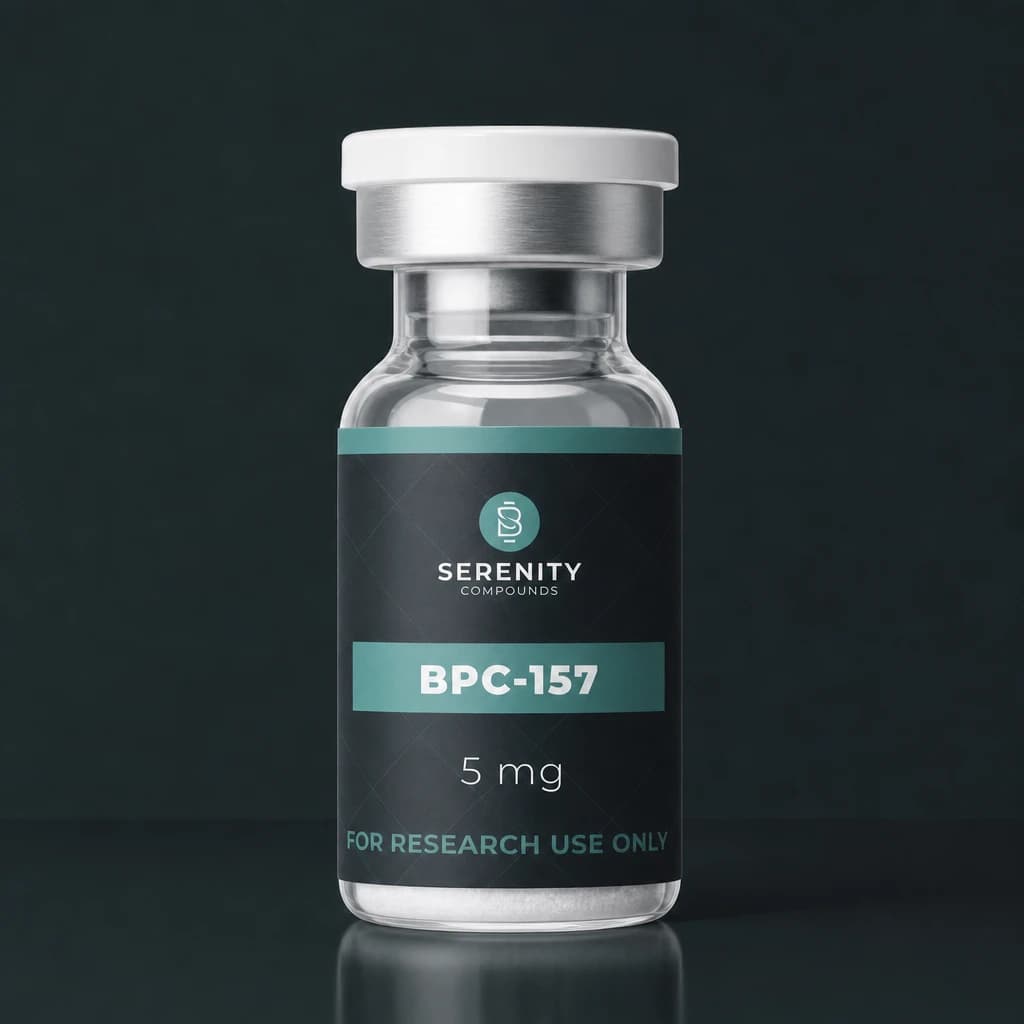
BPC 157 dosage searches often combine three different quantities: the amount in a vial, the concentration of a prepared solution and an amount administered in a study. These are not interchangeable. Serenity's calculator handles laboratory concentration and dilution arithmetic. It does not choose a human dose or provide injection instructions.
What information does a concentration calculation need?
Mass and final solution volume establish mass concentration. The units must be explicit. A label giving milligrams describes an amount, while milligrams per milliliter describes concentration. Dividing by an unspecified number called units cannot produce an interpretable laboratory result because the meaning of that unit has not been defined.
The BPC-157 product page supplies the catalog context for a research reference. Its quantity selector does not prescribe a preparation volume. The laboratory method and the material documentation need to establish whether the proposed preparation is appropriate before arithmetic is used to describe it.
A hypothetical concentration example
Suppose an analytical worksheet contains 2 mg of a generic reference in a validated final volume of 4 mL. Dividing 2 by 4 gives 0.5 mg/mL. Because 1 mg equals 1,000 micrograms, that is also 500 micrograms/mL. These numbers illustrate unit conversion only. They are not a preparation recipe for this product.
Final volume is the volume of the completed solution. It should not automatically be replaced with the volume of solvent added. A validated method may distinguish those quantities. Record which value was used so another analyst can reconstruct the calculation rather than infer it from a note saying mixed with water.
What happens after a dilution?
For a hypothetical stock at 0.5 mg/mL, a fivefold dilution gives 0.1 mg/mL if the dilution is defined and performed as the method requires. The arithmetic divides the original concentration by five. It does not establish solvent compatibility, analyte stability or the suitability of the resulting solution for a biological experiment.
Should purity be included?
Only a relevant content assignment supports a content correction. Chromatographic peak area purity is not automatically the fraction of active peptide by total mass. Water and counterions may affect the latter without appearing in the same way in a chromatogram. Our COA interpretation guide explains that distinction in more detail.
An analyst should state the calculation basis rather than silently multiply every labeled mass by a purity percentage. If the method requires a mass fraction that the report does not provide, the missing measurement cannot be supplied by a calculator. More decimal places do not repair an unsupported input.
How does blend accounting differ?
Each constituent needs its own concentration. A combined mass conceals how much of either peptide is present. Even equal component masses do not imply equal molar concentrations because molecular weights can differ. The blend research guide explains why this matters for controls as well as calculations.
Why isn't a study amount a human instruction?
Published tendon fibroblast work concerns a cell model and its measured response. An amount per volume in that model does not establish an amount to administer to a person. Animal amounts normalized to body mass require a different interpretation again. Replacing the study subject with a human in the same arithmetic would not establish safety or efficacy.
Why a BPC 157 dosage chart can conceal incompatible units
Charts can place a vial amount and an amount per body mass in adjacent columns even though they describe different things. The first is a material quantity. The second describes an experimental exposure normalized to a subject's mass. A conversion between them would require additional information about the actual study, and numerical compatibility would still not establish that the exposure is appropriate outside that study. A research worksheet should identify the physical quantity before performing the calculation.
Concentration units can also conceal a thousandfold difference. Milligrams per milliliter and micrograms per milliliter refer to the same kind of quantity but use different mass units. Converting the number without converting the unit label creates a misleading record. Keep a dimensional line beside the arithmetic so the mass and volume units can be followed from the original input to the reported output, including any later dilution factors.
How do uncertainty and rounding affect a result?
Precision should reflect the inputs rather than the display capacity of a calculator. If a material amount is assigned with limited certainty, an output with many decimal places doesn't become equally certain. The uncertainty in final volume matters as well. A laboratory evaluating repeatability should distinguish variation in the prepared solution from variation introduced by the analytical measurement, rather than attributing every difference to the reference compound.
Rounding is best documented at the reporting step. Repeatedly rounding intermediate values can produce a result that another analyst cannot reproduce from the original inputs. Retain the calculation basis and state the reported precision. This is particularly important when a later worksheet imports the output as a new input, because the second calculation otherwise hides the fact that information was already discarded at the first stage.
Relating a calculated amount to BPC 157 benefits research
Experiments on tendon fibroblasts examine responses in an isolated cellular system. In the linked publication, receptor expression and cellular responses to growth hormone were investigated with separate measurements. A concentration entered into that experiment was part of its method, not a prescription derived from a clinical outcome. Reading the endpoint explains why copying the exposure number into a different setting would not reproduce the scientific question that the investigators asked.
Replicates address another distinction. Several measurements taken from the same prepared sample help characterize measurement variation, while independently prepared samples can reveal preparation variation. Neither is automatically equivalent to several independent biological subjects. A calculation sheet that records only the final average loses this structure. Preserve the sample identifiers and the relationship between repeats so the reported variation can be interpreted correctly.
Preparation and recovery are not calculator outputs
Solubility must be established for the actual preparation conditions. A mathematical concentration assumes that the stated amount is present in the stated final volume, but incomplete dissolution or loss during transfer can make that assumption inaccurate. A clear appearance alone may not settle the question. The laboratory method should explain how the prepared sample is evaluated and what evidence supports the concentration basis used for the assay.
Storage can change the material after the initial calculation without changing the number written in the worksheet. If a working solution is held between measurements, its preparation time and handling history need to remain connected to the result. An elapsed storage period is not itself a stability measurement. A newly calculated value cannot certify that an older preparation still contains the same amount of intact analyte.
Questions about calculators and study claims
Does BPC 157 work?
Answering that question requires a defined outcome. A cellular response reported in a laboratory experiment is not the same outcome as faster recovery in a person. The calculator cannot adjudicate either claim because it measures no biological response. Its useful role is narrower: checking whether the stated arithmetic follows from the stated inputs after the material and method questions have been addressed.
Is BPC 157 safe?
Safety is not an output of concentration arithmetic. A mathematically correct number does not establish the safety of a compound, preparation or route of administration. Questions about adverse effects require evidence from an appropriate study population and exposure context. A certificate likewise addresses its named analytical measurements rather than supplying a human safety assessment. This guide therefore keeps laboratory calculations separate from personal use decisions.
What should be saved with the result?
Retain the input mass, final volume and units beside the output. Add the relevant lot and method version so the number stays connected to a defined preparation. Use the peptide calculator to check the arithmetic once those inputs are justified. An unresolved material or method question should remain unresolved in the record rather than be hidden behind a calculated number.