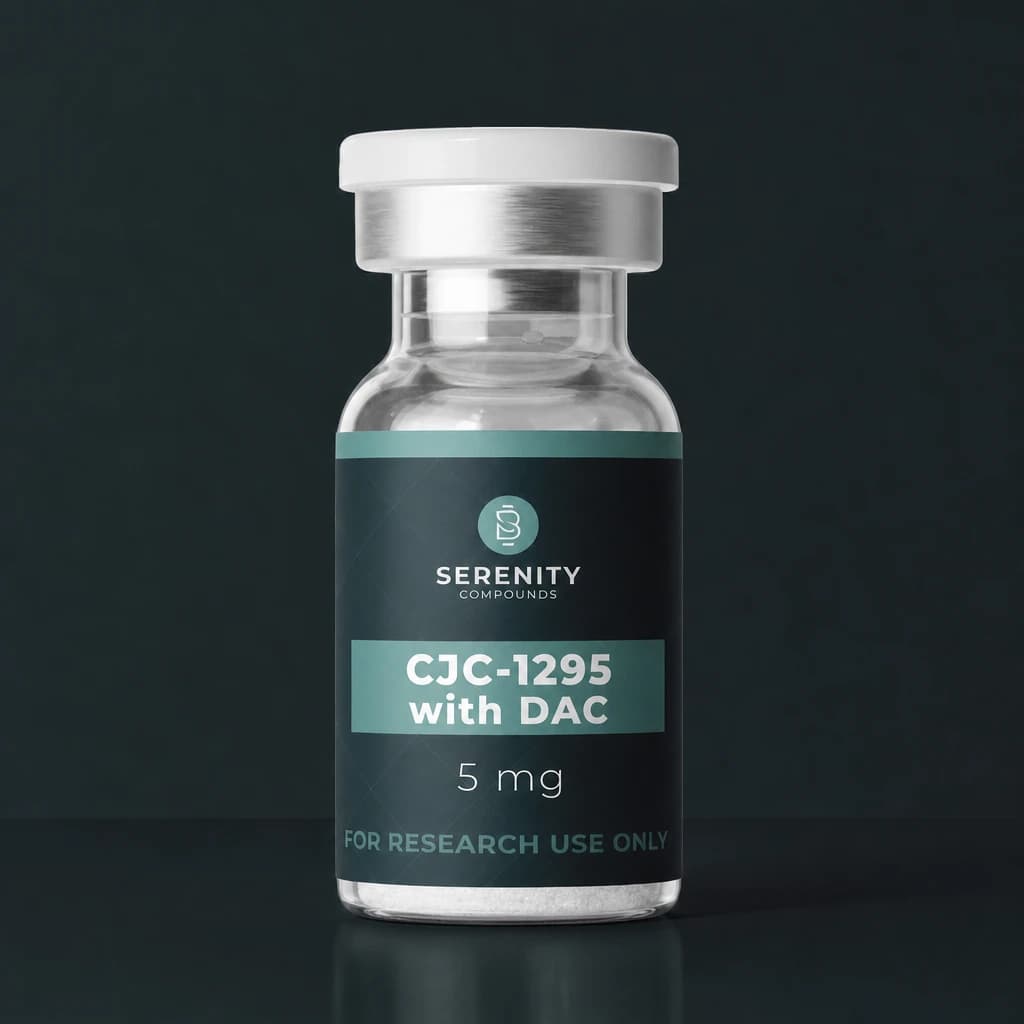
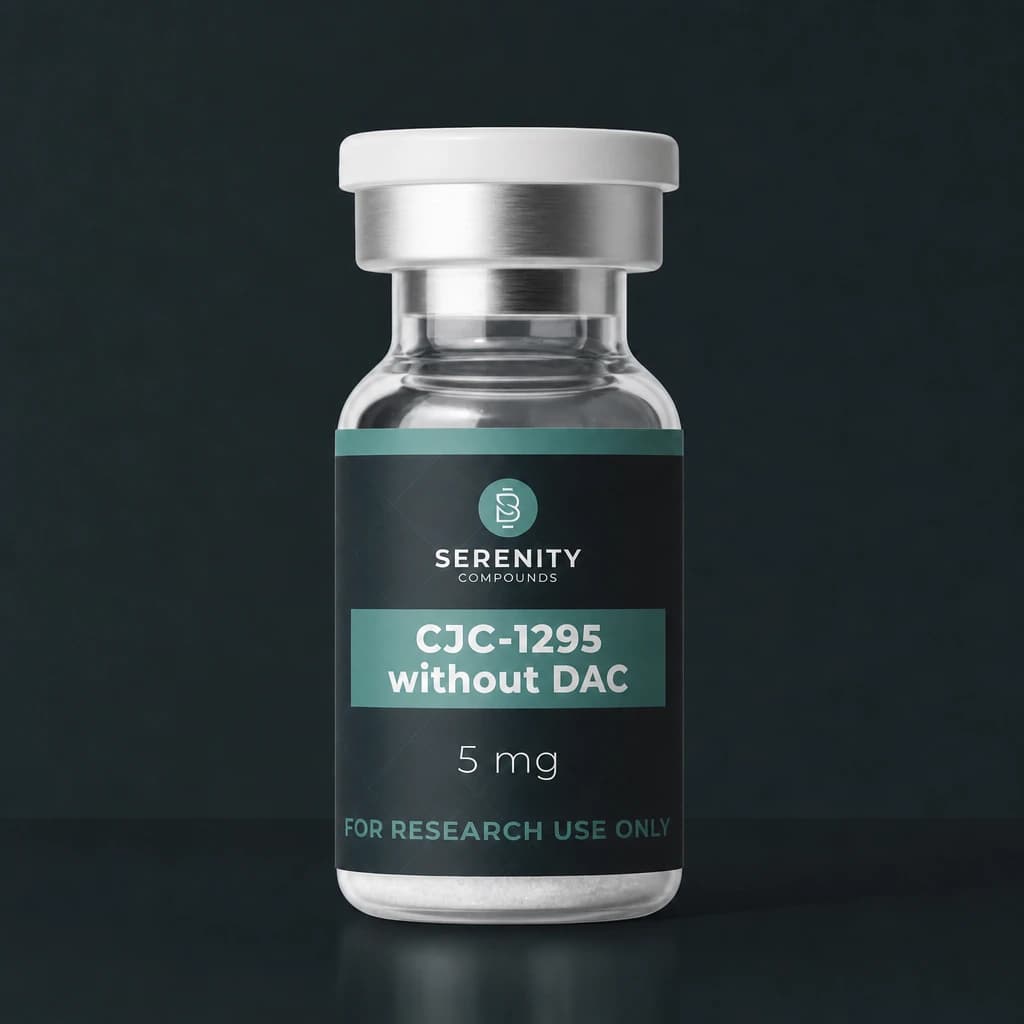
CJC 1295 dosage research cannot be interpreted without knowing whether the material includes a drug affinity complex, usually shortened to DAC. That modification affects persistence in circulation. Published findings for the modified analog do not establish a schedule for a product described as no DAC. They also do not turn a laboratory reference into a medicine.
Which form did the published study test?
The human pharmacology study investigated a long acting growth hormone releasing hormone analog and measured growth hormone and IGF-I responses. Its identity and study conditions belong alongside any summary of the results. Removing those details can make an observation about one analog appear to describe every similarly named catalog item.
Serenity lists CJC-1295 with DAC separately from the version without DAC. Those are distinct procurement choices. A researcher needs the structure or specification associated with the chosen material, not just a shortened name copied from a chart.
What does a hormone increase actually establish?
Growth hormone is a measured endocrine output. IGF-I is another biological marker influenced by that axis. Neither measurement alone establishes an increase in muscle strength or functional performance. A study can demonstrate a hormonal response while leaving those other questions unanswered.
Muscle growth claims require an appropriate body composition or tissue endpoint and a comparison that can address alternative explanations. Changes in hydration can influence some estimates of lean mass. Training and food intake can also differ between groups. The bodybuilding evidence guide explains why these distinctions matter when interpreting promotional claims.
Why does the sampling window matter?
Imagine two hypothetical experiments. One measures a response shortly after exposure while another reports the average over a longer interval. Even if both use the same assay units, their numbers answer different questions. A peak value and an integrated response should not be treated as interchangeable results.
Timing also affects whether a study captures a transient change or a persistent one. Repeated samples can describe a pattern that a single measurement misses. That doesn't justify copying a clinical sampling schedule into an unrelated cellular experiment, but it does explain why a result needs its time context.
How should a laboratory concentration table be read?
Concentration is an amount per volume, whereas an administered amount in a publication may be normalized to body mass. These are different quantities. A chart that puts them in one unlabeled column has lost information required to interpret the experiment. Unit conversion can correct arithmetic, but it cannot supply a missing biological model.
For a purely hypothetical assay worksheet, a stock recorded in micrograms per milliliter needs a separate entry for the final concentration after it enters the assay mixture. Recording only the stock value can overstate exposure. Our calculator explanation follows that distinction through a worked dilution example.
Does combining receptor pathways validate a blend schedule?
No. A CJC 1295 ipamorelin blend introduces a second constituent acting through a different receptor pathway. Its total mass doesn't specify either constituent's molar concentration. Evidence for the ingredients individually cannot establish a combined schedule or prove synergy.
Comparison work needs to state the amount of each constituent and explain the controls. A larger response to a mixture could reflect the sum of two responses rather than a special interaction. The blend research guide addresses that experimental question separately.
CJC 1295 DAC versus material described as no DAC
Structure determines which publication is relevant. A duration result for a modified analog belongs to that analog, including the feature responsible for altered persistence. Sharing part of a name does not establish comparable pharmacokinetics. Before extracting numbers from a paper, record the tested structure and formulation alongside the population and measured endpoint. Otherwise, a precise number can be attached to the wrong material.
Commercial naming can make this comparison difficult. An abbreviation may conceal differences that are apparent only in the sequence or specification. If the provided documents do not resolve the identity, the literature mapping remains incomplete. Asking the supplier for clarification is more useful than choosing whichever published duration best fits a desired narrative. Uncertainty about the compound must remain visible in the research record.
CJC 1295 for muscle growth: what would a study need to measure?
Body composition and physical function address different questions. An estimate of lean mass does not directly measure muscle force, and a strength test can change through practice or training. A useful study specifies its primary endpoint and the method used to measure it. Secondary outcomes can add context, but they should not replace a primary result merely because they produce a more favorable story.
Baseline comparability also matters. If one group starts with a different training history or nutritional intake, later differences may have more than one explanation. Randomization and a suitable comparison help address that problem in a clinical design. A laboratory assay cannot resolve those population level questions, even if it supplies a plausible mechanistic observation. Evidence at one level should not be presented as a completed argument at another.
Absolute changes should be read alongside relative changes. An increase expressed as a percentage can sound large when the starting value is small. The units, baseline and uncertainty help a reader understand the scale. A summary that reports only the most impressive percentage loses information needed to judge whether the observed difference supports the proposed functional claim.
Reading a CJC 1295 dosage chart without losing the study context
Tables should identify whether their entries describe administered amount, measured concentration or a calculated stock. Those quantities cannot share an unlabeled unit heading. Population and exposure route are also part of a published pharmacology result. Removing them to create a general chart changes the meaning of the evidence. Arithmetic can be checked independently, but scientific transfer requires its own justification.
Normalization introduces another possible source of confusion. A value per kilogram describes an amount relative to body mass. A value per milliliter describes a concentration. Neither becomes a universal equivalent of the other. For literature review, retain the original expression and explain what was measured rather than constructing a human schedule from a research reference's vial size.
Storage, reconstitution and the identity of the tested preparation
Handling conditions should follow evidence for the actual material and experimental matrix. The presence of a structural modification does not by itself establish how long a prepared solution remains suitable for a particular assay. A stability assessment needs an endpoint and acceptance criteria. Chemical integrity and functional activity may require different measurements, depending on the question being asked.
Batch documentation should therefore connect sequence or specification, declared amount and the analytical report. A high purity figure cannot settle whether the correct analog was supplied unless the accompanying identity evidence addresses that question. If the experiment compares forms, both need their own traceable records. Otherwise, an apparent difference in duration or response might reflect an unresolved material difference rather than the planned comparison.
What is CJC 1295?
Precisely identifying the analog is the first part of the answer. The published human study cited above investigated a defined long acting growth hormone releasing hormone analog. Catalog language may also include a no DAC designation. Treating those labels as synonyms would make the literature review unreliable. Confirm which structure the paper and the supplied reference each describe before comparing their properties.
What does CJC 1295 do?
Endocrine research examines how the defined analog affects the growth hormone axis under the studied conditions. That statement is narrower than a claim about muscle development or athletic performance. To assess a stronger claim, look for a study that directly measured the proposed outcome in an appropriate population. A mechanistic explanation can motivate that study but cannot supply its missing results.
What can the evidence support?
Published endocrine findings are useful for understanding the analog that was tested. They do not establish a human muscle building regimen for a research vial. Preserve the exact material identity and the measured endpoint when summarizing the paper, then assess whether the proposed laboratory method asks the same question.