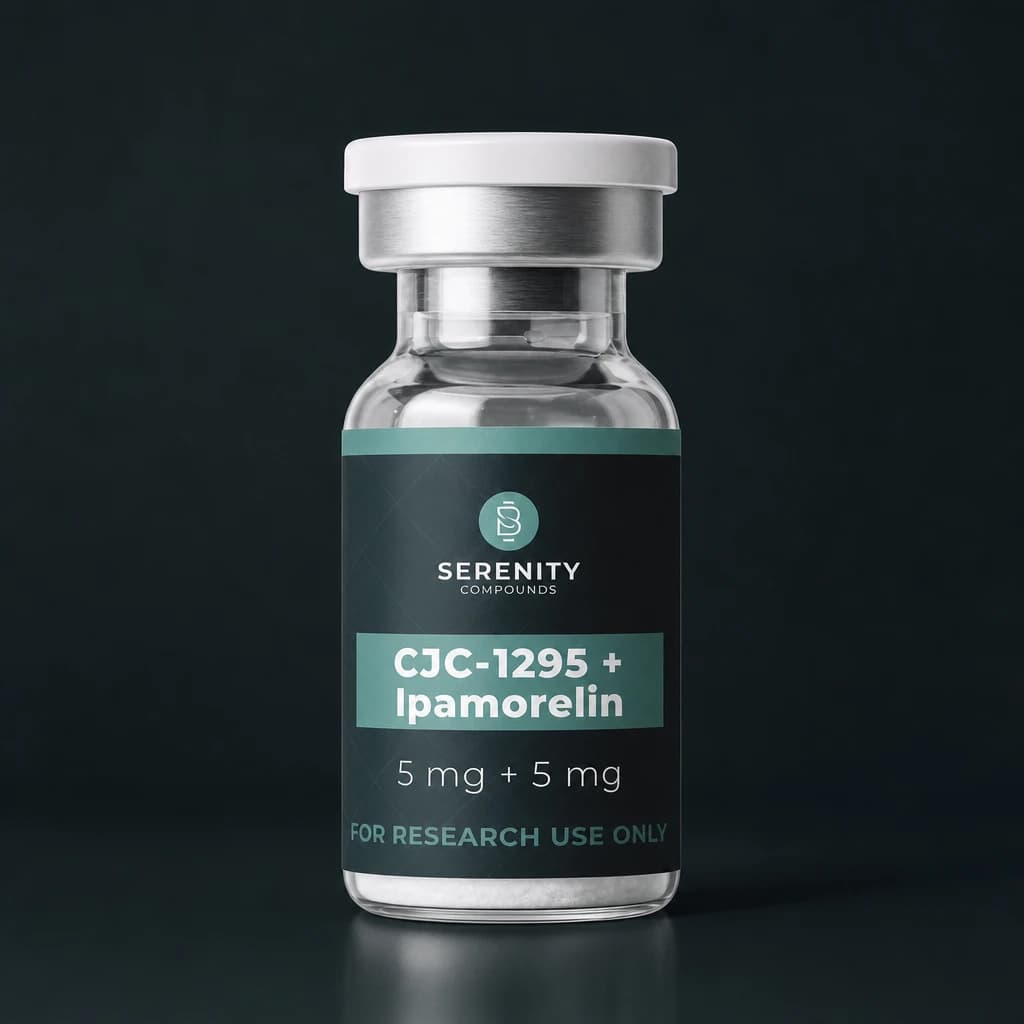
CJC 1295 and ipamorelin dosing searches often lead to charts that report only a blend's total amount. That number cannot describe the exposure to either constituent unless the composition is known. Laboratory interpretation needs the identity and amount of each component, followed by an explanation of what the experiment measured. This article does not provide a human administration schedule.
Why are the receptor mechanisms different?
Ipamorelin was investigated as a growth hormone secretagogue in original pharmacology research. Its receptor pathway is different from that of a growth hormone releasing hormone analog. Both can influence an endocrine output without being interchangeable molecules.
Published CJC-1295 research concerns a defined long acting analog. A mixture described using the same abbreviation still requires confirmation of whether DAC is present. The duration observed in that publication cannot simply be assigned to another form or to a combined product.
What does a blend label need to tell a researcher?
Serenity's combined reference listing should be read with the available composition and lot documents. The specification needs to connect the stated total to the two constituent amounts. A ratio by mass is not automatically a ratio by molecule count because the compounds have different molecular masses.
Suppose a hypothetical reference contains four mass units of constituent A and one of B. A solution containing one total mass unit per milliliter would nominally contain 0.8 units of A and 0.2 units of B per milliliter. Those values describe the declared composition only. They do not establish analytical recovery or biological potency.
Molar comparison adds another calculation. Each constituent's mass concentration must be divided by its own applicable molecular mass. Using a single molecular mass for the mixture can produce a number that describes neither ingredient. Salt and water content may also matter if the specification reports a form other than the bare peptide.
How could an experiment test an interaction?
Separate constituent conditions help distinguish the mixture's response from the effects of its parts. A vehicle condition addresses the solution background. The concentration of each component in a single constituent condition should match the corresponding exposure in the mixture when that is the comparison being tested.
Synergy requires more than observing that the blend produced the largest value. The analysis needs a defined expectation for an additive response and enough measurements to evaluate departures from it. Without that framework, a larger combined result may simply reflect the presence of two active components.
Why can one fixed ratio be misleading?
Testing only one ratio leaves most of the possible concentration space unexplored. An apparent interaction at that point may disappear elsewhere. A fixed commercial composition can be useful for studying that exact material, but it cannot establish the best ratio for every model or provide a general clinical recommendation.
Are endocrine markers the same as functional outcomes?
Hormone changes provide information about the measured endocrine system. They don't by themselves show greater strength, improved recovery or a particular body composition result. Our muscle claim analysis explains the gap between a biomarker and a functional outcome.
Safety interpretation also remains specific to the tested material and population. Selectivity in an experimental assay doesn't mean that an uncharacterized combination is free of adverse effects. The hexapeptide comparison explains why several endocrine endpoints may be relevant. Unknowns should remain visible in the research summary rather than being replaced with assurances.
CJC 1295 ipamorelin benefits require a defined endpoint
Benefit claims often collapse several biological levels into one sentence. Receptor activation, hormone release and a functional outcome are separate observations. An experiment that addresses the first does not automatically establish the other two. Before comparing a mixture with its constituents, specify which level the assay measures and what size of difference would be relevant to the research question.
Response curves can reveal information that a single concentration misses. A condition may appear inactive at one point yet produce a response elsewhere in the tested range. Conversely, a large response at one selected point may not persist across the range. A fair comparison should explain why the concentrations were chosen and whether the measurement can distinguish the expected responses without reaching its own detection or saturation limits.
CJC 1295 ipamorelin side effects and selectivity claims
Selectivity refers to what was compared under particular experimental conditions. An assay investigating selected hormone responses does not establish the absence of every possible adverse effect. The original ipamorelin work is relevant to its pharmacology, but a combined product adds identity and interaction questions. Those questions remain even when each constituent has a plausible mechanism or an individually documented analytical profile.
Adverse event interpretation requires a denominator and an observation period. A statement that several events occurred is hard to assess without knowing the number of exposed participants and how monitoring was conducted. A small study may be unable to detect an uncommon problem. Research summaries should preserve those limits and avoid converting an unobserved event into a general claim of safety.
Comparing the blend with a single pathway reference
Matching the comparator matters more than matching total vial mass. If the mixture contains a particular amount of constituent A, an A only condition should use the relevant comparable exposure for the hypothesis. Comparing equal total masses can accidentally compare unequal quantities of A. The resulting difference would then combine the presence of B with a change in A rather than isolating the intended variable.
Background effects also need attention. Two preparations may introduce different solvent amounts or other matrix differences even when their peptide concentrations are aligned. The vehicle controls should reflect those differences. A control that matches only one preparation cannot resolve every comparison in the experiment. Writing the complete composition of each condition helps expose that problem before interpreting the assay output.
Reconstitution records for CJC 1295 ipamorelin dosage research
Worksheets should preserve each component's declared mass, applicable molecular mass and final assay volume. Those inputs answer different parts of the accounting problem. A total concentration can remain useful as a product description, but it should not replace component concentrations in the method. If the ratio is unknown, a calculator cannot infer it from the blend's name or the total amount printed on the vial.
Stability evidence should apply to the mixture in its actual prepared form. Separate dry material specifications do not establish the lifetime of a combined solution. A method following only one constituent could miss a change in the other. Where the research question depends on a fixed ratio, an appropriate analytical check needs to address whether that ratio remains supported over the relevant handling interval.
Does CJC 1295 ipamorelin work?
Define the intended outcome before answering. A mixture could produce a measurable endocrine response in a model without demonstrating a human performance benefit. It could also differ from a constituent alone without meeting a formal definition of synergy. The evidence needs to match the exact composition and endpoint. Findings from separate ingredient papers are not a substitute for a study of the proposed combination.
Is CJC 1295 ipamorelin safe?
Neither a clean chromatogram nor a mechanistic rationale can establish human safety for a research blend. Analytical testing addresses specified material properties. Clinical safety requires evidence about a defined preparation in a monitored population. Those are different tasks. Unknown interaction effects or incomplete characterization should remain identified as uncertainties rather than being dismissed because both ingredient names appear in the literature.
What is CJC 1295 ipamorelin?
Here the phrase describes a combined research reference containing two intended constituents, not a single molecular identity. The CJC form and the amount of each component still need confirmation. A useful product specification resolves those details and connects them to a lot. Without that information, neither a literature comparison nor a component concentration calculation can be completed reliably.
What should a useful study record preserve?
Record the declared constituents separately from the measured analytical results. Connect the source lot to the preparation and retain the final concentration of each component in the assay. The concentration calculator guide can help check units, but the protocol must supply scientifically justified conditions. Neither a product ratio nor correct arithmetic establishes a human dose.