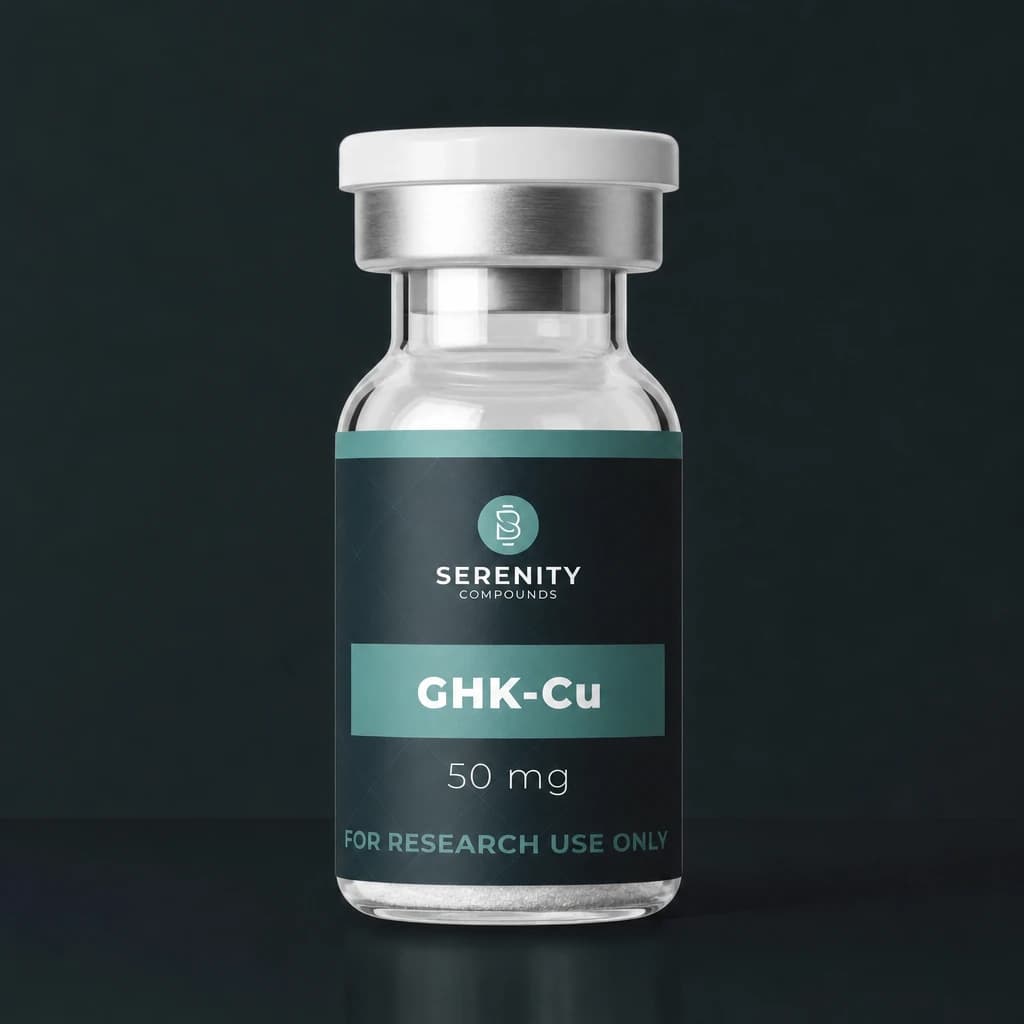
GHK Cu dosage claims need to be evaluated against the route and formulation actually studied. A concentration reported in cultured cells cannot establish a human injection amount. A topical observation cannot fill that gap either. Research interpretation starts by preserving those differences rather than combining unrelated numbers into a single chart.
What evidence sits behind commonly repeated amounts?
Published fibroblast collagen experiments measured a cellular response under controlled conditions. Other matrix research examined glycosaminoglycan synthesis. Their exposure conditions describe those experiments, not a clinical administration protocol.
Animal work adds another level of evidence without eliminating the translation problem. A rat wound chamber study investigated tissue related endpoints in a defined model. Species and experimental setting remain essential parts of the finding. They cannot be removed while retaining the same strength of conclusion.
Why does route change the question?
Topical delivery involves a formulation and a barrier between the applied material and the tissue of interest. A cell culture exposure places material in a very different environment. Injection introduces another set of distribution and safety questions. Similar units on a page do not make these situations equivalent.
Copper coordination can also change with the solution environment. The copper peptide formulation guide explains why the surrounding medium matters. A reported mass of complex is not necessarily a direct measure of biologically available copper at a target site.
What if a chart contains only milligrams?
Mass alone omits the concentration and the experimental context. It also leaves open whether the number refers to peptide, complex or total formulation. A useful source should define the material and connect the amount to a model and measured endpoint.
Imagine a hypothetical table with the entry 2 mg and no other information. It could describe material purchased, material used in a stock preparation or an amount distributed across many assay conditions. Interpreting it as an administered amount would invent information that the table never supplied.
What can laboratory arithmetic establish?
Concentration calculations can connect a known amount to a defined final volume. They cannot choose a scientifically justified exposure or prove stability. The calculator guide explains stock and final assay concentrations using hypothetical examples rather than personal administration instructions.
Measured content may differ from a label's nominal amount. A purity percentage based on detected chromatographic peaks is not a universal correction factor for that difference. The method used to quantify the actual material should be clear before a worksheet treats the number as measured content.
Does a clear solution demonstrate suitability for injection?
No. Visual clarity cannot establish sterility or an acceptable endotoxin result. Chemical identity is a separate question again. Research materials do not become clinical products because a preparation looks clear or because an online chart gives a convenient volume.
FDA's peptide safety information identifies concerns around injectable GHK-Cu, including limited human data and potential immunogenicity risks. That is a reason to preserve uncertainty, not to describe an unverified chart as a safe starting point.
GHK-Cu dosage: checking what a number represents
Units identify the quantity being described. Milligrams report mass, milligrams per milliliter report mass concentration and micromolar values report amount of substance per volume. Moving between the latter two requires an applicable molecular mass. That input must correspond to the documented material form. Using the free peptide's molecular mass for a differently specified complex can make an apparently careful calculation inconsistent with the starting material.
Percentage values need a defined basis as well. A formulation percentage by mass is not the same expression as mass per volume. The surrounding product may contain other components that contribute to total mass. A source that omits its basis leaves a real information gap. Rather than choosing a convenient interpretation, preserve the ambiguity and seek the original formulation or method description.
GHK Cu copper peptide exposure across different models
Direct exposure of fibroblasts investigates how those cells respond in their culture environment. A tissue model adds barriers and interactions that are absent from an isolated culture. A topical formulation introduces its own delivery questions. These differences help explain why a concentration that produces a measurable cellular response is not a transferable specification for every experimental or clinical setting.
Local exposure and total amount also differ. A nominal quantity placed into an experimental system does not establish its concentration at every relevant site over time. Distribution and chemical changes can affect what is available where the endpoint is measured. A useful pharmacology study investigates those relationships. A retail vial label supplies none of that information merely by stating a mass.
Comparing topical evidence with injection claims
Finished product studies should identify the preparation tested and the endpoint assessed. A change in a topical outcome cannot establish the safety of a different route. Conversely, a cellular mechanism does not prove that a topical formulation delivers enough intact material to reproduce the culture conditions. Each transition requires evidence connecting the original experiment with the proposed claim.
Sterility and endotoxin testing address specific quality questions, but even satisfactory results would not establish clinical efficacy or choose an administered amount. Identity and impurity characterization are separate again. This is why a collection of laboratory reports should not be described as a complete human safety assessment. The missing pharmacological and clinical questions remain missing after the analytical questions are answered.
Reconstitution calculations without administration instructions
Suppose a hypothetical analytical reference contains 1 mg of the specified material in a verified final volume of 4 mL. Its nominal mass concentration is 0.25 mg/mL. If a later assay uses one part of that stock in ten final parts, the nominal assay concentration is 0.025 mg/mL. These values describe a fictional laboratory dilution, not a preparation or injection recommendation for the catalog item.
Recovery remains outside that arithmetic. If some material is lost or chemically changed, the calculation still reports the nominal value based on its inputs. A suitable analytical measurement can address the actual prepared sample. Writing nominal and measured values in separate fields avoids implying that a calculator has verified the chemical contents of a solution.
Storage information that a research worksheet should preserve
Preparation date, matrix and container identify the solution whose history is being recorded. A statement about dry material cannot automatically define that solution's usable interval. When a method depends on retained complex identity, its stability evidence needs to address that property. Following only total copper could leave changes in the associated peptide unresolved.
How much GHK-Cu should I inject daily?
Nothing in the cited cell or animal experiments establishes a daily human injection amount for a research reference. The question requires clinical evidence on a defined preparation and appropriate medical oversight, not a conversion from vial mass. This article therefore explains why commonly copied figures are insufficient rather than selecting one as a starting schedule. Research materials are not intended for personal administration.
What is GHK Cu?
It refers here to a copper associated tripeptide reference. The exact characterized form still matters when comparing concentrations or interpreting an analytical report. A supplier's abbreviated name does not specify every aspect of metal content, counterions or solution behavior. Those details should be resolved from the material documentation when they are relevant to the assay rather than inferred from an online dosage chart.
What should a researcher verify before selecting material?
Match the available reference to the analytical requirements of the proposed method. Clarify the reported complex and the relationship between copper and peptide. Keep formulation evidence separate from general compound literature, then state the experimental endpoint precisely. This article supports evidence interpretation and laboratory procurement only, not human injection planning.