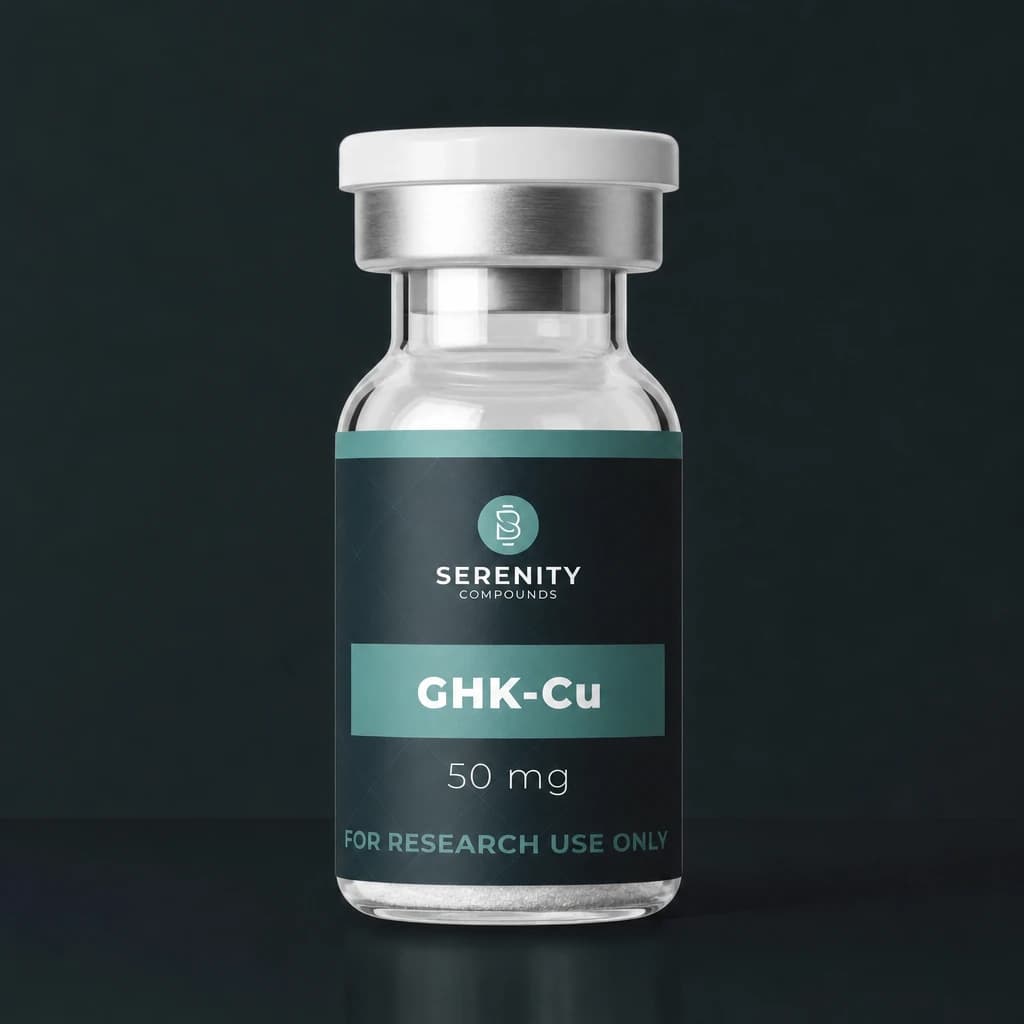
GHK-Cu is the copper complex of the tripeptide glycyl-L-histidyl-L-lysine. Research examines its chemistry and responses in experimental models, including measurements related to extracellular matrix components. Identifying the complex is different from demonstrating a biological effect. Neither task on its own establishes that a research reference is suitable for human use.
What is the difference between GHK and its copper complex?
The peptide sequence describes the ligand. The copper association adds information about a metal complex, which needs its own characterization. A name on a vial should not leave the researcher guessing whether the report concerns the free peptide, the complex or a formulation containing other components.
Serenity's GHK Cu peptide listing provides the available research material and quantities. The chosen lot should remain connected to its documentation. A catalog description cannot settle a question about copper content or the species present in a prepared assay solution.
Which analytical measurements answer which questions?
Chromatography can help assess the pattern of species detected under a particular method. Mass related measurements provide another kind of identity evidence. Metal analysis addresses copper content. These techniques are complementary, and a report should make clear which ones were performed.
Purity percentages require their method definition. A value calculated from peak area does not necessarily express the fraction of total vial mass that is the intended complex. Counterions and water may affect the material's mass without appearing in the same way in the reported chromatogram. The COA guide follows these distinctions through a hypothetical report.
Can color identify the material?
Appearance may be worth recording, but color is not a definitive identity test. Concentration and the surrounding solution can alter what is visible. A sample that resembles a reference photograph still requires appropriate analytical evidence. The same limitation applies to using apparent clarity as proof of purity.
What do matrix related studies show?
Early collagen synthesis research investigated cultured fibroblasts. Separate rat wound chamber work examined tissue composition in an animal model. These studies belong to different experimental levels and should not be merged into a single claim of clinical repair.
Matrix measurements describe particular biological outputs. More of one component does not automatically mean better tissue organization or function. A useful interpretation distinguishes production of a measured substance from the broader structural outcome that a reader might assume.
Why does solution composition matter in experiments?
Other ligands in a medium may interact with copper. The nominal amount added to a well therefore does not describe every relevant feature of the exposure. Matching the vehicle and considering copper related controls helps make the comparison more interpretable.
Optical assays deserve an additional check when the preparation has color or affects redox chemistry. A signal may include a direct interaction with the measurement reagent. Our copper peptide methods article explains controls that can help distinguish that artifact from a cellular response.
GHK Cu copper peptide identity in a prepared sample
Coordination describes the association between the ligand and metal under particular conditions. The form characterized in a starting material does not by itself identify every species present after dilution into a complex medium. Other ligands can participate in that environment. A research method should state whether it is investigating the starting reference, the prepared solution or the biological response after exposure.
Total copper analysis can be useful for amount accounting while leaving coordination unresolved. A technique that measures the metal after destroying the original sample structure does not preserve information about which ligand held it beforehand. Conversely, a peptide identity measurement does not automatically quantify copper. The interpretation should follow the capability of each method rather than treating several different reports as one universal identity result.
GHK Cu benefits: synthesis, accumulation and tissue function
Production of a matrix component is only one part of tissue biology. The amount present at a later time also depends on breakdown and organization. An assay measuring synthesis should therefore be summarized as a synthesis result. Describing it as structural repair adds an outcome that may not have been tested. The distinction becomes especially important when a cellular observation appears beside a consumer product claim.
Functional measurements need their own design. A tissue might contain more of a measured component without demonstrating a corresponding change in mechanical performance. The published model determines which questions can be addressed. Cell cultures, implanted experimental chambers and finished topical products are different systems. Placing their results in a sequence does not make them a single continuous proof of human benefit.
Controls for separating a copper effect from a ligand effect
Matched controls can compare the complex with its component related conditions, but the comparison must specify the basis of matching. Equal total mass does not necessarily mean equal copper amount or equal peptide amount. The design should explain which quantity is held constant. Otherwise, the observed difference can reflect both a changed composition and a changed amount of the component under investigation.
Blanks should address direct interference with the readout where that is plausible. For an optical assay, the preparation itself may contribute a signal in the absence of the biological system. A second measurement using a different principle can help investigate whether an apparent response survives that concern. Agreement across methods strengthens interpretation only when their shared limitations are also considered.
Reconstitution and storage evidence for the copper complex
Stock solutions and final assay mixtures can have different chemical environments. Dilution may change the relative abundance of other ligands or alter the conditions governing the prepared complex. The method record should therefore preserve more than the volume added. It needs enough matrix information to let another researcher understand what material environment produced the reported result.
Stability should be stated against a defined measurement. A retained chromatographic pattern, retained copper content and retained functional response are not identical acceptance criteria. Choose evidence that matches the experiment's needs and retain the conditions under which it was collected. A generic storage statement without a preparation or endpoint cannot establish the suitability of every later solution.
Buyer verification beyond the purity headline
Review the lot connection before comparing analytical values. A report for another batch may describe a supplier's testing approach but does not directly characterize the vial received. Check which identity methods and quantity measurements were actually reported. Missing information should remain a question for the supplier, especially when the assay requires a known relationship between peptide amount and copper amount.
What does GHK-Cu do?
Research examines the complex's chemical behavior and biological responses in defined models. The matrix studies discussed above provide examples of measured cellular or tissue related endpoints. They do not establish that every material sold under the name performs identically. A useful answer names the preparation and outcome instead of reducing the literature to a broad promise about skin repair or general regeneration.
How to use GHK-Cu peptide?
Laboratory use is determined by the validated method and the material specification it requires. The necessary reference may be the free peptide, a copper complex or a formulated preparation. Those choices are not interchangeable. Confirm identity and documentation before selecting assay conditions, and do not convert a cell culture concentration into a personal application or injection instruction.
How should benefits and dosage language be handled?
Benefit claims need a named endpoint and the study that measured it. GHK Cu dosage discussions often cross from topical or cellular evidence into injection claims without supporting data. Those transitions require evidence of their own and cannot be justified by a shared ingredient name.
For a research summary, keep the complex identity and the experimental system attached to every finding. Procurement should follow the method's characterization needs rather than a cosmetic promise. That approach preserves what the published observations actually contribute without suggesting that a laboratory reference is a treatment.