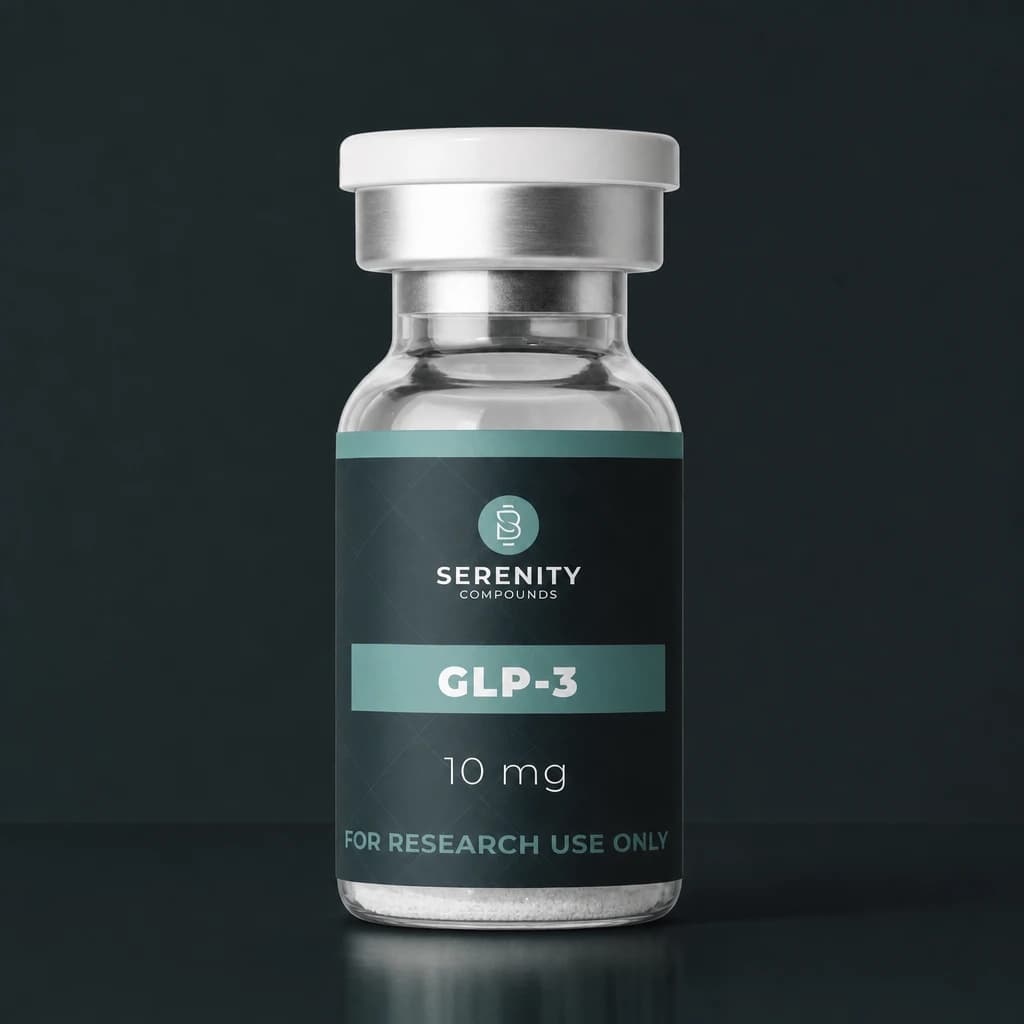
GLP 3 is used in Serenity's catalog as a name for retatrutide. It is not the name of a third established incretin receptor. The molecule is studied as an agonist at GIP, GLP-1 and glucagon receptors. Keeping the catalog label separate from receptor terminology prevents a common identity error when reading research or comparing products.
What does the catalog name refer to?
Serenity's GLP-3 listing preserves the retatrutide mapping. The full compound name should remain visible in the supporting research record and analytical documentation. A shortened label alone is not enough to establish sequence identity or confirm what a supplier tested.
Nicknames such as reta can help locate an article, but they should not replace the documented material name. Our alias glossary explains how to resolve an abbreviated search without treating every spelling variation as a different compound.
How is triple receptor activity different from GLP-1 activity?
Three receptor targets means that pharmacology can be studied across three distinct signaling systems. It does not mean that every response is three times stronger. Relative activity depends on the assay and endpoint, while a clinical result depends on much more than receptor count.
GLP-1 receptor agonism is one part of that profile. GIP and glucagon receptor activity add different biological questions. A comparison with a single receptor agonist needs matched conditions if it is intended to compare potency or signaling behavior. The main retatrutide guide covers the entity and trial evidence in more depth.
Is GLP 3 vs GLP 1 a drug comparison?
Sometimes the search is trying to compare a catalog nickname with an entire therapeutic class. That is not a like for like comparison. A useful answer first identifies the exact molecule meant by each term, then asks which receptor or clinical endpoint is being compared.
Semaglutide is one specific molecule associated with GLP-1 receptor agonism. It is not a synonym for the receptor or the whole class. The same discipline applies when a shop uses GLP-2 as a label for another product. A catalog numbering scheme does not redefine biological nomenclature.
What does the published trial establish?
The phase 2 obesity trial investigated a defined study product in a controlled clinical setting. Its results describe the enrolled population and trial conditions. They do not characterize a retail research vial or establish that an unapproved product is equivalent to the trial material.
Body weight change is also distinct from receptor potency or a laboratory concentration response. A clinical outcome cannot be reconstructed by comparing catalog purity percentages. The evidence levels answer different questions and should remain separate in a product or literature comparison.
Does a catalog listing establish regulatory approval?
No. Availability as a research reference is not evidence of authorization as a medicine. FDA's unapproved GLP-1 product information explains why research labeling and commercial availability do not establish safety or approval for human use.
Status claims also need a date and a primary regulatory source. A trial result or manufacturer announcement cannot substitute for an approval record. The distinction matters even when an online discussion uses confident language about when a product will become available.
GLP 1 vs GLP 3: molecule, receptor and catalog label
Receptor names describe biological targets. A drug or research compound can act at one or several targets without acquiring a new receptor number. The three in a triple agonist description counts the relevant activities, not a newly discovered member of a numbered series. This distinction matters when searching scientific databases, where an informal product name may retrieve different material from an established compound name.
Comparison tables should therefore begin with separate fields for the catalog label, documented molecule and receptor profile. Those fields prevent a shorthand name from becoming a biological claim. They also make discrepancies easier to notice. If a listing and its report use different names, the supplier should explain their relationship rather than leaving a researcher to infer identity from similar marketing descriptions.
What does receptor potency measure?
Potency describes the concentration associated with a specified response in an assay. Maximum response describes another property. A compound can reach a larger maximum while requiring a different concentration to reach a selected fraction of it. Reporting only one of those values can obscure an important difference. The receptor system and readout must remain attached to either number.
Expression levels can influence an experimental response. A receptor assay using engineered cells may not reproduce the receptor distribution of an intact organism. Its value is in a controlled comparison, not in directly forecasting an individual clinical outcome. For a triple agonist, each receptor assay also needs a suitable reference and analysis. Three positive readouts do not by themselves quantify the integrated effect in a person.
What the retatrutide study actually measured
Primary and secondary endpoints serve different roles. The cited phase 2 obesity trial designated percentage body weight change at 24 weeks as its primary endpoint. It also evaluated later weight outcomes and safety. That design is evidence about a clinical study product and its enrolled population. It is not an analytical comparison of commercial research references bearing an abbreviated catalog name.
Weight alone does not identify the composition of every kilogram changed. Questions about visceral fat, liver fat or lean tissue require the relevant measurements. A receptor profile cannot fill in an unmeasured body composition result. When reading a summary, check whether the endpoint was directly assessed or whether the author inferred it from a broader weight change.
GLP-3-RT naming and buyer verification
Suffixes can vary between suppliers and should not be interpreted as standardized chemical modifications without documentation. If a name includes RT, ask what the listing intends it to mean and whether the supporting report uses the established compound identity. Preserve that mapping in the accession record. A familiar suffix is not an identity test and cannot establish equivalence to another source's material.
Batch verification then asks a separate set of questions. Does the report match the received lot, what identity evidence was generated and which quantity claims were measured? A chromatographic percentage cannot resolve an unexplained naming discrepancy. Only after the material is identified can the laboratory assess whether its other reported properties suit the intended assay.
Storage information follows the reference, not its nickname
Prepared solution behavior depends on the actual material and matrix. An informal label cannot define an appropriate diluent, concentration or storage interval. The same applies to a chart copied from another catalog. Research methods need supporting evidence for their own preparation and a record distinguishing nominal concentration from any measured analytical result. Changing the name used in a search does not change those requirements.
What is GLP 3 peptide?
Here it is a catalog search term mapped to retatrutide, a molecule researched for activity at three named receptors. It should not be read as a third natural incretin or a new receptor designation. For literature review, use the established compound name and verify that the paper concerns the same identity. For procurement, retain the supplier's label as an additional identifier rather than the sole description.
Where to buy GLP-3?
Start by resolving the intended molecule, because the abbreviated term alone may be used inconsistently. A research supplier should provide enough specification and lot information to evaluate the material against the laboratory's method. Availability does not establish clinical approval or suitability for personal use. Compare the evidence attached to the actual lot rather than selecting a product solely because its nickname matches the search.
Which name belongs in a laboratory record?
Record the documented compound identity together with the supplier's catalog identifier and lot. That connects the searchable name to the material actually received. Use established receptor names when describing the experiment, and reserve GLP-3 for the catalog mapping rather than inventing a new biological target.