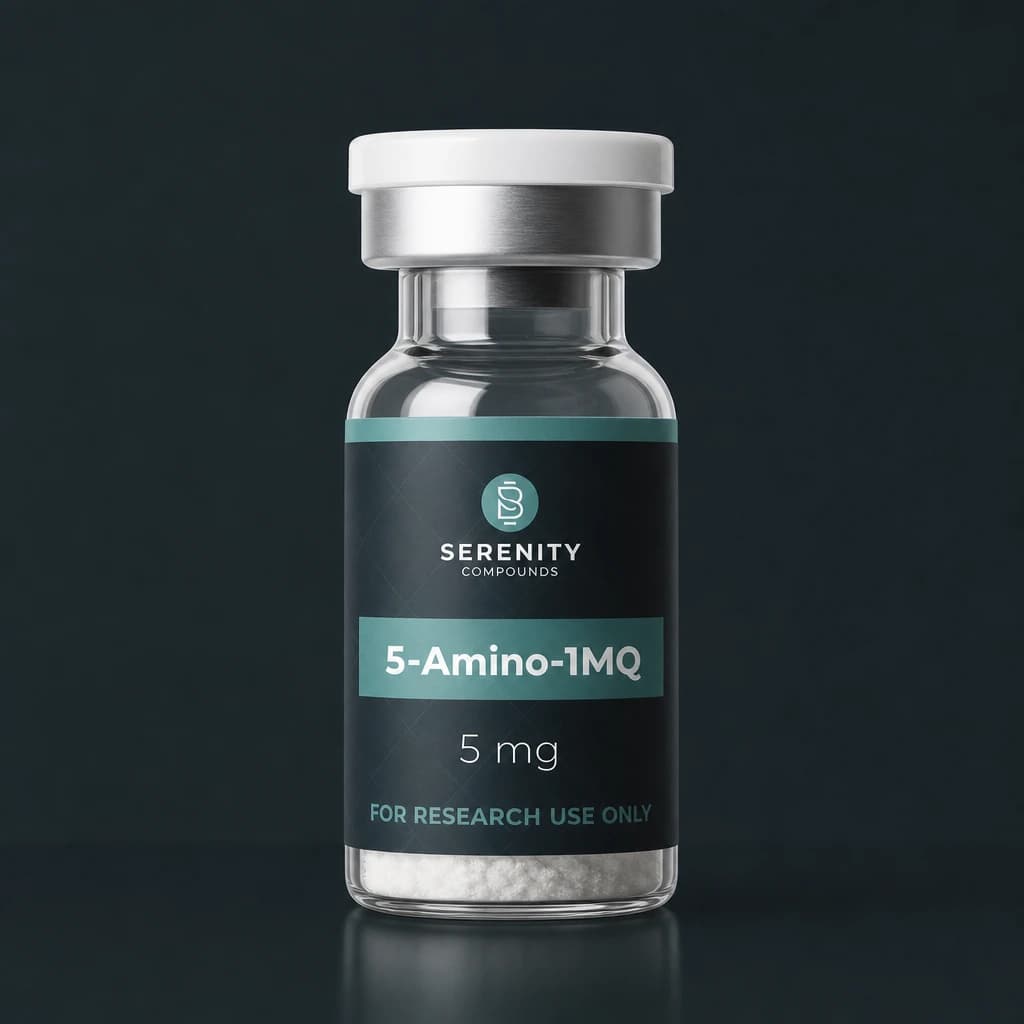
5 Amino 1MQ is a small molecule studied as an inhibitor of nicotinamide N-methyltransferase, or NNMT. It isn't a peptide. That distinction matters because a peptide catalog category tells you where a product is listed, while chemical identity determines which analytical methods and experimental comparisons are appropriate.
What does NNMT do?
NNMT transfers a methyl group from S-adenosylmethionine to nicotinamide. Researchers can investigate that reaction by measuring substrate consumption or product formation. The enzyme sits within a wider metabolic network, so inhibiting it raises further questions about the surrounding pools. It doesn't automatically establish that every downstream pathway changes in a beneficial direction.
Published small molecule inhibitor research includes enzyme characterization and experiments in mice fed a high fat diet. Those are preclinical observations. They don't establish a safe human amount or show that the research material on a supplier's page reproduces the experimental preparation.
Why is it sometimes called a peptide?
Catalog organization explains much of the confusion. Suppliers may group small molecules and biochemical cofactors beside peptides because researchers browse them together. The phrase 5 amino 1mq peptide reflects that usage, but the underlying structure is not an amino acid chain. A laboratory record should identify the actual compound and supplied form.
Serenity's 5-Amino-1MQ listing keeps the molecule separate from a clinical benefit claim. Its place in the store does not establish a solvent choice, a validated assay range or pharmaceutical equivalence. Those questions need the lot documents and the method relevant to the experiment.
What would a useful enzyme experiment measure?
Consider a hypothetical result in which the detector signal falls after adding a reference compound. Three explanations remain possible: the enzyme produces less product, the detector responds differently to the matrix or the preparation disrupts the system. Calling the result inhibition before distinguishing those possibilities would be premature.
Vehicle measurements address the contribution of the preparation medium. An independent detection method can test whether the original readout is misleading. In a cell experiment, a viability measurement adds another check because fewer viable cells can also produce a smaller signal. These controls serve different purposes and shouldn't be treated as interchangeable.
Does a metabolite increase prove faster pathway activity?
Pool size is a balance between production and removal. A larger pool may reflect faster production, slower consumption or a shift in the sampled cell population. Measuring abundance at one time point does not establish flux through a pathway. The same distinction matters in our NAD+ research notes, where cofactor levels are often confused with whole body energy claims.
5 amino 1mq dosage and study exposure context
Amounts reported in a mouse experiment belong to that species and protocol. A cell concentration belongs to a defined matrix and exposure interval. Neither can be converted into a human schedule by copying a number from a chart. The phrase 5 amino 1mq dosage therefore needs a clear distinction between literature reporting and personal instructions, which this guide does not provide.
Benefit claims need an endpoint attached to them. An enzyme response, a metabolite change and a body composition outcome are different observations. A paper may investigate one without establishing the others. Reading the methods and comparator is more useful than treating the word benefits as a single measurable result.
What did the animal studies measure?
Adiposity was examined through more than a scale reading in the early inhibitor study. The investigators considered white adipose tissue mass, fat cell size and circulating cholesterol alongside body weight. Food intake was also recorded. Keeping these measurements separate matters because a change in total weight could otherwise be attributed to a tissue compartment that was never measured. None of those observations was a direct test of athletic performance or a result obtained in a human population.
Later mouse research on metabolic dysfunction examined body composition, glucose handling and tissue distribution. Exposure measurements help connect an administered compound with the tissues in which a response is being investigated. They do not make every measured change a consequence of the proposed target. The comparison remains between specified experimental groups, with the animal model and duration attached to the result rather than omitted from a benefits summary.
Why separate target inhibition from tissue exposure?
Exposure describes whether the preparation reaches the relevant biological compartment. An isolated enzyme assay may show inhibition under controlled conditions without showing that the same concentration occurs inside a cell. Transport and metabolism create additional questions between those two observations. A study that measures an effect in purified enzyme and a different endpoint in an animal therefore needs evidence connecting those stages, not simply a shared compound name in both methods sections.
Selectivity asks a separate question: how strongly does the material affect other relevant enzymes or assay components? An apparent downstream response could include contributions beyond NNMT. A useful experiment compares the proposed target with plausible alternatives and reports the conditions of that comparison. Describing a compound as selective without naming the tested alternatives makes the claim harder to assess, especially when another laboratory uses a different concentration or detection method.
How do 5 amino 1mq benefits differ from NAD+ claims?
Comparisons with NAD+ often start from the fact that nicotinamide participates in cellular cofactor metabolism. But an inhibitor acting at one reaction is not equivalent to adding a cofactor to a preparation. The intervention, biological compartment and readout differ. A comparison needs a defined endpoint, such as a measured metabolite pool in the same cell system, before it can establish whether either intervention changes that endpoint under comparable conditions.
Timing further affects interpretation. A brief change in metabolite abundance may disappear as a system adapts, while a delayed tissue response may involve mechanisms not visible in the initial enzyme assay. Collecting one favorable time point can conceal that difference. For a laboratory comparing pathways, a sampling plan should specify which stage is being measured and why that interval addresses the research question. Longer observation is not automatically better if the relevant event is transient.
Storage and preparation questions for a small molecule
Preparation records should describe the supplied chemical form rather than borrow a peptide mixing recipe. Solvent identity, pH and final concentration are method variables, not properties that can be inferred from the term research compound. A visibly clear solution establishes appearance only. It does not prove complete recovery of the intended material or show that the compound remains unchanged during the measurement period.
Repeated sampling can introduce changes unrelated to the planned biology. Opening a container, transferring material between vessels and holding a working solution for different intervals can affect comparability. Record those events and investigate them when results shift between runs. If the available documentation doesn't provide stability evidence for the preparation used, an arbitrary storage period copied from another molecule would not resolve the uncertainty.
Questions from the research cluster
Does 5 amino 1mq work?
Measured NNMT inhibition and preclinical metabolic observations support specific research questions. They do not answer whether a person will lose weight or experience another claimed benefit. To interpret the word work, identify the endpoint and population first. Enzyme activity, fat tissue measurements and human clinical outcomes require different evidence, even when an online summary places them under the same heading.
Is 5 amino 1mq safe?
Human safety cannot be established from the cited mouse experiments or a purity certificate. Safety evaluation would need appropriate exposure information and systematic adverse event assessment in a defined population. A material can meet an analytical specification without having an established clinical use. The absence of a reported event in a short experiment is also different from evidence that the event cannot occur.
What should the material record contain?
Identity comes first: full chemical name, supplied form and the lot associated with the report. For a molar calculation, the molecular weight must describe that form. Chromatographic peak area purity may not equal the active compound's fraction of total weighed material. Counterions or water can make those values differ.
Before using a reference, resolve whether its documentation answers the method's actual questions. The COA reading guide explains why identity and purity need separate interpretation. Keep that distinction with the experiment so an interesting biochemical result remains connected to the material that produced it.