Copper coordination changes chemical behavior relative to the unbound sequence. A comparison needs to identify whether the tested material was a defined complex, an in situ mixture or peptide alone. Those preparations should not be grouped solely because their labels contain GHK. The relevant question is what chemical species were present during measurement.
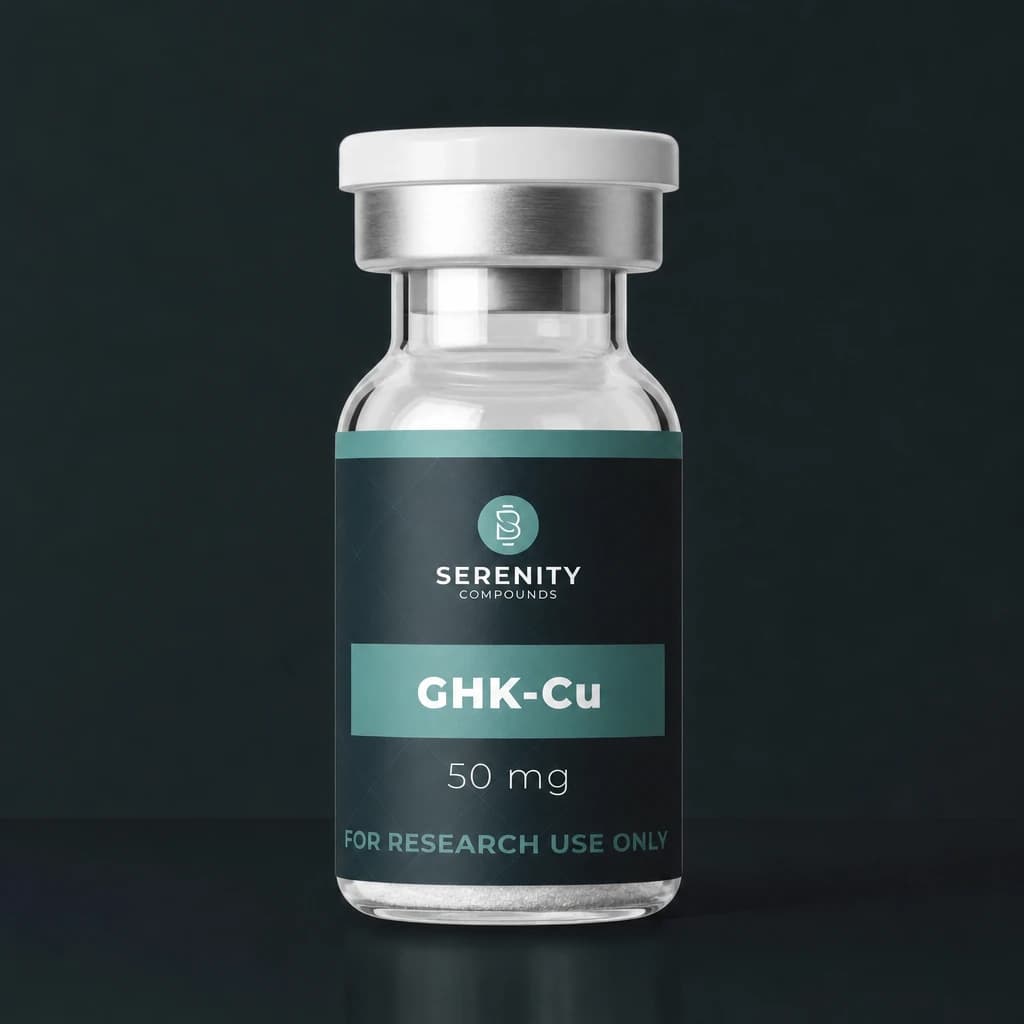
Representative product imagery. Verify the physical label and lot documentation on receipt.
Tissue Research
GHK-Cu
In stock·Ships in 1–2 business days
GHK-Cu copper peptide available in 50 mg and 100 mg sizes. Each unit is labeled with a traceable lot code and links to its corresponding analytical report.
Select size2 options
Select pack sizeSave 18% on kits
1 × 50 mg$31.99
In stockSelected size 50 mgSC-GHK-050
Transparent volume pricing10-vial peptide kits save 18%.
Secure checkout US & EU dispatch
Research use only acknowledgment required at checkout
Published report · Lot 2026303
Reports describe the tested lot. Match the lot on your label before interpreting results.
Compound context
What researchers study
GHK-Cu is a complex of the tripeptide glycyl-histidyl-lysine with copper. The peptide and its metal content both matter when selecting a laboratory reference. This listing supplies material for research on analytical identity and defined biological systems. Available quantities are shown in the selector and should be matched to the lot's chemical documentation.
Published fibroblast studies have examined collagen and glycosaminoglycan measurements after exposure to the complex. Those experiments help define questions about matrix biology, but they don't establish a cosmetic or wound treatment result from this product. GHK CU copper peptide findings should also be distinguished from experiments using unbound peptide or a copper salt.
Free copper and bound copper can behave differently in a sample. Competing ligands and pH can alter coordination, so the prepared matrix is part of the experimental condition. A measurement of peptide content alone may not establish copper stoichiometry. An appropriate characterization plan should account for both components rather than relying only on appearance.
Scope limitReview peptide identity and metal related analytical information together. Research materials are not cosmetic ingredients supplied with a formulation claim or products for injection. Human benefits cannot be inferred from the lot's purity result.
Serenity Compounds is not a compounding pharmacy or chemical compounding facility as defined under Section 503A of the Federal Food, Drug, and Cosmetic Act.
Common laboratory focus
Metal ions can contribute to redox changes or detector behavior independently of the intended complex. A suitable copper comparison can help investigate that contribution. The concentration basis must be clear because matching total material mass does not necessarily match copper content. Any inference about peptide specific behavior depends on those distinctions.
Chromatography and mass spectrometry can characterize peptide related species, while elemental measurements can address metal content. The methods answer different questions and may require different sample preparation. A blue appearance is not a substitute for either measurement. Retain the test conditions when comparing reports because coordination can change with the analytical matrix.
Quality documentation
Know what your laboratory receives.
Batch records are published for transparency and should be independently reviewed by qualified research personnel.
Current certificateGHK-Cu · Lot 2026303Liquilabs s.r.o.View report
- Tamper-evident packaging
- Lot and SKU traceability
- Independent analytical review
Continue exploring