Glutathione injections is a search phrase that spans clinical studies and unsupported wellness claims. Glutathione itself is a three amino acid molecule involved in cellular redox chemistry. Evidence from a defined infusion study cannot establish every claimed skin or general health benefit, and it doesn't validate a laboratory supplier's vial for human administration. This article separates clinical route evidence from biochemical research and explains why reduced and oxidized measurements require careful interpretation.
What are reduced and oxidized glutathione?
Reduced glutathione is commonly abbreviated GSH. Its cysteine residue contributes a thiol group relevant to redox reactions. The oxidized disulfide form is commonly abbreviated GSSG. Those forms are related but not identical analytes, so a method that measures total glutathione answers a different question from one that distinguishes the reduced and oxidized components.
Ratios can be useful indicators within a defined analytical framework, but they need consistent measurement and interpretation. A change in a ratio may reflect a change in either component. Reporting only the ratio can conceal whether one quantity rose or another fell. The underlying values and method help the reader understand what changed rather than assuming every ratio movement has one biological explanation.
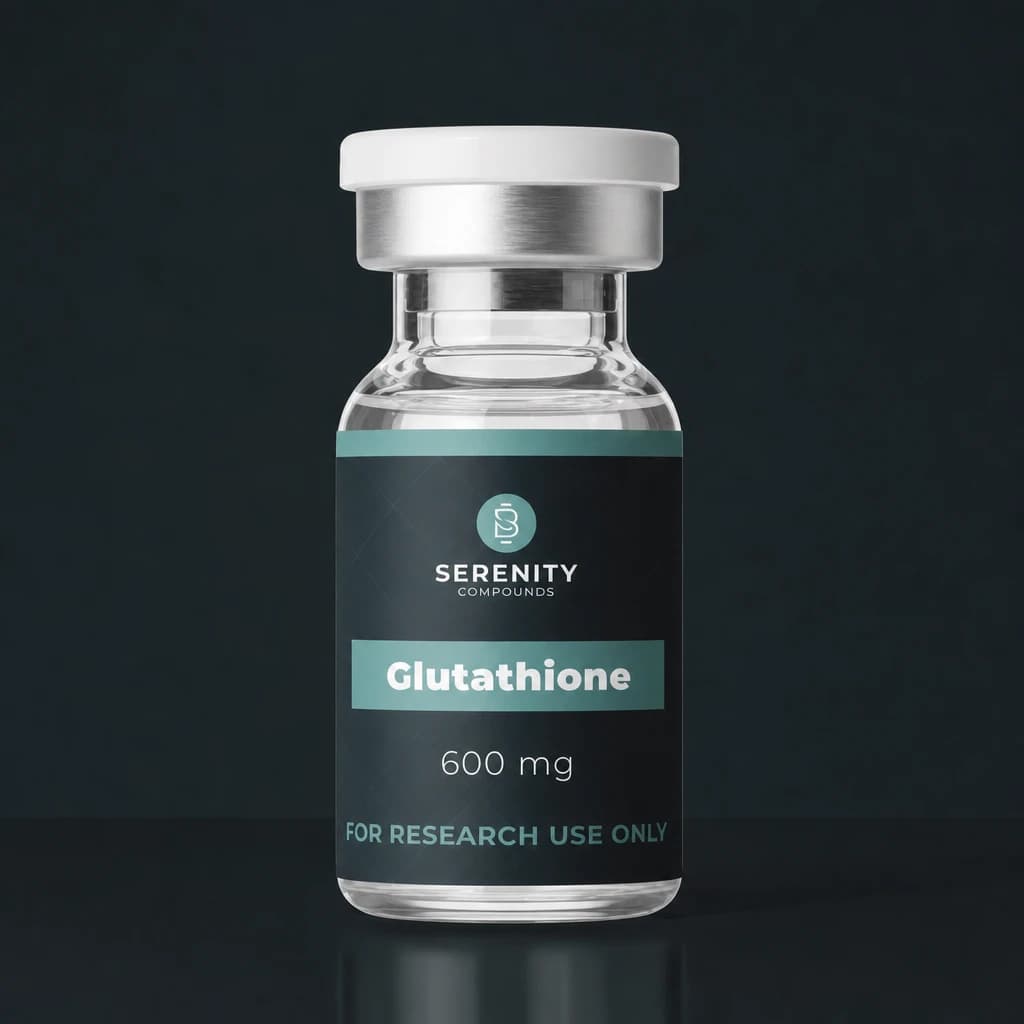
Serenity's glutathione reference listing provides the catalog starting point for biochemical research. The stated form and lot documents should be checked against the intended assay. A product name doesn't establish the redox composition of a prepared sample after handling, and a laboratory reference is not a pharmaceutical injection product or a clinical recommendation.
What does the clinical literature actually address?
A controlled infusion study in peripheral arterial disease examined specified vascular and functional outcomes in a defined patient population. That is a narrower question than general wellness or cosmetic benefit. The result belongs to the tested intervention and population, not to every product sharing the molecule name. It should not be used as proof that an unrelated research preparation treats disease.
Route differences matter when other papers enter the discussion. An oral study provides evidence about its own formulation and exposure route. It cannot establish an injection effect simply because the active molecule is related. A useful review separates routes rather than pooling all publications into a general statement that administration by any method produces the same result.
Clinical endpoints also differ from a change in a laboratory redox marker. A marker can provide mechanistic information while leaving a functional benefit uncertain. The converse is possible too: a functional observation may not identify the biochemical pathway that produced it. A complete explanation should preserve both the measured outcome and the limits of the mechanism claim.
Glutathione injection benefits: why antioxidant is not enough
Redox chemistry depends on context and compartment. A molecule participating in an antioxidant system doesn't establish that adding more of it improves every biological outcome. The available concentration and interaction with other pathways matter. A simplified chemical reaction can demonstrate a property without predicting the net effect in an intact organism or a person with a particular clinical condition.
Cellular compartments can have different redox environments. A measurement from a whole cell extract may average across those environments and obscure local changes. It should not be described as a direct measurement of every organelle. Researchers need a method suited to the compartmental question if that distinction is central to the hypothesis.
Claims about skin appearance require relevant skin outcomes and appropriate controls. A vascular study or a general redox assay cannot supply them. Photographs with changing lighting or an incomplete participant record are also insufficient to establish a typical effect. This article does not recommend cosmetic administration or convert mechanistic interest into a human use claim.
Sample handling can change the apparent redox state
Oxidation after collection can alter the balance measured in a sample. If the method doesn't preserve the relevant state adequately, part of the observed result may arise during handling rather than within the original biological system. A validated analytical procedure should address that risk and define the conditions under which its measurements remain interpretable.
Timing matters because the interval between collection and analysis can differ across samples. A systematic difference between study groups could create an apparent biological pattern. The research record should preserve the handling information relevant to the method. This is a discussion of analytical validity, not a preparation recipe or a universal sample stabilization protocol.
Recovery and detector response also need evaluation. A method may respond differently to analytes or matrix components, and calibration must fit the intended measurement. An apparently precise ratio doesn't guarantee an accurate one if either component is measured poorly. Quality controls should address the actual sources of uncertainty rather than relying on repeated measurement of the same potentially biased sample.
A hypothetical ratio example
Suppose a fictional assay reports a lower GSH to GSSG ratio after an experimental condition. That observation alone doesn't reveal whether reduced material decreased or oxidized material increased. It also doesn't exclude a handling artifact. Examining the component values and the collection process is necessary before assigning the change to a specific cellular mechanism.
Now suppose total glutathione is unchanged in that example. The result may be consistent with a redistribution between forms, but the conclusion still depends on whether the method accurately distinguishes them. A total assay cannot retrospectively establish the separate quantities. This example illustrates why the analytical question should be defined before selecting a method, rather than inferred from whichever measurement is available.
Uncertainty can become especially important when one component is near a method's reliable quantification limit. A small absolute error in a low denominator can produce a large change in a ratio. Reporting the result without that context can exaggerate confidence. The method's limits belong beside the biological interpretation rather than being treated as an unrelated technical appendix.
How do related metabolic references differ?
Cobalamin research involves a distinct cofactor system and different analytical questions. Our B12 reference guide explains its own evidence context. Shared discussion under cellular energy or wellness does not make the molecules interchangeable. A study measuring one system cannot be used as evidence that another reference produces the same effect.
Carnitine participates in a different part of metabolism. The carnitine reference discussion separates transport biology from broad energy claims. These connections are useful for understanding the wider biochemical setting, but they don't validate a combination of catalog compounds or establish that adding several references produces a clinically beneficial stack.
Mixtures can complicate redox assays because multiple constituents may affect the detector or biological system. A larger apparent antioxidant signal doesn't identify which ingredient caused it. Suitable constituent comparisons and matrix controls are needed for attribution. A commercial formula cannot inherit a validated mechanism by combining ingredient names from unrelated papers.
Questions about preparation and route
What is glutathione injection?
The phrase describes administration of a preparation rather than the entire evidence base for the endogenous tripeptide. Formulation and route matter when interpreting a study. A biochemical antioxidant role does not establish a clinical outcome for every preparation, and a research reference cannot inherit pharmaceutical suitability merely because its ingredient name matches.
How much glutathione should be injected?
Neither a redox ratio nor an enzyme assay selects a personal amount. Clinical administration requires appropriate product evidence and qualified care outside this article's research scope. For laboratory work, the method supplies justified conditions and the worksheet preserves its quantities. A nominal concentration does not establish human safety or an administration schedule.
Injectable glutathione: what a laboratory or reader should retain
Document the exact chemical form and the measurement question. Separate total concentration from the reduced and oxidized components when the hypothesis requires that distinction. Preserve sample handling and analytical limits. This record makes it possible to assess whether a reported change reflects biology or a difference introduced during the measurement process.
Purity documentation answers only the claims supported by its method. The certificate guide explains why an identity or chromatographic result doesn't establish sterility or clinical suitability. Research material should not be promoted for injection because its name appears in a clinical publication or because a supplier report contains a high purity percentage.
Ultimately, keep clinical route evidence and laboratory redox measurements in separate categories. Each can be scientifically useful without supporting every wellness claim associated with the search term. Human treatment questions require qualified clinical guidance, and this page does not provide injection instructions or an administration schedule.