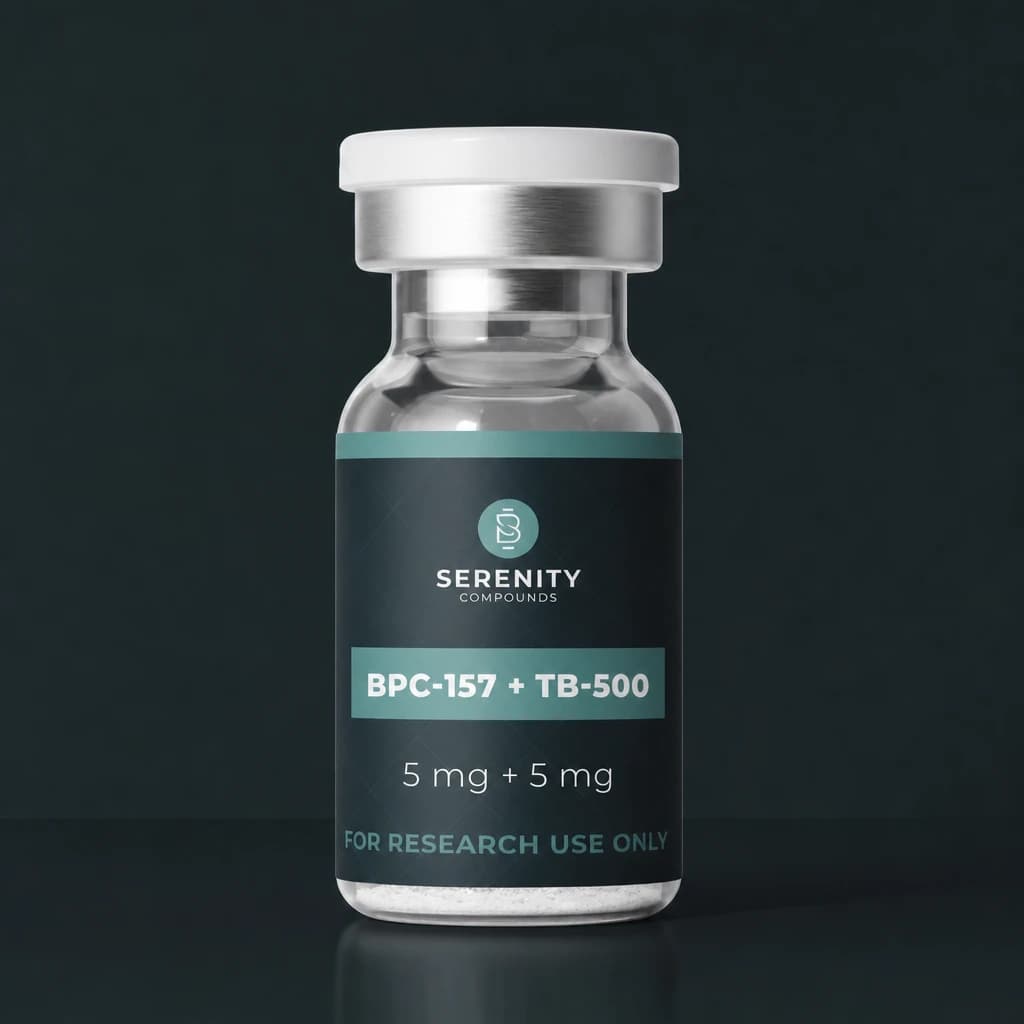
BPC 157 and TB 500 are distinct research materials. Combining them requires separate identity and quantity records for both constituents. A total blend mass cannot describe the exposure to each component, and evidence about either material alone does not establish the behavior of the mixture.
What must the blend identity record resolve?
TB-500 terminology is not consistent across every supplier and publication. Some discussions concern full length thymosin beta-4 while others concern a fragment. The exact sequence in the supplied material must match the intended research question. Assuming a particular length from a nickname can make a literature comparison invalid before any measurement is taken.
The Serenity blend listing identifies the available catalog variants. A laboratory should preserve the labeled quantity of each constituent and resolve any missing sequence information in the batch documents. The shorthand blend does not provide enough information for a reproducible method.
How does a combined mass hide useful information?
Imagine a hypothetical two component reference containing 3 mg of one analyte and 1 mg of another. The combined mass is 4 mg, but recording only that number loses the ratio. In a validated final volume of 2 mL, the component concentrations would be 1.5 mg/mL and 0.5 mg/mL. This is an accounting example, not a preparation instruction for the catalog product.
Equal mass would not imply equal molarity either. Each constituent has its own molecular weight, which must match its documented sequence and form. A worksheet should distinguish total blend concentration from component mass concentration and component molar concentration. Those labels prevent an apparently simple number from changing meaning between readers.
What would show an interaction between constituents?
Separate component conditions can help establish what each material does under matched experimental circumstances. A vehicle condition addresses the preparation background. The combined condition can then be compared with a stated expectation. Without that expectation, a larger response is not enough to justify the word synergy.
Published thymosin beta-4 actin research supplies a molecular research context for that sequence. It does not validate every material named TB-500 or a mixture containing it. The BPC-157 identity guide addresses the separate evidence questions for the other component.
Why can a fixed ratio limit an experiment?
Increasing the amount of a premixed material increases both constituents together. If the outcome changes, the experiment cannot identify one constituent as responsible solely from that concentration series. A question about independent contributions may require separately characterized references. The convenient format of a blend does not determine whether it fits the hypothesis.
How should a blend certificate be read?
Analytical separation should be capable of addressing the mixture's relevant components. A single purity percentage might describe one measurement without establishing individual quantities. Ask what each reported peak represents and whether the method distinguishes the identities needed by the experiment. A report can be useful while still leaving an important question unanswered.
Stability also belongs to the actual mixture and matrix. A finding about an isolated constituent does not establish the shelf life of a combined solution. Clear appearance is not a measurement of intact analyte. Any stability claim should identify the preparation and analytical endpoint to which it applies.
BPC 157 benefits in a combination study
Endpoints should be chosen before interpreting a blend as better than either constituent. If a study measures migration, the conclusion should concern migration in that model. A second measurement of cell viability can help determine whether an apparent change reflects a different number of living cells. Neither result alone establishes tissue repair. Combining compounds increases the number of possible explanations rather than removing the need to separate them.
Mechanism claims need a similar distinction. The cited thymosin research concerns interaction with actin. The BPC literature asks different mechanistic questions. Placing those observations beside one another does not demonstrate that both pathways operate in a particular mixture or that they reinforce one another. A blend experiment must test its own hypothesis using the actual identities and concentrations present in that preparation.
Comparing a blend with separate research references
Procurement format should follow the comparison being planned. A fixed ratio can simplify studying that one composition across a series of total concentrations. Separate references allow one component to remain constant while the other changes. That flexibility matters when a researcher wants to distinguish the contribution of each constituent. A convenient vial format is not necessarily the most informative design for the question.
Consider a hypothetical result in which the mixture improves an assay reading by 20% while constituent A alone improves it by 19%. Without uncertainty estimates, the one percentage point difference says little. Comparing the blend only with vehicle would conceal how much of the result A already explains. The study also needs to establish that the compared conditions contain equivalent amounts of the relevant component.
Ratios should be reported in their original basis before being compared across papers. A two to one mass ratio differs from a two to one molar ratio when molecular masses differ. If an article does not explain which it used, the ambiguity belongs in the evidence summary. Reconstructing an unstated ratio from a product name is not a reliable way to fill the gap.
Reconstitution and storage of a two component material
Solubility is a property of each constituent in a particular matrix. A visually clear solution does not prove that both components are quantitatively recovered at the expected ratio. Conversely, a visible particle does not identify which constituent is affected. An analytical method that can follow each relevant component is more informative than appearance alone when composition is important to the experiment.
Recovery can also differ during handling. If one constituent is preferentially lost during a transfer, the final mixture may no longer match its nominal ratio even when total volume is correct. A worksheet should therefore distinguish the declared starting composition from any measured final composition. This is especially relevant when interpreting a failed replication, because the same total mass label can hide a different experimental exposure.
Evidence supporting storage needs to describe the combined material rather than merely two separate ingredient specifications. Matrix composition, container and observation interval belong to that evidence. A laboratory should not infer a prepared solution's lifetime from an unopened dry vial claim. Documented handling conditions help explain differences between experiments without pretending that record keeping alone establishes chemical stability.
Buyer questions to resolve before interpreting the certificate
Ask whether the report identifies both constituents and quantifies their ratio. A method may separate a dominant peak from impurities yet fail to resolve the two intended components sufficiently for individual quantification. The certificate should make the scope clear. Where an important value is absent, preserve it as an unresolved procurement question rather than substituting the advertised total for a measurement that was never reported.
What is BPC 157?
Within this blend, it names one intended peptide constituent rather than the entire material. Its identity must remain distinct from the thymosin related component. Evidence about the isolated peptide can inform a hypothesis, but it cannot establish the composition or performance of a supplied mixture. The batch record needs to connect both named ingredients to the particular reference selected for the assay.
Does BPC 157 work?
For combination research, that question divides into two parts. One asks what the isolated constituent did in a defined experiment. The other asks whether its contribution can be detected in the mixture. A response to the combined material alone cannot answer both. Separate controls and a stated endpoint are needed before assigning the observation to a particular constituent or describing an interaction.
Where does dosage terminology fit?
Clinical or consumer dosage language should not be substituted for the laboratory concentration record. Our research calculation article explains the unit distinctions. A blend calculation can describe justified inputs, but it cannot establish human safety or choose an administration schedule.
Before selecting a premixed reference, state the question the combination is meant to answer. Then check whether its documented identities and fixed ratio allow that question to be tested. If they do not, a more detailed experiment is needed rather than a stronger claim about the same vial.