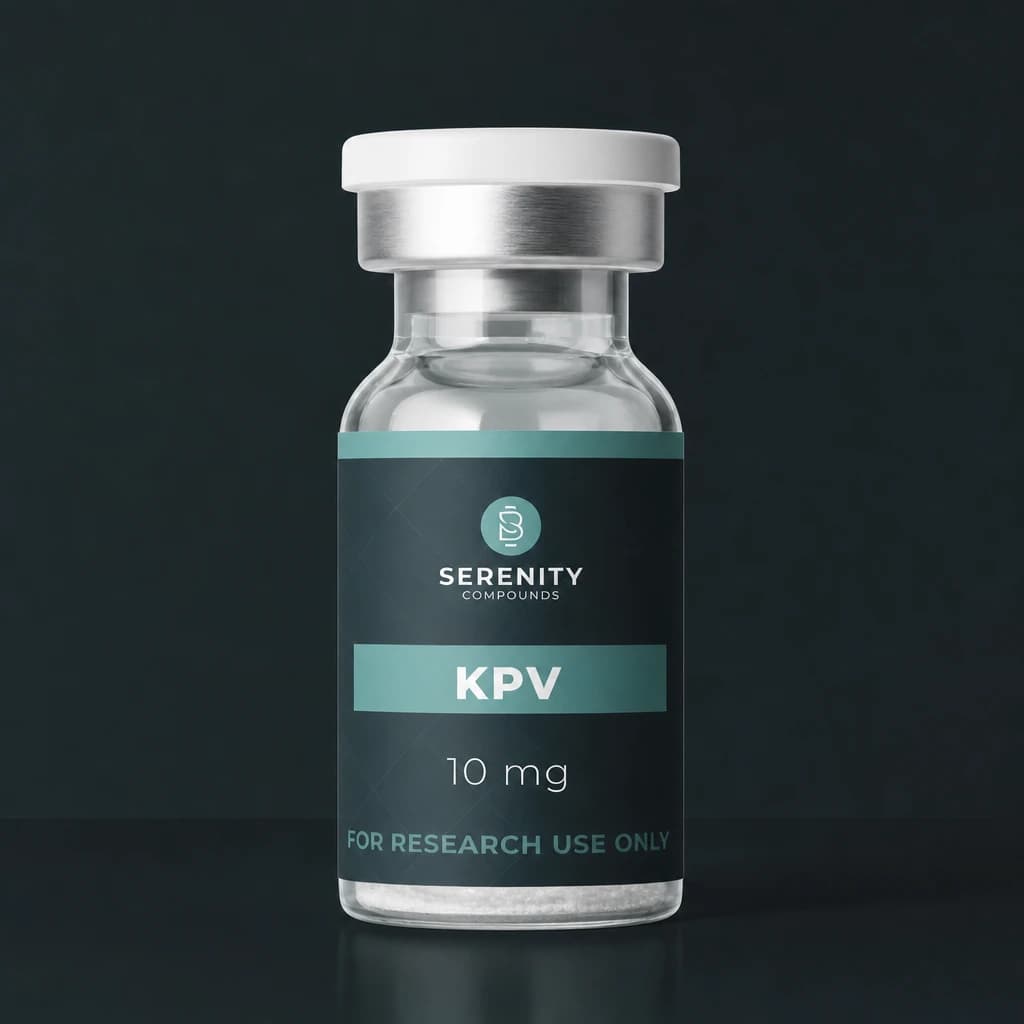
KPV peptide is the Lys-Pro-Val tripeptide studied in preclinical inflammation research. Published work includes intestinal cell experiments and mouse models, with attention to uptake through the peptide transporter PepT1. These findings do not establish that a research reference treats inflammation in humans. The important distinction is between observing a response in a model and demonstrating a clinical outcome.
What does the sequence identify?
Three amino acid residues define the named peptide, but sequence identity still needs appropriate documentation. A short chain does not make analytical characterization unnecessary. The KPV research listing should be matched to the selected lot and its available specification.
Related alpha-MSH biology provides background for the sequence, not permission to assign every full hormone effect to the fragment. Removing most of a molecule can change its properties. Mechanistic claims should be supported by experiments on the actual tripeptide rather than by resemblance alone.
What did the PepT1 study investigate?
Published cell and mouse research examined uptake and anti inflammatory observations in defined models. PepT1 expression was relevant to the proposed mechanism. That makes transporter context important when asking whether a result might be reproduced in a different cell system.
Separate murine colitis work adds evidence in an animal setting. It should still be described as preclinical research. A response in an induced mouse model does not establish benefit across different human inflammatory conditions.
Why can transporter expression change the result?
Consider two hypothetical cell preparations exposed to the same nominal concentration. If they differ in uptake, the cells may not experience the same intracellular amount. An apparently inconsistent biological response could therefore reflect a difference in exposure rather than a contradiction in the compound's behavior.
Measuring transporter expression alone does not prove the full mechanism either. Functional uptake and appropriate comparison conditions address additional parts of the question. A persuasive interpretation connects the proposed transport process to the observed downstream result instead of assuming the relationship from a single marker.
How should KPV peptide benefits be described?
Benefits language needs the specific measured endpoint. A change in a cytokine marker and a change in barrier function are not identical findings. Both may be relevant to an experiment, but a summary should state which was measured and what comparison supported it.
Viability is an important companion observation when a treatment reduces a cellular signal. Fewer viable cells can produce a smaller signal without demonstrating the desired regulatory effect. A suitable design distinguishes those possibilities and avoids translating any decrease into an unqualified positive outcome.
Does the evidence establish a dosage or safety profile?
No validated human regimen follows from the cited preclinical studies. KPV peptide dosage searches often omit the species or assay that produced a quoted number. Unit conversion cannot supply the missing clinical evidence, and the absence of a reported adverse effect in one experiment is not proof of safety.
FDA's peptide substance information identifies limitations in human safety information for this material. Those gaps should remain explicit rather than being hidden behind general statements that short peptides are natural or harmless.
KPV peptide benefits: what the inflammation assays measured
Signaling assays in the cited transporter study investigated NF-kappaB and MAP kinase related responses alongside cytokine measurements. The researchers also used uptake experiments to examine how the tripeptide entered cells. These are distinct pieces of a mechanistic argument. A downstream cytokine change alone would not establish the transport step, just as uptake alone would not establish the full inflammatory response.
Histology added another endpoint in the mouse work. Looking at tissue changes addresses a different level of the model from measuring a signaling marker in cultured cells. Agreement across those levels can strengthen a hypothesis, but it does not make the models equivalent to human disease. The study's induced conditions and observation period remain part of what its findings can support.
Transporter dependence and comparison design
Competition experiments can help investigate whether two materials use a related uptake process. Their interpretation depends on the competitor and conditions employed. A reduced signal could have explanations beyond a single proposed transporter if the comparison affects cell viability or the assay itself. Complementary evidence is useful because each method addresses a different possible weakness in the causal explanation.
Expression differences between cell models are therefore not a minor technical detail. A line with little relevant uptake may be unsuitable for testing the same intracellular hypothesis as a line with functional transport. That does not mean one model is universally better. It means the model must fit the question. Record why it was selected and what evidence supports the proposed exposure mechanism.
KPV peptide dosage and concentration language
Amounts reported in animal methods cannot be interpreted as final intracellular concentrations. Absorption and distribution separate the administered amount from the exposure at a target site. In a cell experiment, the nominal medium concentration still does not establish how much enters each cell. These distinctions are reasons to retain the source's original units and model rather than creating one generalized dosage table.
Time also changes the interpretation of exposure. A short signaling experiment may detect an early response that differs from the result of a longer observation. A sample collected after treatment ends addresses another question again. Describing only concentration loses that information. Research summaries should keep the exposure interval and measurement time attached to the reported outcome without turning either into a human schedule.
KPV peptides in preparation and storage records
Sequence and declared molecular form affect quantitative planning even for a three residue reference. A molar calculation needs the appropriate molecular mass, while an actual content measurement can differ from nominal labeled mass. A short peptide does not make those distinctions unnecessary. The analytical report should clarify which properties were established and which remain assumptions in the worksheet.
Solvent compatibility must be assessed for the intended method. A background component that is acceptable in one analytical test may influence a biological assay. Matched vehicles help investigate that possibility. Storage claims should likewise identify the prepared matrix and measured stability endpoint. A visually unchanged sample cannot establish that the intended reference remains present at the assumed concentration throughout the experiment.
KPV peptide side effects and incomplete human evidence
Safety claims need a preparation, population and monitoring framework. The preclinical studies discussed here cannot establish the frequency of adverse effects in people using independently supplied research material. The absence of a reported problem in one model does not prove its absence elsewhere. A concise evidence summary should state that boundary without claiming that the sequence's small size supplies a safety guarantee.
What is KPV peptide used for?
In laboratory research, it is discussed as a reference for investigating uptake and inflammatory responses in defined models. The cited studies provide examples of those questions rather than a universal use protocol. A proposed assay should identify its target measurement and required material properties. That is more informative than adopting a broad claim about treating every condition associated with inflammation.
What does KPV peptide do?
Reported preclinical observations include changes in inflammatory signaling and tissue related outcomes under the studied conditions. Those findings need their model context to remain meaningful. A response in intestinal cells does not demonstrate the same response in every tissue, and a mouse colitis result does not establish a human treatment effect. The evidence can motivate a focused experiment without resolving those broader claims.
What changes when the compound is part of a blend?
Adding the tripeptide to other constituents creates a new experimental question. The KLOW blend article explains why a result for one component cannot establish the behavior of the finished mixture. Its concentration and the comparison conditions still need to be identified separately.
For independent material evaluation, the COA reading guide separates identity and purity from properties that weren't tested. Keep those analytical questions alongside the model specific biological evidence. Together they support research interpretation without presenting the reference as a treatment.