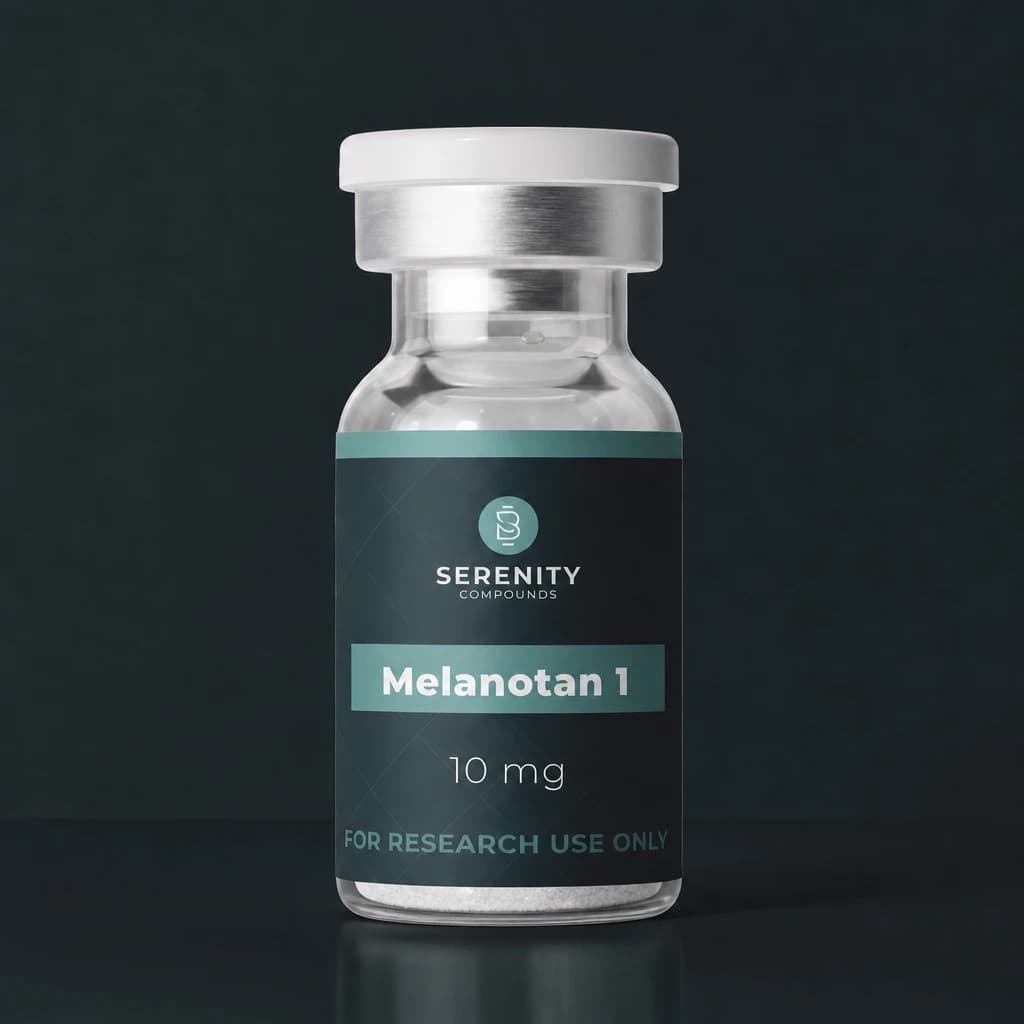
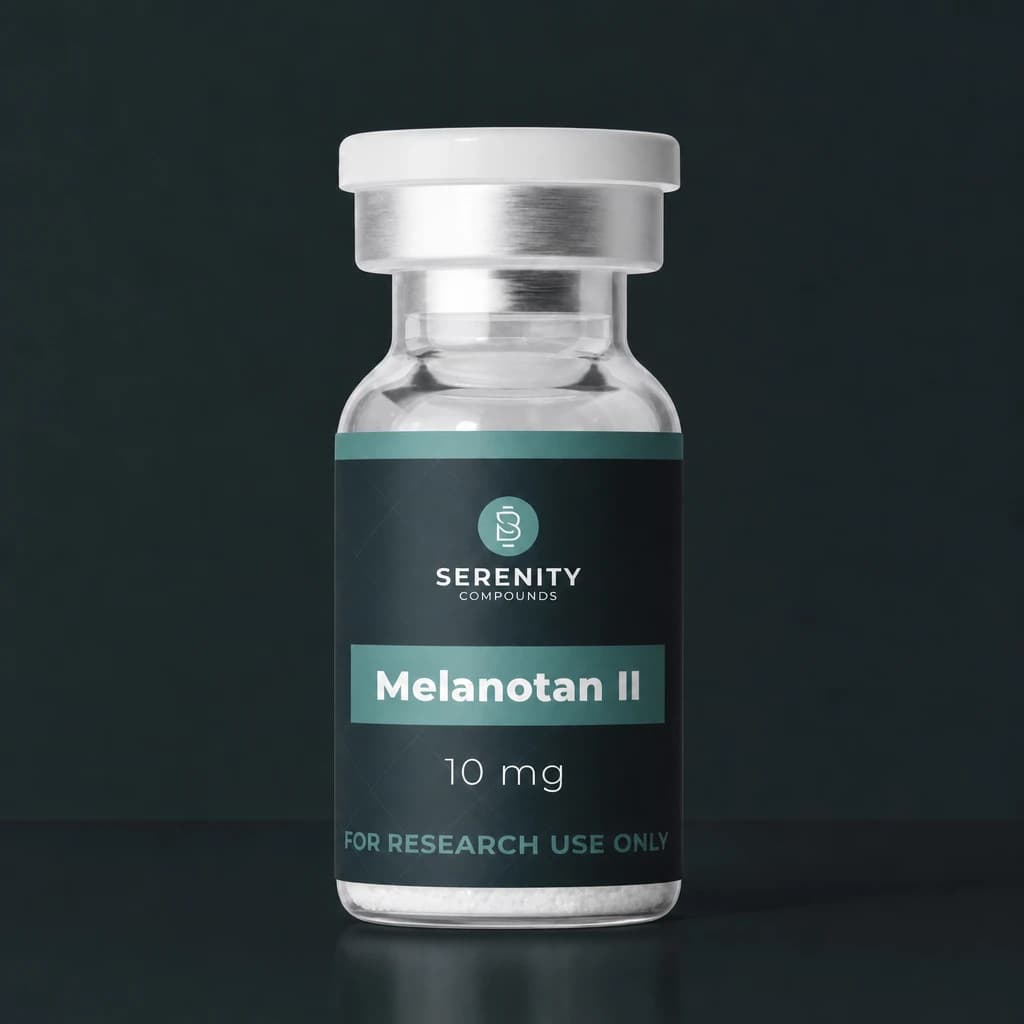
Melanotan 1 vs 2 compares a linear melanocortin analog with a distinct cyclic analog. Their shared relationship to alpha-MSH doesn't make their receptor behavior or clinical evidence identical. A regulated afamelanotide implant also occupies a different product context from a research vial carrying a related name. This guide explains the structural comparison and how to read the evidence without recommending tanning use, UV exposure or a human administration schedule.
Melanotan 1 and melanotan 2 peptide structures
Linear analog terminology is associated with the molecule also known as afamelanotide in pharmaceutical contexts. Its sequence contains modifications relative to the parent hormone. The human pharmacokinetic publication concerns a defined study material and routes. Its findings should not be assigned to every catalog formulation or used as instructions for administering a research reference.
Cyclization distinguishes the seven residue analog described in an early clinical pilot. It constrains the molecule's structure compared with a linear sequence. That structural relationship provides a reason to investigate different pharmacology. It doesn't establish a simple numerical ranking for potency or safety across all receptor systems and outcomes.
Sequence modifications and terminal chemistry remain relevant even when two compounds share a family label. A name alone may not communicate every specification needed by a laboratory. Researchers should match the actual material to the publication before transferring an observation. A modified analog or a different formulation should be recorded as such rather than hidden behind a familiar nickname.
What does a melanocortin receptor assay measure?
Receptor assays can investigate activity at specified melanocortin targets. The receptor subtype and the signaling readout define the scope of the result. Activity in one engineered system doesn't describe every physiological response in an intact organism. A comparison should state the target and method before presenting a potency value or describing one compound as more selective.
Expression level can influence apparent assay response. A cell system with abundant receptor may behave differently from one with lower expression or different coupling. Cross laboratory numbers therefore need caution even when the same endpoint name appears. A within system comparison can reduce some ambiguity, but it still depends on suitable controls and assay validation.
Selectivity is relative to what was tested. A compound favoring one receptor in a panel has not been shown to lack every other effect. Concentration range and method sensitivity matter. The phrase selective should be connected to the evidence rather than used as a shortcut for clinically safe or appropriate for a particular cosmetic goal.
Melanotan 2 before and after: pigment is not a UV safety measurement
Pigmentation is a measurable biological outcome, but a change in pigment does not establish that UV exposure is safe. Skin damage involves additional processes and outcomes. A research article should not turn a pigment finding into advice to increase sun exposure or use a compound as a substitute for established sun protection. Those would be different claims requiring different evidence.
Photographs can document appearance while remaining vulnerable to lighting and selection effects. A darker looking image doesn't quantify protection or establish a clinical benefit. The denominator matters when a gallery shows only favorable examples. Without consistent measurements and a complete record, the images cannot provide a reliable estimate of typical results or adverse events.
Our cyclic analog research guide explains the specific evidence context in more detail. It does not provide a tanning protocol. Keeping appearance and safety separate is particularly important because a visible change can occur without revealing other physiological effects or risks.
What did the early cyclic analog study establish?
The cited phase I pilot involved only three volunteers and recorded adverse events alongside its observations. That is a preliminary research setting, not a sufficient basis for a broad safety claim. A sample of that size cannot characterize uncommon harms or establish expected outcomes across a diverse population. The study should not be summarized as proof that research material is safe for unsupervised use.
Small studies can still provide useful information about feasibility or biological response. Their value doesn't depend on pretending they answer every later question. A responsible summary distinguishes what was observed from what remains uncertain. It also avoids converting the publication's exposure details into instructions for readers, which is outside the purpose of this research catalog article.
Adverse event categories need to be retained accurately. Frequency and severity are separate features, and the absence of an event in a small sample isn't proof that it cannot occur. An online testimonial has additional identity and reporting limitations. Neither source should be used to invent a precise personal risk estimate without an appropriate evidence base.
How is the approved implant different from a research vial?
SCENESSE is a regulated afamelanotide implant with a defined indication and product label. The current DailyMed record, checked September 5, 2026, describes that specific pharmaceutical context. Its approval does not extend to every material sold under a related research name or to the distinct cyclic analog.
Formulation affects how a product is presented and used within its approved framework. A powder and an implant are not interchangeable merely because their active identity is related. Manufacturing and regulated clinical use also differ from research supply. The existence of an approved medicine therefore cannot be used as a blanket endorsement of a supplier's catalog reference.
Clinical indication matters too. Evidence supporting a defined disease related use doesn't establish a general cosmetic recommendation. The population and outcome in the label should remain visible when explaining the product distinction. This page does not advise on eligibility or clinical treatment decisions, which belong with appropriately qualified healthcare professionals.
A hypothetical receptor comparison problem
Suppose a fictional summary compares a potency number from a linear analog assay with a pigment outcome from a cyclic analog study. The measurements describe different biological levels and cannot produce a meaningful ratio of overall strength. A valid comparison first needs a common question and evidence suited to answering it. This example is analytical and isn't a reported experiment.
Even two receptor potency values may be difficult to compare if the systems differ. Concentration response analysis and maximum effect need to be distinguished. One compound reaching a response at a lower concentration doesn't necessarily produce a larger maximum response. A single word such as stronger hides those choices unless the summary explains exactly what it means.
Duration claims require matching identity and formulation as well. A clinical exposure profile cannot be assigned to every research preparation with a related name. The peptide identity introduction explains why sequence and modification are central to classification. The broader lesson applies here without making the two analogs interchangeable.
Questions about the two analogs
Does melanotan 2 work without sun?
Early pigmentation observations in a very small pilot do not establish a reliable personal tanning result or a safe strategy for sun exposure. The cyclic analog's evidence should not be supplemented silently with findings on the linear analog. Neither a darker image nor a receptor signal establishes protection from ultraviolet harm.
How long does melanotan 1 take to work?
Timing belongs to the exact preparation and endpoint measured in a study. A pigment observation at one interval is not a universal onset or duration for every product carrying a related name. The research comparison does not provide a personal tanning timeline. Preserve the original study conditions rather than turning them into an expectation for a catalog reference.
What should the catalog comparison preserve?
Serenity's linear analog listing and cyclic analog listing are separate research records. Their specifications should be checked against the intended method and available lot documents. A laboratory should not assume matching analytical behavior or substitute one for the other on the basis of their numbering.
Purity and identity claims need appropriate methods. The certificate guide explains why one favorable analytical result doesn't establish every quality attribute or clinical suitability. Research material must not be described as safe for injection simply because a chromatogram appears clean or a related pharmaceutical product exists.
Ultimately, compare structure and receptor evidence without collapsing them into a cosmetic recommendation. The linear and cyclic analogs have distinct identities, while the approved implant has its own regulated context. Those boundaries are essential to reading the literature accurately and do not provide a human tanning or administration protocol.