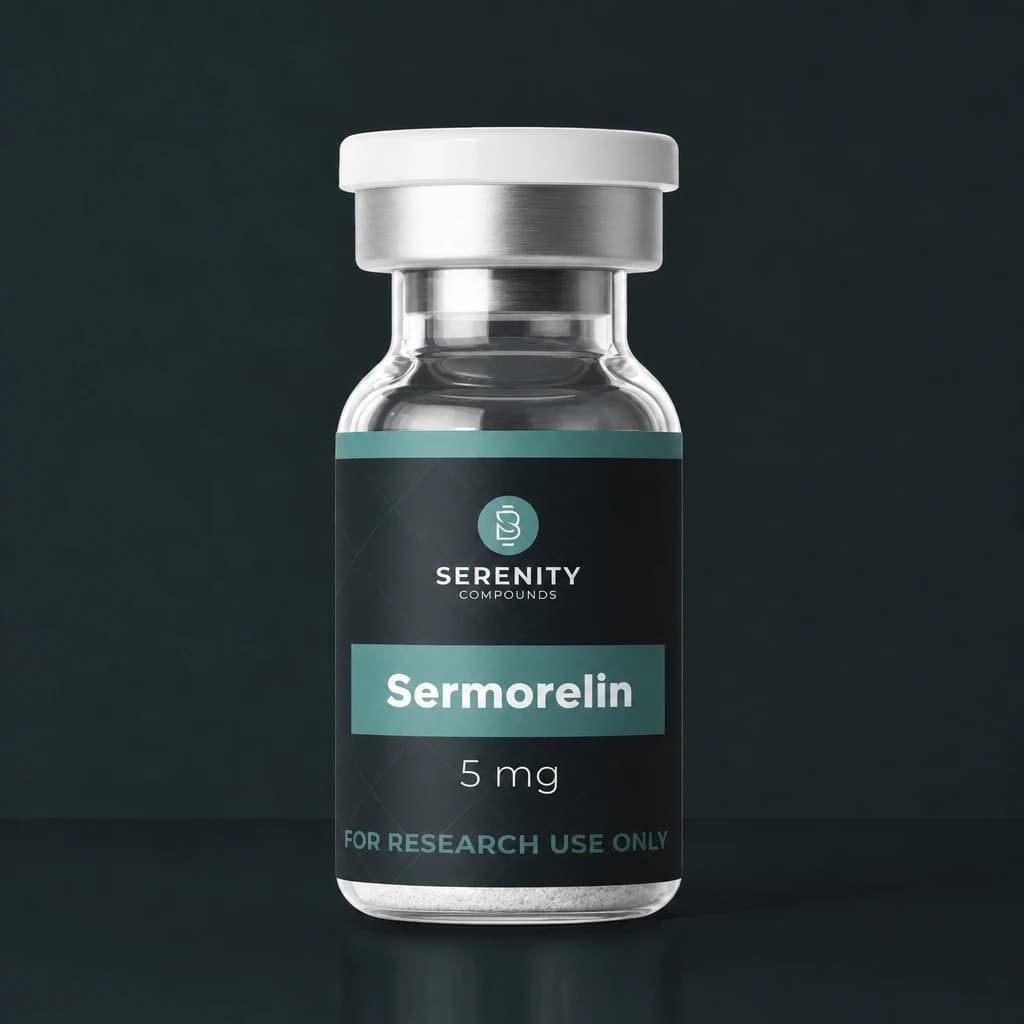
Sermorelin is a synthetic version of the first 29 amino acids of growth hormone releasing hormone, with an amidated terminal group. Researchers study its ability to stimulate growth hormone release through the GHRH receptor. That mechanism doesn't establish the broad muscle, recovery or antiaging benefits often attached to the name. Interpreting the evidence requires attention to the exact molecule, the population studied and the outcome measured. Laboratory catalog material is not a pharmaceutical formulation or an instruction for human use.
Sermorelin peptide and the GHRH receptor mechanism
Natural GHRH participates in the regulation of pituitary growth hormone secretion. The biologically active region near its beginning provides the basis for this synthetic fragment. Receptor activation contributes to hormone release within a system that also contains inhibitory signals and feedback. A simplified cell assay can isolate part of that response, while an intact organism includes additional influences such as sleep timing and nutritional state. Results from those settings answer different questions.
Pulses matter because circulating growth hormone isn't constant throughout the day. A sample collected near a pulse can look very different from a sample taken between pulses. Researchers may examine serial concentrations, peak response or integrated exposure across a specified interval. Reporting only the highest value can conceal changes in the rest of the sampling period. A clear paper should explain its sampling schedule before interpreting a percentage increase as a sustained change in endocrine function.
IGF-I adds another layer. It can serve as a downstream marker within this hormonal system, but it isn't a direct measurement of every effect attributed to growth hormone. Laboratory values also need the assay method and an appropriate reference context. A movement in this marker doesn't tell a reader how much muscle was gained, whether physical performance changed or whether an intervention was safe over a longer period.
What have human studies measured?
Published work includes a six week investigation in 11 older men. Its small sample and short observation period are central to interpretation. Findings from a selected group cannot establish expected results for young athletes or people with different endocrine conditions. The publication should be read for its actual measurements rather than used as a general endorsement of a research product that shares a molecule name.
Earlier research on GHRH 1-29 in older men also examined endocrine responses over a limited period. Such studies are useful for asking whether a signal can be detected under defined conditions. They are much less informative about rare adverse events or durable functional outcomes. A few weeks of observation cannot resolve a claim about years of use, even when the short study reports a statistically significant laboratory change.
Identity creates a further limitation when reviews combine publications. A study of a norleucine substituted analog concerns a modified sequence. Substitution can influence stability or biological behavior, so that paper shouldn't be silently relabeled as evidence for an unmodified reference. Searching for a broad family term is useful during discovery. Extracting results still requires a separate record for each exact compound and formulation.
Sermorelin benefits: why hormone changes do not prove muscle growth
Muscle hypertrophy is a tissue outcome. Strength is a functional outcome. Neither is interchangeable with a circulating hormone measurement, and the relationship between them can be affected by training or energy intake. Even a body composition scan has limits because lean soft tissue includes water and other components beyond skeletal muscle. The bodybuilding evidence review examines those endpoint differences across several endocrine research compounds.
Consider a hypothetical study summary reporting a higher hormone peak but no direct assessment of muscle size. Its defensible conclusion concerns the sampled endocrine response. Writing that participants built muscle would introduce an outcome the experiment never measured. If another paper reports a change in lean mass, the reader still needs the measurement method, comparison group and uncertainty around the result. Combining the two claims doesn't fill the missing evidence.
Photographs supply even less control over this question. Lighting and posture can change apparent definition without a measurable change in tissue. Our separate before and after evidence analysis explains how to assess those images and what a more informative record would contain. It doesn't present customer transformations or imply that Serenity has measured outcomes in people using its catalog materials.
How is it different from other secretagogues?
Ipamorelin belongs to a different receptor pathway associated with the ghrelin receptor. Similar downstream hormone responses therefore don't make the compounds chemically or pharmacologically equivalent. Comparing them requires a model capable of representing the mechanisms under investigation. A single receptor assay may characterize one agent well while giving an incomplete picture of another agent whose relevant receptor is absent or expressed at a different level.
CJC-1295 introduces a separate naming issue. Research involving a version with a drug affinity complex cannot establish the duration of action of material sold without that modification. Nor can a result for that analog be assigned to every GHRH fragment. Sequence identity and formulation belong at the beginning of the comparison table, not in a footnote after a headline about how long an entire peptide family lasts.
Mixtures make attribution harder still. If an experiment includes two active constituents but no matched conditions for each constituent alone, it may not reveal which component produced the observed response. A larger response isn't automatically synergy. A valid interaction claim requires an explicit reference model for the response expected from the components and measurements capable of testing that expectation across the relevant conditions.
What should a laboratory check about the reference material?
Serenity's sermorelin reference page provides the catalog starting point. Procurement records should connect the ordered item to its lot documentation and stated chemical form. The named peptide, terminal modification and any salt designation should be consistent across the specification and the analytical report. A catalog mass alone doesn't explain whether the reported amount refers to peptide content or another specification convention.
Chromatographic purity describes a result under a particular analytical method. It doesn't by itself establish sequence identity, biological potency or suitability for clinical administration. Mass spectrometry can contribute identity evidence, but the interpretation depends on what was measured and how the report presents it. Researchers should avoid converting a clean chromatogram into a general safety claim or a guarantee that a vial reproduces the material used in a published trial.
Stability needs its own support. A storage statement for unopened material doesn't necessarily describe a solution in a particular laboratory matrix. Repeated handling, adsorption to containers or degradation can affect the amount available in an assay. If the project depends on a specific exposure, that assumption needs validation under the actual experimental conditions. This article doesn't supply a preparation method or a human administration schedule.
Questions about the research evidence
Does sermorelin work?
Effectiveness depends on the endpoint. A study detecting an endocrine response can support that observation without proving a visible transformation. To assess a claim, identify its population and direct measurement first. A trial on older men does not automatically predict the result of a different experiment or establish an outcome for a catalog reference.
Is sermorelin safe?
Safety cannot be established from a hormone increase or a purity percentage. The short studies discussed here have limited ability to characterize uncommon or delayed outcomes. Their preparations and monitored participants also differ from an independent research purchase. Keep those limits alongside the reported observations instead of converting incomplete evidence into a universal assurance.
A practical framework for reading the next paper
Start an evidence record with the full compound description and the scientific question. Add the model or population, comparison condition and duration. Then identify the primary endpoint before reading the discussion section. This order reduces the chance that a persuasive interpretation will be mistaken for a measurement. It also makes differences between two superficially similar studies easier to see without forcing them into a common outcome category.
Uncertainty should be retained alongside the central estimate. Sample size alone isn't a complete measure of quality, but small studies often leave wide uncertainty and limited ability to detect uncommon harms. Missing observations or selective reporting can further affect interpretation. A result can be scientifically interesting while still being insufficient for a broad commercial or clinical claim.
Finally, keep the conclusion at the same level as the evidence. Receptor activation supports a mechanistic statement, a controlled endocrine study supports a population specific hormone statement and a measured functional endpoint supports only the function actually tested. That separation is the most useful way to read this literature without turning preliminary findings into promises about a laboratory product.