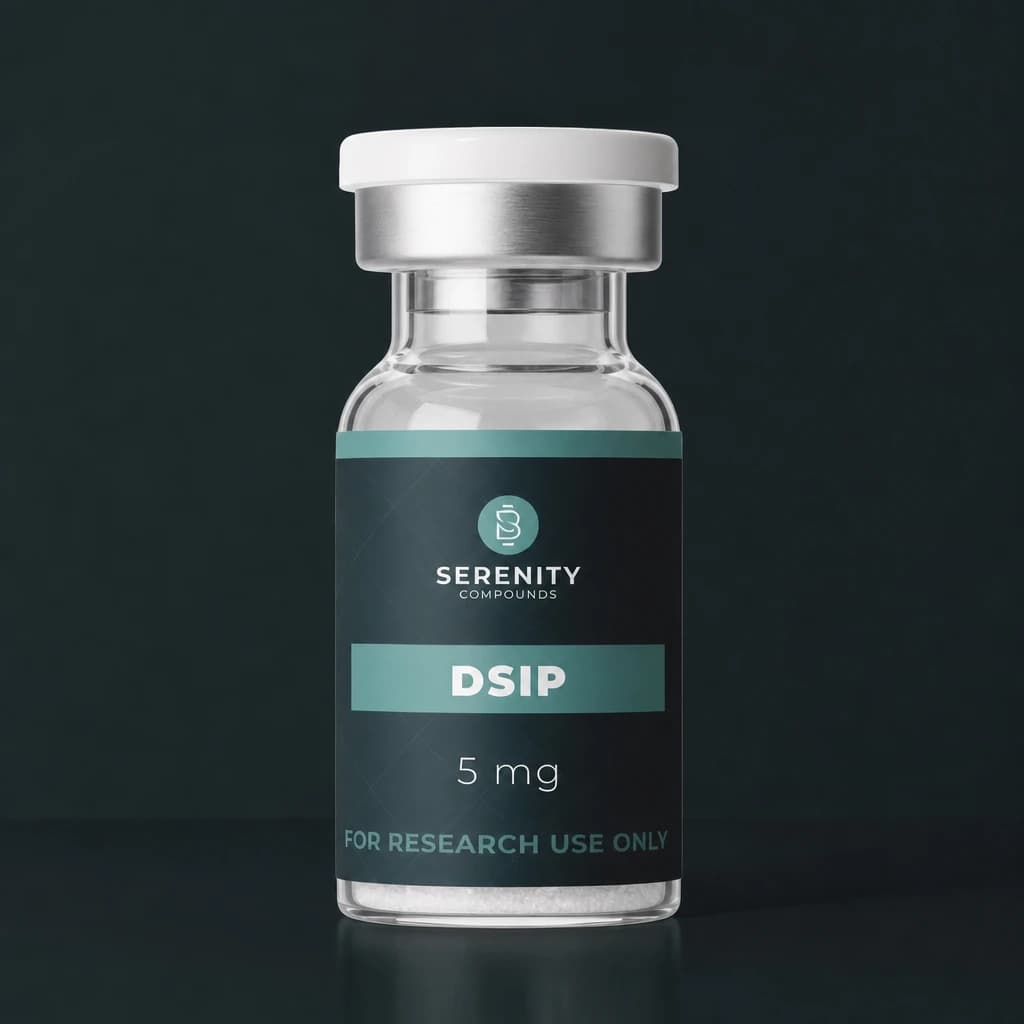
DSIP peptide is the abbreviation commonly used for delta sleep inducing peptide, a nine amino acid research peptide. Its name reflects the history of its investigation, not a guarantee that it improves sleep in people. Small clinical studies and laboratory observations need to be assessed by their actual measurements, and the literature doesn't justify treating the catalog material as an established sleep treatment. This guide separates sleep architecture, subjective experience and functional outcomes without supplying a human regimen.
Why the name cannot answer the efficacy question
Historical compound names often reflect an early observation or a proposed function. Later work may narrow that interpretation or produce inconsistent findings. The words in a name therefore shouldn't replace evidence from controlled experiments. A useful review begins with the sequence and then asks which effects were reproduced in which models, rather than assuming that a descriptive label proves the biological outcome under every condition.
Serenity's DSIP reference page concerns laboratory material. Its identity and lot documentation are procurement information, not a clinical recommendation. A shared sequence name doesn't establish equivalence to a formulation used in an older human study. Route and formulation differences remain important when interpreting those publications, even though this article intentionally omits preparation and administration instructions.
Sleep itself is not a single measurement. The interval before sleep begins differs from the amount of time spent asleep, and both differ from the distribution of stages. A person can report feeling better without a corresponding change in a particular recorded stage. An instrument can detect a change that the participant doesn't experience as useful. Those possibilities require separate reporting rather than a single label of improved sleep.
What did the small human studies report?
An early crossover investigation involving six volunteers provides a preliminary human research context. A sample that small has limited ability to characterize variation or detect uncommon adverse events. Its design should be read for the specific question it tested. It cannot establish an expected response across the broader population or validate the use of unrelated research vials.
Another study in chronic insomnia reported findings with limited clinical significance. That result matters because an evidence summary should retain less favorable observations rather than relying entirely on the compound's name or early interest. Differences among studies may involve design or population, but those possibilities need investigation. They should not be used as an excuse to dismiss a result without evidence.
Together, these publications show why the research question remains more complicated than a simple claim that the peptide induces restorative sleep. They concern defined study conditions and relatively limited evidence. The appropriate interpretation preserves uncertainty about general benefit and doesn't transform historical clinical experimentation into a modern self administration schedule.
Reading sleep latency and total sleep time
Latency is the time between a defined starting point and the onset of sleep under the study's scoring rules. The starting point must be specified because time in bed and the start of a recording are not always identical. A lower latency may be relevant to one complaint, but it doesn't describe the quality or continuity of the rest of the night.
Total sleep time sums the intervals scored as sleep. Its meaning depends partly on the opportunity provided for sleep and the measurement method. A longer recording window can permit more sleep without changing the underlying response in the same way as a fixed window comparison. Researchers should state the recording period and avoid interpreting duration without its context.
Efficiency commonly relates time asleep to time in bed. A percentage can change because the numerator changes or because the denominator changes. A clear report preserves both quantities where relevant. This arithmetic point is easy to overlook when a summary presents only a favorable percentage and leaves readers unable to tell whether the participant slept longer or simply spent less time in bed.
DSIP peptide benefits: what does a delta activity result mean?
EEG measurements describe electrical activity recorded under a specified acquisition and analysis method. Spectral measures and scored sleep stages are connected but not identical. A change in a frequency related measure shouldn't automatically be rewritten as a change in a clinical sleep outcome. The paper needs to explain what was recorded and how the selected signal relates to its hypothesis.
Artifacts can affect recordings. Movement or poor signal quality may influence the data available for scoring. Consistent rules for excluding or handling affected intervals help maintain comparability across conditions. A report should identify those rules so the reader can distinguish a biological observation from a difference caused by recording quality or data processing.
Restoration is a broader claim than a waveform measurement. It may imply improved daytime functioning or a subjective sense of recovery, which require their own assessments. Without those measures, the conclusion should remain about the recorded signal. The melatonin assay discussion offers a related example of why circadian biology and a particular experimental readout must remain distinct. Our telomere research review examines the same evidence gap when cellular measurements are stretched into lifespan claims.
Why crossover studies need special care
Participants in a crossover design experience more than one study condition. This can help reduce some variation between people, but it introduces questions about order and carryover. If the first condition affects the later observation period, the second result may not represent an independent response. The design needs a justified approach to those issues, not simply the assumption that each observation starts from the same baseline.
Adaptation to a sleep laboratory can also matter. An unfamiliar environment may influence the first recorded night differently from later nights. If one condition consistently occurs after more adaptation, the comparison can become difficult to interpret. Randomization and appropriate scheduling help address design concerns, but the report should still describe what was done and which limitations remain.
Repeated nights are correlated observations within a person. Counting each night as a fully independent participant can overstate precision. The statistical model should match the design and preserve the actual number of people studied. Multiple recordings can improve characterization of an individual's sleep without providing the same evidence as a much larger independent sample.
A hypothetical result that needs a narrower headline
Suppose a fictional experiment finds a change in one recorded stage but no clear difference in total sleep time or daytime function. A headline claiming better sleep would omit those distinctions. The defensible summary would name the stage related result and acknowledge the other endpoints. This example is analytical only and doesn't describe a trial result or a test conducted by Serenity.
Multiplicity becomes relevant when many endpoints are examined. Even without a true effect, some comparisons may appear statistically unusual by chance. A prespecified primary endpoint and appropriate analysis help readers judge the strength of the evidence. Selecting the most favorable result after examining a large set can create an impression that wasn't supported by the original study question.
Effect size and uncertainty should accompany statistical significance. A small change can be detectable without being clinically meaningful, while a small study can leave a potentially meaningful difference uncertain. Neither situation is captured by a simple significant or not significant label. The result needs both a numerical interpretation and a clear statement of the outcome it concerns.
Questions about sleep study interpretation
Does DSIP peptide work?
Evidence must be matched to the sleep outcome. A difference in one EEG measure does not establish improved total sleep time or a clinically important benefit. The small studies discussed above need their own endpoint and design context. A compound's name cannot settle an efficacy question that requires controlled observations.
What is DSIP peptide used for?
Within laboratory research, the reference can support a justified question about the defined molecule and relevant assay. Its historical name does not supply a personal sleep protocol. Procurement should follow the method's identity requirements, while the literature review should retain both favorable and limited findings instead of treating every sleep related observation as equivalent.
DSIP peptide side effects and laboratory quality
Safety cannot be inferred from a nine residue sequence or a short study with few participants. Event collection and follow up determine what a trial can detect. Catalog purity doesn't establish human tolerability, and a research label isn't a clinical approval. People with sleep concerns should seek qualified clinical assessment rather than treating this article as a guide to using experimental material.
Documentation should connect the reference to its lot and analytical methods. The certificate reading guide explains why identity and purity answer different questions. If a laboratory's experiment depends on a stable active reference, suitability must be evaluated under the actual conditions instead of assumed from the product name.
Ultimately, read the sleep literature by endpoint. Latency, stage distribution and daytime function can lead to different conclusions. The available studies deserve to be represented with those differences intact. The historical name explains why researchers became interested in the peptide, but it doesn't settle whether a particular intervention provides a meaningful benefit in people.