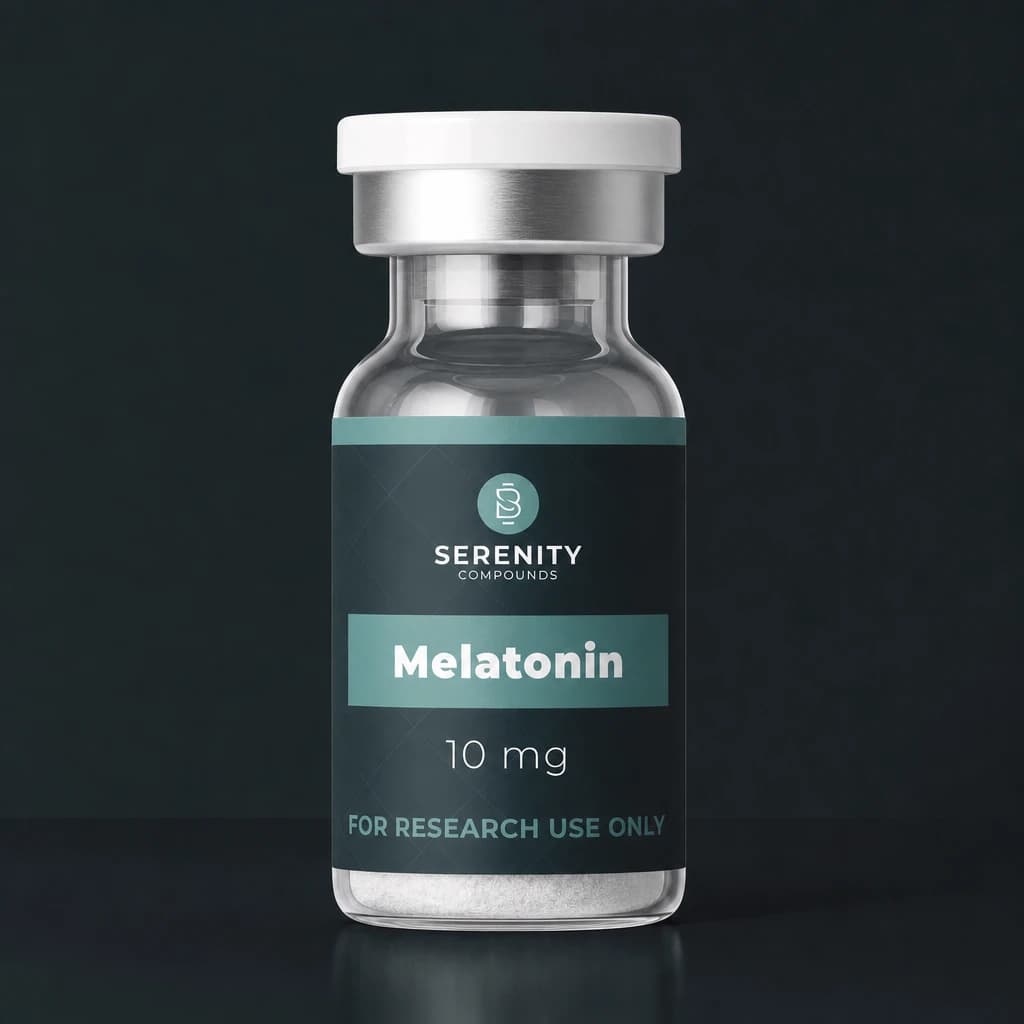
Melatonin injections is a route specific search phrase, not a complete description of a research material or evidence base. Melatonin is an indoleamine involved in circadian signaling, not a peptide. Its receptor biology and other chemical effects need to be distinguished when interpreting an assay. A laboratory reference cannot be treated as a human injection product because the molecule is familiar from sleep discussions. This guide provides research context without a dosing schedule or administration instructions.
Injectable melatonin searches and the nonpeptide identity
Peptides consist of amino acid residues connected through peptide bonds. This molecule has a different indoleamine structure, even though its biosynthesis is related to an amino acid pathway. Chemical origin and chemical classification are not the same question. Placement in a catalog near peptide references does not change the structure or make peptide specific analytical assumptions automatically appropriate.
Serenity's melatonin reference listing should be connected to the exact specification and available lot records. The name identifies a molecule, while formulation and intended use identify a product context. A research reference should not be represented as equivalent to a clinical product or a consumer formulation merely because they share the same active identity.
Structural identity matters when comparing related compounds or metabolites. A paper measuring a metabolite doesn't necessarily measure the parent molecule's concentration or receptor activity. The analytical target should be named explicitly. A broad phrase such as melatonin levels can conceal differences in what a particular method actually detects.
What does MT1 receptor research show?
Published MT1 and Gi structural research provides a molecular view of receptor signaling context. Structural evidence can help explain how a defined complex is organized. It doesn't by itself quantify a clinical sleep benefit or establish the effect of every exposure route. The level of the observation should remain visible when the finding is summarized.
MT1 and MT2 are distinct receptor subtypes. An experiment involving one should not automatically be described as a complete test of both. Receptor expression and coupling can influence a cellular response. A useful comparison therefore states the subtype and signaling readout rather than treating all receptor assays as interchangeable measurements of overall biological strength.
Binding and functional activity answer related questions. A binding observation doesn't fully describe the downstream cellular response, while a signaling result may depend on the system's amplification and regulation. Comparing compounds or methods requires attention to those distinctions. A precise numerical result is only as interpretable as the biological question and reference scale behind it.
Why is circadian timing part of the experiment?
Circadian systems vary across time, so the same clock time isn't always the same biological context. Experimental schedules and prior environmental conditions can affect interpretation. A study that examines a response at one phase cannot automatically establish the same response at every phase. Timing belongs in the method rather than being treated as a minor scheduling detail.
Light conditions can influence the system under study. The relevant record may include the environmental schedule and how the observation period relates to it. A laboratory should preserve the factors needed to interpret its model. This discussion does not recommend a lighting or administration schedule for people and does not convert circadian physiology into a self treatment plan.
Sleep onset and circadian phase are different outcomes. A person falling asleep sooner doesn't by itself establish how a circadian marker shifted. Conversely, a measured phase change doesn't describe every aspect of sleep quality. Our DSIP sleep evidence guide explains why latency and stage related observations must be separated from broader claims about restorative sleep.
A hypothetical timing comparison
Suppose two fictional experiments expose the same model to the same nominal amount but at different biological phases. If the results differ, the difference may involve timing rather than a failure to identify the compound. A summary that omits phase could make the studies look contradictory. The example illustrates a design issue and is not a result measured by Serenity.
Now suppose the experiments also use different observation intervals. One might capture an early response while the other measures a later state. Those results can answer different questions even when both are described as effects after exposure. A time course can clarify the relationship, but it must actually be measured rather than inferred from two isolated observations.
Baseline measurements help establish the context for change. An absolute value and a change relative to baseline are not interchangeable quantities. A percentage may look larger when its starting value is smaller. The analysis should retain the relevant baseline and comparator so a reader can judge what the numerical difference represents.
Can an assay response occur without proving receptor action?
Chemical effects on a detector or assay component can produce a signal change that isn't caused by the proposed receptor mechanism. Cell based systems introduce additional possibilities involving viability or metabolism. An experiment needs controls suited to the actual readout. A favorable signal in a test labeled antioxidant doesn't automatically establish receptor activity or a clinically meaningful outcome.
Concentration context matters when discussing receptor independent possibilities. The behavior observed at one experimental concentration may not be relevant to another setting. A study should avoid presenting a chemical effect as evidence of a physiological mechanism without addressing exposure and model relevance. This article does not specify an experimental concentration or translate one into a human amount.
Orthogonal measurements can strengthen interpretation when they address different sources of uncertainty. A second method that relies on the same vulnerable detection chemistry may repeat the same artifact rather than independently confirm a mechanism. The useful question is what alternative explanation each measurement can exclude, not simply how many assays produced a favorable number.
Why does route specific evidence need separation?
An oral formulation and an administered clinical formulation can have different exposure contexts. A study using one route cannot automatically establish an outcome for another. The molecule name connects the literature, but formulation and study design determine comparability. Search results that group all routes together can obscure those differences and encourage unsupported generalizations.
Clinical endpoints also need a relevant population. A finding in one sleep or circadian context isn't a universal recommendation for every sleep complaint. Safety and interactions require appropriate clinical assessment. People seeking help with sleep should consult qualified healthcare guidance rather than treating a research catalog article as an injection or dosing resource.
The glutathione evidence discussion provides another example of why a familiar molecule and an administration keyword do not define one interchangeable evidence base. The comparison is about reading methods, not about combining the substances or claiming that they produce the same biological effects.
Melatonin injections for tanning: resolving the molecule
Tanning terminology can confuse melatonin with similarly named melanocortin analogs. They are not the same chemical identity or receptor system. A sleep related molecule should not be assigned pigment research because a search phrase blends the names. Resolve the intended compound from the specification before selecting literature or making an analytical comparison.
Melatonin injectable formulations and research references
Route specific evidence belongs to the actual preparation tested. A receptor assay or structural study cannot validate an independently prepared injectable product. The research reference needs its own identity and handling record for the laboratory method. This distinction prevents a correct chemical name from being treated as sufficient evidence for personal administration or an unrelated cosmetic outcome.
What should an analytical reference record preserve?
Identity and concentration claims should be supported by methods appropriate to an indoleamine. A generic peptide report may not answer the relevant chemical questions. The record needs to identify the actual analyte and any formulation constituents important to the assay. A nominal amount alone doesn't establish the available concentration at every observation point.
Stability should be evaluated in the relevant matrix and conditions. A statement about unopened material doesn't necessarily establish the behavior of a solution during an experiment. The certificate reading guide explains how to distinguish analytical claims from assumptions about suitability. No universal storage deadline or preparation instruction is supplied here.
Reproducibility depends on preserving timing as well as material identity. A later reader should be able to determine which receptor or endpoint was measured and how the observation relates to the model's biological schedule. Without that context, even a correctly identified reference can produce a result that is difficult to compare meaningfully with another study.
Ultimately, interpret the molecule as an indoleamine with specific receptor and circadian research questions. A laboratory signal should not be rewritten as a guaranteed sleep benefit, and a route keyword doesn't turn a research vial into a clinical product. The evidence remains useful when identity and timing stay attached to the measurement.