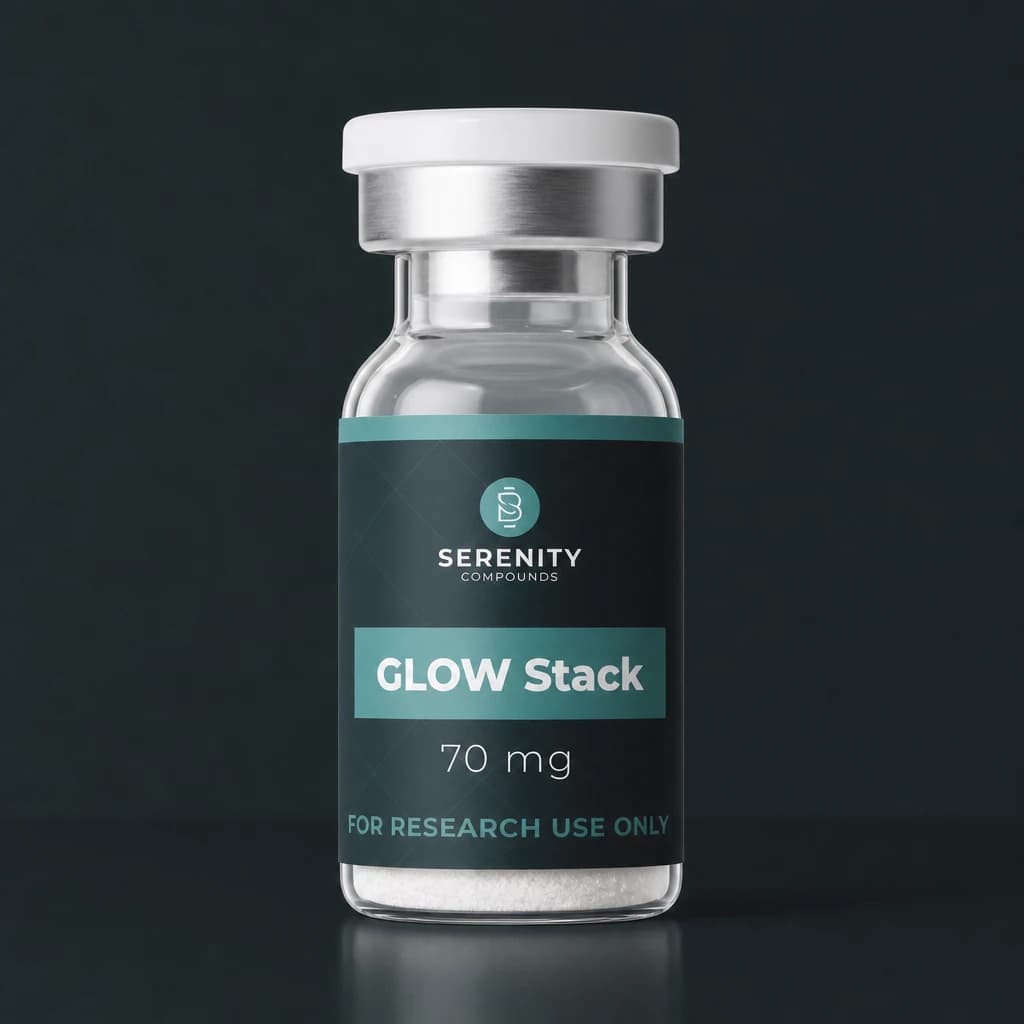
What is GLOW peptide? In Serenity's catalog, GLOW names a blend associated with GHK-Cu, BPC-157 and TB-500. It does not identify one peptide sequence. Research interpretation depends on confirming the constituents and their declared amounts for the selected listing, then distinguishing evidence for individual compounds from evidence for the mixture.
Why does the product specification matter more than the nickname?
Blend names are not a substitute for chemical identity. A similarly named item from another source may use a different composition. The GLOW listing and its lot documentation should define the reference a laboratory actually receives.
TB-500 naming needs particular care because published thymosin beta-4 findings may concern a different material from a fragment sold under a shortened name. The thymosin identity article explains why sequence confirmation matters before transferring a literature claim to a constituent.
What do the ingredient studies establish?
Published BPC-157 fibroblast work investigated receptor expression in a defined cellular setting. That result is not a test of the finished blend. Adding other materials changes the experimental question even if the original ingredient is still present.
Copper complex collagen research provides another example of a constituent finding. Its measured endpoint and solution conditions belong to that study. The GHK identity guide separates those observations from claims about a mixed formulation.
Does combining ingredients establish GLOW peptide benefits?
No. Separate observations cannot prove that a combination improves an outcome or is safe. A mixture may produce an additive response, an interaction or no useful response in a particular model. Those possibilities need to be tested rather than selected from ingredient marketing.
Synergy is a specific comparison against an expected combined effect. Calling a mixture synergistic because its ingredients have different mechanisms is not enough. An experiment needs a declared analytical framework and appropriate constituent controls before that term becomes meaningful.
How can a fixed ratio complicate interpretation?
Imagine a hypothetical blend containing three components in unequal amounts. Increasing the total concentration changes all three exposures together. If the response changes, the experiment may not reveal which component caused it or whether two components interacted. Single constituent conditions can help address that ambiguity.
Molar amounts introduce another distinction. Equal masses of different compounds do not contain equal numbers of molecules. A study that compares total blend mass with the mass of one ingredient must explain what comparison it intends to make. Otherwise a numerical match can conceal an unmatched exposure.
What does a useful blend report contain?
Documentation should connect each declared constituent to the tested lot and identify the methods used. One combined chromatographic percentage may not independently establish every ingredient's amount. A report needs enough detail to support the specific composition claim used in the experiment.
Prepared solution behavior also matters. Copper interactions with the medium or with other constituents can affect interpretation. The initial specification doesn't automatically establish the species present after preparation or during an assay. Those questions require methods appropriate to the mixture.
KPV introduces a separate identity when it is added to a related four component formulation. The tripeptide research overview describes its own uptake and model evidence. That addition does not establish that the amounts or behavior of the original three ingredients remained unchanged.
GLOW stack peptide composition and component accounting
Total blend mass should be accompanied by the amount assigned to each constituent. A three component mixture cannot be fully described by its total and one ingredient's quantity. The remaining balance could be distributed in several ways. A laboratory needs the actual declared composition before it can calculate component concentrations or determine whether two similarly named products are appropriate comparators.
Equal percentages by mass would still not imply equal molar contributions. Each constituent has its own molecular mass and relevant material form. The copper complex adds another characterization question beyond the peptide sequences. A worksheet should retain these inputs separately so that a correction to one constituent does not silently alter an unrelated component's calculation.
What would a meaningful blend experiment compare?
Factorial comparisons can investigate more than a mixture versus vehicle. Individual constituent conditions help establish their separate responses. Selected pairwise combinations can then address whether a particular interaction deserves further investigation. The full design depends on the hypothesis, but the reasoning should be explicit. Testing only the finished blend cannot identify which ingredient explains a change in the measured endpoint.
Response expectations need to be declared before claiming synergy. If the mixture exceeds one ingredient alone, the difference could reflect the ordinary contribution of another ingredient. The combined value must be compared with a justified expectation for the components together. Measurement uncertainty also matters. A small departure from the expected value may not support a meaningful interaction once variability is considered.
GLOW peptides compared with related four component blends
Adding KPV changes the composition and the possible experimental explanations. It also raises the question of whether the original three component amounts remain constant. A comparison of equal total masses may inadvertently reduce their exposure when a fourth ingredient is introduced. To isolate the added constituent's contribution, the study needs to explain how the other quantities and the solution background were matched.
Naming conventions cannot settle that issue. Two products with similar branding may use different ratios or different thymosin related sequences. Before reviewing their literature, compare the actual specifications. A difference in observed activity is difficult to interpret if the material identities themselves remain uncertain. The catalog names are useful for navigation, but the experiment needs a more precise description.
Reconstitution, storage and analytical separation
Compatibility belongs to the actual mixture in its selected matrix. Evidence that separate ingredients can be prepared individually does not show that all remain unchanged when combined. A useful analytical method should be able to follow the constituents relevant to the experiment. One overall purity percentage may conceal a change in ratio or a component that the method does not adequately distinguish.
Recovery during preparation can also affect the apparent composition. If an ingredient is lost preferentially, the resulting mixture no longer matches the nominal ratio even when the total volume is recorded correctly. The method should distinguish a calculated composition from a measured one. That distinction can explain a failed replication without assuming that the underlying biological hypothesis must be wrong.
Storage history needs to remain connected to the particular prepared sample. A statement about unopened material cannot establish the stability of every solution made from it. If the research question depends on simultaneous exposure to intact constituents, the supporting stability endpoint should address that requirement. Visual appearance alone cannot confirm the continued identity and amount of all three components.
What is in GLOW peptide?
For Serenity's listing, the named constituents are the copper complex, BPC-157 and TB-500. The selected variant and lot documentation still need to establish their quantities and exact identities. Do not assume another supplier's similarly named blend has the same composition. The product nickname does not define a universal formula that can replace a specification in a research method.
What does GLOW peptide do?
Evidence for the individual constituents can suggest questions worth testing, but it does not provide the result of a blend experiment. Any claim about the mixture should identify the actual composition, model and measured endpoint. An observed response in one assay would still not establish general clinical benefits. The research value lies in a defined comparison, not in treating three ingredient summaries as proof of a combined effect.
Is GLOW peptide dosage established by ingredient charts?
An ingredient schedule cannot establish a combined human regimen. The phrase may appear in consumer searches, but laboratory concentration planning requires a protocol justified for the actual model. Correct arithmetic does not resolve unknown safety or compatibility questions.
Use the blend name as a catalog identifier and the specification as the basis for experimental planning. Any research conclusion should describe the actual mixture and measured endpoint. Neither constituent publications nor the word stack establishes a clinical benefit for a research product.