Retatrutide peptide reconstitution is a laboratory preparation question involving material identity, a compatible solution and a defined concentration. There is no universal volume that can be justified from the compound name alone. This article explains the evidence and records needed for research planning. It does not provide instructions for preparing or administering a product to a person.
What needs to be known before calculating a volume?
The declared material amount is only one input. A method also needs the intended final concentration and evidence that the proposed solution is suitable for the reference and assay. A mathematically convenient volume does not establish solubility or compatibility.
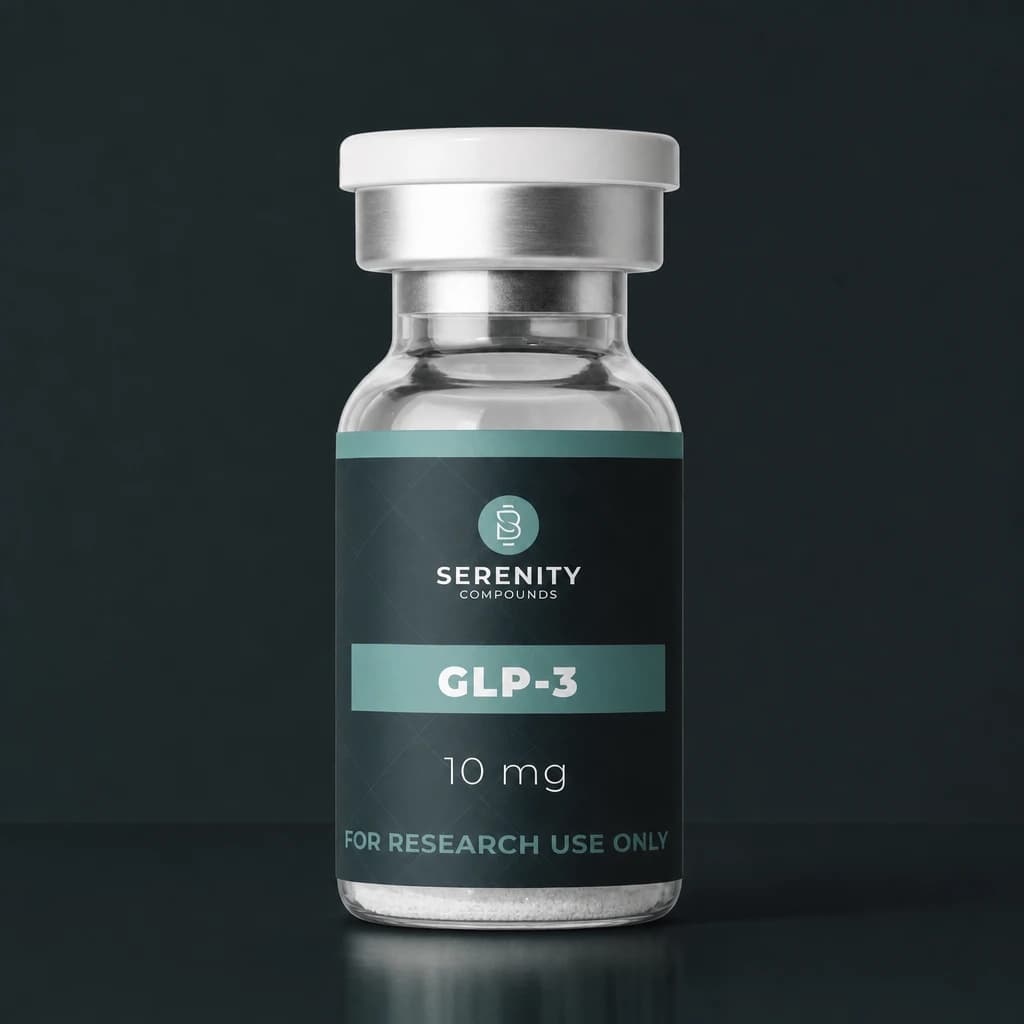
Serenity's GLP-3 reference uses the retatrutide catalog mapping. Its specification should be connected to the received lot. The formulation used in a published clinical trial is not automatically the same as a research catalog preparation, even when the molecule has the same name.
Does bacteriostatic water work for every peptide?
No. A preservative changes the solution background and may affect an experimental system. Diluent selection needs compatibility evidence for the actual material and method. The diluent comparison explains why preserved and unpreserved water cannot be treated as interchangeable labels.
Pharmaceutical diluent documentation describes a particular product. It does not establish that every research vial has the same formulation or that mixing two separately characterized items produces a clinically suitable preparation. The relevant research question is whether the defined solution supports the proposed analytical or biological method.
What can a concentration calculation establish?
Mass divided by final volume gives nominal mass concentration when the inputs are valid. The word final matters if the preparation method distinguishes added solvent from the resulting solution volume. A worksheet should state which quantity was used rather than silently treating them as identical.
For a hypothetical analytical reference unrelated to a human regimen, 4 mass units in a final volume of 8 volume units gives 0.5 mass units per volume unit. This is dimensional arithmetic only. The calculator guide follows stock concentration through a later assay dilution and explains common unit errors.
Does dissolution prove chemical stability?
Appearance cannot establish that the intended species remains unchanged. A clear solution may contain degradation products or a concentration different from the nominal value. Stability requires a suitable method and observations over the conditions and period being claimed.
Recovery is also different from visual dissolution. Material lost to a container surface may not be visible. If recovery matters to the assay, a relevant measurement needs to support the assumed concentration. A calculation based on the original label cannot detect that loss.
How long can a prepared research solution be stored?
Storage duration must come from evidence for the preparation being used. There is no general refrigerated expiry that can be assigned from a search result or another supplier's chart. Container and solution conditions can change the question. The solution stability guide explains how to assess a claimed window.
Temperature records help describe exposure but do not prove chemical stability on their own. A preparation kept within a recorded range can still change over time. The acceptance criteria and analytical method should explain what unchanged means for the intended experiment.
How to reconstitute peptides: defining the laboratory question
Preparation planning begins with the assay rather than the vial size. An analytical identity method may require a different matrix from a biological response assay. The method should establish what material state it needs and which background components it can tolerate. Choosing a solution only because it is commonly mentioned online can create a sample that is inconvenient or unsuitable for the actual measurement.
Solubility describes whether material can be present in solution under stated conditions. Compatibility asks whether that solution fits the experimental system. A preparation may meet the first requirement while interfering with the readout or affecting a vehicle control. Those questions should be evaluated separately. Neither one establishes a human administration method or supports transferring pharmaceutical instructions to a research reference.
Peptide reconstitution and final assay concentration
Stock accounting is only the first stage of a quantitative record. Once a portion enters the assay mixture, its contribution must be divided by the complete final volume. Other additions can further change that volume or the matrix. A worksheet that retains every relevant dilution step makes it easier to find a mismatch between a prepared stock and a reported experimental exposure.
Uncertainty in the starting amount carries into the calculated concentration. Adding more decimal places does not remove it. If the label states a nominal quantity and no content assay is available, the resulting concentration should remain identified as nominal. Where the experiment needs a measured value, the appropriate analytical method must provide it. A calculator cannot improve the evidential quality of its inputs.
How to store reconstituted peptides: evaluating a claimed window
Supporting evidence needs a defined preparation, observation period and acceptance criterion. A statement that a sample remained stable is incomplete without explaining which property was followed. An identity method may detect a chemical change, while an activity assay may reveal a different kind of loss. The relevant criterion depends on how the material will be used in the research method.
Environmental logs describe the sample's surroundings rather than directly measuring its chemistry. They can support an investigation when a preparation behaves unexpectedly, especially if the record includes transfers or excursions. Their value is greatest when the sample identifier remains connected to the logger and storage location. A general freezer record cannot establish the history of a vial whose movements were never recorded.
Comparing reconstituted peptides with the clinical study material
Formulation equivalence cannot be inferred from a shared compound name. The clinical trial cited above used a defined investigational preparation under a protocol. A catalog reference may differ in its specified form, formulation and supporting quality information. Those distinctions prevent the trial from functioning as a universal preparation guide for independently supplied material.
Diluent labels do not resolve that difference. A diluent characterized for one purpose does not automatically validate every mixture made with it. The resulting preparation creates a new set of compatibility and analytical questions. For laboratory work, document the chosen matrix and the method supporting its use rather than combining two separate product descriptions into an unsupported claim about the final solution.
What to investigate when a preparation gives an unexpected result
Separate arithmetic, recovery and biological explanations. Check whether the final concentration was calculated correctly, whether the material was recovered as expected and whether the assay controls behaved normally. These are independent questions. A weak response does not prove that the compound lacks activity, just as a strong response does not prove that the intended intact reference caused it.
Retained records make that review possible without relying on memory. The source lot, preparation identifier and instrument sample name should remain connected. An observation such as an unusual appearance belongs in the record, but it should not be upgraded to a chemical diagnosis without measurement. Preserve uncertainty until a suitable check resolves the specific question.
What is retatrutide?
It is the molecule mapped to Serenity's GLP-3 research listing and investigated for activity at GIP, GLP-1 and glucagon receptors. That pharmacological identity does not define a universal laboratory solvent or storage interval. Preparation choices still depend on the specified material and the method. A name can connect a reference to literature without supplying the missing formulation evidence.
Is retatrutide safe?
Clinical safety findings apply to the studied preparation and monitored population. They do not establish the safety of a research solution made from an independently supplied vial. Clear appearance, a plausible concentration and an available certificate cannot bridge that gap. This preparation discussion is limited to laboratory evidence and records rather than personal administration planning.
What should remain in the preparation record?
Preserve the source lot and the method reference alongside nominal concentration and any measured result. Record the diluent identity and the final sample identifier so another analyst can trace the preparation. Keep observations such as cloudiness separate from analytical conclusions. That record supports reproducible laboratory work without creating a personal injection recipe.